
 A SCHOLARLY BOOK REPOSITORY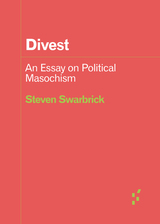
A manifesto for liberating desire from the grip of capital and colonial violence in Palestine
Could a psychoanalytic theory of masochism help us to understand the politics of protest? A socially engaged psychoanalysis of 2024’s widespread student uprisings in support of Palestine, Divest posits that masochism, as theorized by Freud in his later years, is a fundamental structure at the heart of anticapitalist and anticolonial resistance. Conceptualizing masochism as a radical form of divestment, Steven Swarbrick theorizes the affective economies of solidarity, self-sacrifice, and collective struggle. Through vivid film readings and sharp critique of state and university violence, Swarbrick explores the emancipatory potential of masochism in the protest movement and the sadistic machinery of capitalist governance it has laid bare.
Divest is both a politically urgent manifesto and a theoretical companion to the global movement for Palestinian liberation. Asserting that the politics of left-wing solidarity must reckon with the libidinal investments that sustain both power and resistance, this bold volume argues that divestment from global capitalism may begin with a revolution in our psychic attachments.
Retail e-book files for this title are screen-reader friendly with image accompanied by short alt text and/or extended descriptions.
Bringing psychoanalysis to bear on the diagnosis of ecological crisis
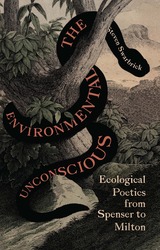
Why has psychoanalysis long been kept at the margins of environmental criticism despite the many theories of eco-Marxism, queer ecology, and eco-deconstruction available today? What is unique, possibly even traumatic, about eco-psychoanalysis? The Environmental Unconscious addresses these questions as it provides an innovative and theoretical account of environmental loss focused on the counterintuitive forms of enjoyment that early modern poetry and psychoanalysis jointly theorize.
Steven Swarbrick urges literary critics and environmental scholars fluent in the new materialism to rethink notions of entanglement, animacy, and consciousness raising. He introduces concepts from psychoanalysis as keys to understanding the force of early modern ecopoetics. Through close readings of Edmund Spenser, Walter Ralegh, Andrew Marvell, and John Milton, he reveals a world of matter that is not merely hyperconnected, as in the new materialism, but porous and off-kilter. And yet the loss these poets reveal is central to the enjoyment their works offer—and that nature offers.
As insightful as it is engaging, The Environmental Unconscious offers a provocative challenge to ecocriticism that, under the current regime of fossil capitalism in which everything solid interconnects, a new theory of disconnection is desperately needed. Tracing the propulsive force of the environmental unconscious from the early modern period to Freudian and post-Freudian theories of desire, Swarbrick not only puts nature on the couch in this book but also renews the psychoanalytic toolkit in light of environmental collapse.

How films help us understand the inevitable death of Earth and humanity
Negative Life: The Cinema of Extinction brings cinema studies, queer theory, and psychoanalysis into novel configuration around the concept of negative life, a sundering of human and nonhuman relations. Engaging a philosophical and cinematic corpus that rejects the pastoralism of “entanglement” or “enmeshment,” Steven Swarbrick and Jean-Thomas Tremblay counter ecocritical pieties and cut a new path for theory. They examine films by Julian Pölsler, Kelly Reichardt, Lee Isaac Chung, Mahesh Mathai, Paul Schrader, and others that exemplify the existential contradictions currently intensifying amid the sixth mass extinction. Each case study testifies formally and thematically to negative life as a structural condition of thought and film. Together, the cases reveal the unlivable dimension of life and art, where form, desire, and nonbelonging tarry with the future-oriented promise of ecostudies—where all that lives connects. Negative Life militates against this promise, showing that faith in connection is a dead end.
READERS
Browse our collection.
PUBLISHERS
See BiblioVault's publisher services.
STUDENT SERVICES
Files for college accessibility offices.
RECENTLY PUBLISHED


UChicago Accessibility Resources
home | accessibility | search | about | contact us
BiblioVault ® 2001 - 2026
The University of Chicago Press