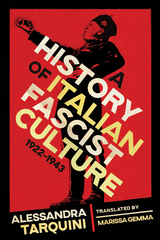
front cover of A History of Italian Fascist Culture, 1922–1943
A History of Italian Fascist Culture, 1922–1943
Alessandra Tarquini, Translated by Marissa Gemma
University of Wisconsin Press, 2022
Alessandra Tarquini’s A History of Italian Fascist Culture, 1922–1943 is widely recognized as an authoritative synthesis of the field. The book was published to much critical acclaim in 2011 and revised and expanded five years later. This long-awaited translation presents Tarquini’s compact, clear prose to readers previously unable to read it in the original Italian.
 
Tarquini sketches the universe of Italian fascism in three broad directions: the regime’s cultural policies, the condition of various art forms and scholarly disciplines, and the ideology underpinning the totalitarian state. She details the choices the ruling class made between 1922 and 1943, revealing how cultural policies shaped the country and how intellectuals and artists contributed to those decisions. The result is a view of fascist ideology as a system of visions, ideals, and, above all, myths capable of orienting political action and promoting a precise worldview.
 
Building on George L. Mosse’s foundational research, Tarquini provides the best single-volume work available to fully understand a complex and challenging subject. It reveals how the fascists used culture—art, cinema, music, theater, and literature—to build a conservative revolution that purported to protect the traditional social fabric while presenting itself as maximally oriented toward the future.
[more]

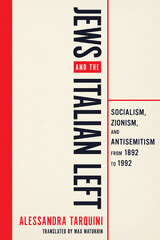
front cover of Jews and the Italian Left
Jews and the Italian Left
Socialism, Zionism, and Antisemitism from 1892 to 1992.
Alessandra Tarquini, Translated by Max Matukhin
University of Wisconsin Press, 2026
Alessandra Tarquini, an expert on Italian Fascism, untangles the complicated relationship between the Italian left and Jews since the late nineteenth century. Due largely to indifference, and sometimes to antisemitism, Italian leftists consistently overlooked Jews in their visions for a collectivist future. Yet, from the birth of the Socialist Party in 1892 until 1992, when the heirs of the Marxist tradition dispersed or set out on a new path, questions continually arose in revolutionary efforts to remake the Italian state: Should Jews be seen as oppressed, and therefore welcome to participate in the struggle that would lead to the advent of a new civilization? Or might they hinder the realization of socialism because of their attachment to a religious identity? 

Tarquini’s research fills an important lacuna by analyzing the antisemitism of twentieth-century socialist movements. Crucially, however, Tarquini makes important distinctions between antisemitism on the Italian left and right, and identifies the relationship between leftism and antisemitism as a distinct formation.
[more]


Send via email Share on Facebook Share on Twitter