
 A SCHOLARLY BOOK REPOSITORY
Results by Title
2 books about Television supplies industry
2 books about Television supplies industry
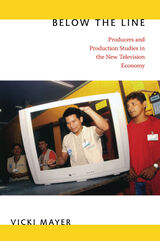
Below the Line
Producers and Production Studies in the New Television Economy
Vicki Mayer
Duke University Press, 2011
Below the Line illuminates the hidden labor of people who not only produce things that the television industry needs, such as a bit of content or a policy sound bite, but also produce themselves in the service of capital expansion. Vicki Mayer considers the work of television set assemblers, soft-core cameramen, reality-program casters, and public-access and cable commissioners in relation to the globalized economy of the television industry. She shows that these workers are increasingly engaged in professional and creative work, unsettling the industry’s mythological account of itself as a business driven by auteurs, manned by an executive class, and created by the talented few. As Mayer demonstrates, the new television economy casts a wide net to exploit those excluded from these hierarchies. Meanwhile, television set assemblers in Brazil devise creative solutions to the problems of material production. Soft-core videographers, who sell televised content, develop their own modes of professionalism. Everyday people become casters, who commodify suitable participants for reality programs, or volunteers, who administer local cable television policies. These sponsors and regulators boost media industries’ profits when they commodify and discipline their colleagues, their neighbors, and themselves. Mayer proposes that studies of production acknowledge the changing dynamics of labor to include production workers who identify themselves and their labor with the industry, even as their work remains undervalued or invisible.
[more]

The Japanese Television Cartel
A Study Based on "Matsushita v. Zenith"
David Schwartzman
University of Michigan Press, 1993
The Japanese Television Cartel examines the argument that Japanese television manufacturers dumped televisions in the United States as part of a long-run strategy to dominate the market. This issue is used to explore the related general issues— ones of extraordinary importance that are continually in the forefront of public policy.David Schwartzman builds his argument around the landmark case of Matsushita v. Zenith, in which Zenith, by then the last remaining U.S. television manufacturer, contended that the Japanese manufacturer had manipulated the U.S. market to the detriment of domestic firms. Zenith lost, but the author insists the decision was erroneous and that dumping did occur.The Supreme Court refused to reverse the case; it took the view that because predation is unprofitable, the Japanese manufacturer could not have been guilty of that charge. The author nonetheless maintains that the analysis underlying this argument is predicated on a domestic dominant firm, the predatory losses of which would exceed those of the victimized fringe firms. But in the case of a foreign predator, its immediate losses would be smaller than those of its victims because its initial market share is small. This is just one of several criticisms of the basis of the Court’s argument and a prime example of the applicability of the economic theory developed by the author.The Japanese Television Cartel deserves the attention of all who are concerned with U.S. policy on international trade and international economic competition.
[more]
READERS
Browse our collection.
PUBLISHERS
See BiblioVault's publisher services.
STUDENT SERVICES
Files for college accessibility offices.
RECENTLY PUBLISHED







UChicago Accessibility Resources
home | accessibility | search | about | contact us
BiblioVault ® 2001 - 2026
The University of Chicago Press