
 A SCHOLARLY BOOK REPOSITORY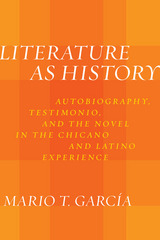
Literature as History offers a critical new path for Chicano and Latino history. Historian Mario T. García analyzes prominent works of Chicano fiction, nonfiction, and autobiographical literature to explore how they can sometimes reveal even more about ordinary people’s lives. García argues that this approach can yield personal insights into historical events that more formal documents omit, lending insights into such diverse issues as gender identity, multiculturalism, sexuality, and the concerns of the working class.
In a stimulating and imaginative look at the intersection of history and literature, García discusses the meaning and intent of narratives. Literature as History represents a unique way to rethink history. García, a leader in the field of Chicano history and one of the foremost historians of his generation, explores how Chicano historians can use Chicano and Latino literature as important historical sources. Autobiography, testimonio, and fiction are the genres the author researches to obtain new and insightful perspectives on Chicano history at the personal and grassroots levels. Breaking the boundaries between history and literature, García provides a thought-provoking discussion of what constitutes a historical source.

This is the first biography of the renowned American Chicano visual artist and activist Rupert García, drawing on fifty hours of interviews conducted over thirty years and accompanied by eighty images. This in-depth oral history gives an unparalleled look at García’s life and work, tracing his evolution as an artist and the political upheavals that shaped his life and worldview.
Mario T. García’s testimonio places Rupert García’s art in historical perspective, from his beginnings as a working-class Mexican American from California’s Central Valley, his coming of age in the U.S. Air Force during the Vietnam War, his involvement in the antiwar movement during the San Francisco State student strike in 1968-69, and his participation in the Chicano Movement and beyond. Influenced by history and politics, García’s vital works of art represent a changing world through the eyes of an artist, speaking to issues of poverty, racism, capitalism, war, and the role of the artist in society.
His art—from revolutionary silkscreen posters to monumental pastels to portraits of political icons like Frida Kahlo, Che Guevara, and Dolores Huerta—serves to critique history and reassess it. It is work that will endure for generations to come.
A revealing perspective on the controversial literature of witnessing
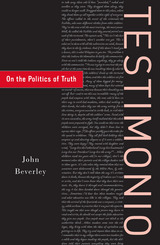
These four germinal essays by John Beverley sparked the widespread discussion and debate surrounding testimonio—the socially and politically charged Latin American narrative of witnessing—that culminated with David Stoll’s highly publicized attack on Rigoberta Menchú’s celebrated testimonial text. Challenging Hardt and Negri’s Empire, Beverley’s extensive new introduction examines the broader historical, political, and ethical issues that this literature raises, tracing the development of testimonio from its emergence in the Cold War era to the rise of a globalized economy and U.S. political hegemony.
Informed by postcolonial studies and the current debate over multiculturalism and identity politics, Testimonio reaches across disciplinary boundaries to show how this particular literature at once represents and enacts new forms of agency on the part of previously repressed social subjects, as well as its potential as a new form of “alliance politics” between those subjects and artists, scientists, teachers, and intellectuals in a variety of local, national, and international contexts.READERS
Browse our collection.
PUBLISHERS
See BiblioVault's publisher services.
STUDENT SERVICES
Files for college accessibility offices.
RECENTLY PUBLISHED




UChicago Accessibility Resources
home | accessibility | search | about | contact us
BiblioVault ® 2001 - 2025
The University of Chicago Press