
 A SCHOLARLY BOOK REPOSITORY
An intervention in World War I historiography that foregrounds personal accounts of the conflict from its non-European participants and witnesses.
Accounts of World War I tend to focus on Europe, the epicenter of this conflict, and find in its battlefields the later death of empires, spreading revolution, and eventual decolonization. However, the war was also global, drawing in people from all over the world while rapidly circulating ideas and innovations far beyond Europe.
Almost two million non-Europeans participated in the war as soldiers, workers, and professionals, including Asians in particular. They could be found in the battlefields of France, behind the lines in munitions factories and military hospitals, in the frozen construction sites of the Murmansk Railway, and in Mesopotamia’s burning deserts. The voices of these volunteers and conscripts are rarely heard; the war’s narratives are mainly European. And yet, here and there, lone voices pierce the silence.
In a compelling intervention in World War I historiography, Masters of Their Own Destiny offers a history from below, demonstrating how rare personal accounts may illuminate broader historical forces. Alongside the story of Nguyen Xuan Mai, a Vietnamese military doctor whose pursuit of professional recognition ended in disillusionment with colonial promises, this study draws on a wealth of material like Indian soldiers’ letters, Vietnamese workers’ censored correspondence, and records of Chinese laborers who witnessed revolution in Russia. It gives voice to hitherto ignored wartime experiences that later transformed the expectations of millions of colonial subjects and seeded the anticolonial movements that followed.
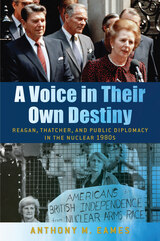
On June 8, 1982, Ronald Reagan delivered a historic address to the British Parliament, promising that the United States would give people around the world “a voice in their own destiny” in the struggle against Soviet totalitarianism. While British Prime Minister Margaret Thatcher celebrated Reagan’s visit and thanked him for putting “freedom on the offensive,” over 100,000 Britons marched from Hyde Park to Trafalgar Square to protest his arrival and call for nuclear disarmament. Reagan’s homecoming was equally eventful, with 1,000,000 protesters marking his return with a rally for nuclear disarmament in Central Park—the largest protest in American history up to that point.
Employing a wide range of previously unexamined primary sources, Anthony M. Eames demonstrates how the Reagan and Thatcher administrations used innovations in public diplomacy to build back support for their foreign policy agendas at a moment of widespread popular dissent. A Voice in Their Own Destiny traces how competition between the governments of Reagan and Thatcher, the Anglo-American antinuclear movement, and the Soviet peace offensive sparked a revolution in public diplomacy.
READERS
Browse our collection.
PUBLISHERS
See BiblioVault's publisher services.
STUDENT SERVICES
Files for college accessibility offices.
RECENTLY PUBLISHED



UChicago Accessibility Resources
home | accessibility | search | about | contact us
BiblioVault ® 2001 - 2026
The University of Chicago Press