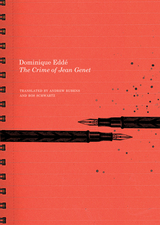
front cover of The Crime of Jean Genet
The Crime of Jean Genet
Dominique Eddé
Seagull Books, 2016
Now in paperback, The Crime of Jean Genet is a powerful personal account of the influence of one writer on another and one of the most penetrating explorations yet of Genet’s work and achievement.

Dominique Eddé met novelist and playwright Jean Genet in the 1970s. And she never forgot him. “His presence,” she writes, “gave me the sensation of icy fire. Like his words, his gestures were full, calculated, and precise. . . . Genet’s movements mimicked the movement of time, accumulating rather than passing.”

This book is Eddé’s account of that meeting and its ripples through her years of engaging with Genet’s life and work. Rooted in personal reminiscences, it is nonetheless much broader, offering a subtle analysis of Genet’s work and teasing out largely unconsidered themes, like the absence of the father, which becomes a metaphor for Genet’s perpetual attack on the law. Tying Genet to Dostoevsky through their shared fascination with crime, Eddé helps us more clearly understand Genet’s relationship to France and Palestine, Judaism, Christianity, Islam, the theater, and even death.  A powerful personal account of the influence of one writer on another, The Crime of Jean Genet is also one of the most penetrating explorations yet of Genet’s work and achievement.

[more]

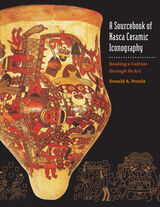
front cover of A Sourcebook of Nasca Ceramic Iconography
A Sourcebook of Nasca Ceramic Iconography
Reading a Culture through Its Art
Proulx, Donald A.
University of Iowa Press, 2006
For almost eight hundred years (100 BC–AD 650) Nasca artists modeled and painted the plants, animals, birds, and fish of their homeland on Peru’s south coast as well as numerous abstract anthropomorphic creatures whose form and meaning are sometimes incomprehensible today. In this first book-length treatment of Nasca ceramic iconography to appear in English, drawing upon an archive of more than eight thousand Nasca vessels from over 150 public and private collections, Donald Proulx systematically describes the major artistic motifs of this stunning polychrome pottery, interprets the major themes displayed on this pottery, and then uses these descriptions and his stimulating interpretations to analyze Nasca society. After beginning with an overview of Nasca culture and an explanation of the style and chronology of Nasca pottery, Proulx moves to the heart of his book: a detailed classification and description of the entire range of supernatural and secular themes in Nasca iconography along with a fresh and distinctive interpretation of these themes. Linking the pots and their iconography to the archaeologically known Nasca society, he ends with a thorough and accessible examination of this ancient culture viewed through the lens of ceramic iconography. Although these static images can never be fully understood, by animating their themes and meanings Proulx reconstructs the lifeways of this complex society.
[more]


Send via email Share on Facebook Share on Twitter