
 A SCHOLARLY BOOK REPOSITORY
Inspired by the iconic American Guide Series published by the Federal Writers Project in the 1930s, this new guide to Flint, the Saginaw Valley, and the Thumb showcases the industrial-agricultural heart of Michigan, which has been beating irregularly for the last three decades, but whose importance to its people has lasted millennia. The ten counties featured in the book have lost population, industries, small farms, natural resources, and clean water. Instead of focusing on loss, the authors uncover the region’s unique history and culture, characterized by the productive tension between factories and farms, urban and rural spaces, labor and management, migrants and the mainstream, conservatives and progressives. The book documents the genesis of an ecological awareness that grew out of deforestation, habitat and species loss, and a succession of water crises. Encyclopedic in scope like their WPA forebears, the book is a functional guide that offers suggestions and strategies for enriching travel while celebrating the tenacity of those who came, worked, and stayed: lumberjacks, farmers, foundry workers, labor activists, judges, Indigenous peoples, African Americans, artists, poets, and environmental warriors.
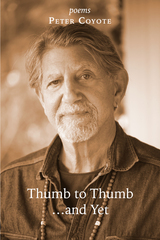
If Emmy Award-winner Peter Coyote’s debut collection represents the culmination of a half-century’s devotion to writing poetry, his second functions as a true encore: triumphant and raw. Thumb to Thumb… and Yet presents eighty-plus years of living — the countercultural adventures, the journey from Zen Buddhist discipleship to priesthood, marriage and divorce, a public career in entertainment, and the private work and rewards of parenthood — not as a retrospective but as a perpetual process of becoming. Coyote captures often-elusive wisdom and infuses these pages with the fullness of human experience: weariness that labor never ceases, that we cannot outgrow suffering, that we’re like “Manteaux ducks, immobilized so the fat / of everything can be forced down our gullets,” the glut of gavage neverending and “no option to stop swallowing”; frustration that ambition and ego persist despite the “pre-dawn Zendo chill” and over five decades spent “thumb-to-thumb sitting” in devoted practice; the satisfaction of pleasure, “smiling in the ruined sheets”; gratitude for life consummated and life ongoing and life that will continue long after us, for the opportunity of existence, for the work itself, for the “single nuthatch [that] bows / upside down on the grand oak” and its reminder during meditation that “everything presents itself as a partner.” The titular qualification of that “and yet” is an argument against and a celebration of conclusion; in a masterful encapsulation of the lyrical moment itself, these poems find Coyote returning to the stage only to perform another finale, every end recycled toward beginning. One song cedes to another, and yet the music flows on.

If Emmy Award-winner Peter Coyote’s debut collection represents the culmination of a half-century’s devotion to writing poetry, his second functions as a true encore: triumphant and raw. Thumb to Thumb… and Yet presents eighty-plus years of living — the countercultural adventures, the journey from Zen Buddhist discipleship to priesthood, marriage and divorce, a public career in entertainment, and the private work and rewards of parenthood — not as a retrospective but as a perpetual process of becoming. Coyote captures often-elusive wisdom and infuses these pages with the fullness of human experience: weariness that labor never ceases, that we cannot outgrow suffering, that we’re like “Manteaux ducks, immobilized so the fat / of everything can be forced down our gullets,” the glut of gavage neverending and “no option to stop swallowing”; frustration that ambition and ego persist despite the “pre-dawn Zendo chill” and over five decades spent “thumb-to-thumb sitting” in devoted practice; the satisfaction of pleasure, “smiling in the ruined sheets”; gratitude for life consummated and life ongoing and life that will continue long after us, for the opportunity of existence, for the work itself, for the “single nuthatch [that] bows / upside down on the grand oak” and its reminder during meditation that “everything presents itself as a partner.” The titular qualification of that “and yet” is an argument against and a celebration of conclusion; in a masterful encapsulation of the lyrical moment itself, these poems find Coyote returning to the stage only to perform another finale, every end recycled toward beginning. One song cedes to another, and yet the music flows on.
READERS
Browse our collection.
PUBLISHERS
See BiblioVault's publisher services.
STUDENT SERVICES
Files for college accessibility offices.
RECENTLY PUBLISHED




UChicago Accessibility Resources
home | accessibility | search | about | contact us
BiblioVault ® 2001 - 2026
The University of Chicago Press