
 A SCHOLARLY BOOK REPOSITORY
In this timely and bold book, Miriam Ticktin explores how a concept that consistently appears as a moral good actually ends up creating harm for so many. Claims to innocence protect migrant children, but often at the expense of their parents; claims to the innocence of the fetus work to punish women. Ticktin shows how innocence structures political relationships, focusing on individual victims and saviors, while foreclosing forms of collective responsibility. Ultimately, she wants to understand how the discourse around innocence functions, what gives it such power, and why we are so compelled by it, while showing that alternative political forms already exist. She examines this process across various domains, from migration, science, and environmentalism to racial and reproductive justice.
Throughout the book, Ticktin shows how the concept of innocence intimately shapes why, how, and for whom we should care and whose lives matter—and how this can have devastating consequences when only an exceptional few can qualify as innocent. A politics grounded on innocence justifies a world built on inequality, designating most people—especially the racialized poor—as unworthy, undeserving, and less than human. As an alternative, she explores the aesthetics and politics of “commoning”—a collective regime of living that refuses a liberal politics of individual identity and victimhood.
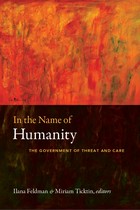
The editors argue that ideas about humanity find concrete expression in the governing work that operationalizes those ideas to produce order, prosperity, and security. As a site of governance, humanity appears as both an object of care and a source of anxiety. Assertions that humanity is being threatened, whether by environmental catastrophe or political upheaval, provide a justification for the elaboration of new governing techniques. At the same time, humanity itself is identified as a threat (to nature, to nation, to global peace) which governance must contain. These apparently contradictory understandings of the relation of threat to the category of humanity coexist and remain in tension, helping to maintain the dynamic co-production of governance and humanity.
Contributors. Arun Agrawal, Joao Biehl , Didier Fassin, Allen Feldman, Ilana Feldman, Rebecca Hardin, S. Lochann Jain, Liisa Malkki, Adriana Petryna, Miriam Ticktin, Richard Ashby Wilson, Charles Zerner
READERS
Browse our collection.
PUBLISHERS
See BiblioVault's publisher services.
STUDENT SERVICES
Files for college accessibility offices.
RECENTLY PUBLISHED


UChicago Accessibility Resources
home | accessibility | search | about | contact us
BiblioVault ® 2001 - 2026
The University of Chicago Press