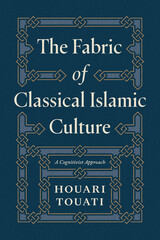
front cover of The Fabric of Classical Islamic Culture
The Fabric of Classical Islamic Culture
A Cognitivist Approach
Houari Touati
University of Chicago Press, 2027

A sweeping account of the evolution of early Islamic culture.

This book argues that early Islamic literature was influenced less by the Qur’an and more by the bureaucratic culture of the Diwan, the secular political system in place long before a written religious culture emerged. As Houari Touati explains, this secular Arab culture quickly outstripped written religious erudition: first, because of the diverse communities who participated in the scholarly networks of the empire; and second, because of the universalizing influence of the period’s Greco-Arabic translation movement. This process of cross-cultural fertilization, Touati recounts, flourished within Islam until the canonization of the Hadith (the official sayings, actions, and sanctions of Muhammad) began to disrupt this dynamic of interchange after the tenth century, without, however, managing to put a definitive end to it. The Fabric of Classical Islamic Culture is a wide-ranging, comparative account of the parallel development of secular and sacred culture that produced the modern Arabic world.

[more]

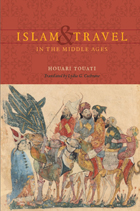
front cover of Islam and Travel in the Middle Ages
Islam and Travel in the Middle Ages
Houari Touati
University of Chicago Press, 2010

In the Middle Ages, Muslim travelers embarked on a rihla, or world tour, as surveyors, emissaries, and educators. On these journeys, voyagers not only interacted with foreign cultures—touring Greek civilization, exploring the Middle East and North Africa, and seeing parts of Europe—they also established both philosophical and geographic boundaries between the faithful and the heathen. These voyages thus gave the Islamic world, which at the time extended from the Maghreb to the Indus Valley, a coherent identity.

Islam and Travel in the Middle Ages assesses both the religious and philosophical aspects of travel, as well as the economic and cultural conditions that made the rihla possible. Houari Touati tracks the compilers of the hadith who culled oral traditions linked to the prophet, the linguists and lexicologists who journeyed to the desert to learn Bedouin Arabic, the geographers who mapped the Muslim world, and the students who ventured to study with holy men and scholars. Travel, with its costs, discomforts, and dangers, emerges in this study as both a means of spiritual growth and a metaphor for progress. Touati’s book will interest a broad range of scholars in history, literature, and anthropology.


[more]


Send via email Share on Facebook Share on Twitter