
 A SCHOLARLY BOOK REPOSITORY

Beyond the Fourth Wall of War sheds light on forms of embodied performance that emerge in the aftermath of structural violence—war, displacement, and militarism—as individual bodies and bodies politic are shaped by communal disorders. Elise R. Morrison argues theater that addresses audiences directly through the so-called “fourth wall”—which allows spectators to see but not interact with the events onstage—can offer embodied frameworks for reckoning with war trauma that move beyond traditions of illusionism and spectatorial distance.
Grounded in performance studies, this interdisciplinary study also draws deeply from digital media studies, peace studies, neuroscientific research in embodied cognition and trauma, and drama therapy. Through a comparative analysis of somatic, interactive methodologies in contemporary trauma-informed therapies, Morrison reveals the capacity of theatrical performance to model “somatic witnessing,” kinesthetic empathy, and cultivate communal practices of repair in response to state-sanctioned violence. Underlying this work is a broader inquiry into war’s performative nature, as participatory theater uniquely reorients spectatorship toward rehearsing “performative ethics” in representational and militarized “theaters of war.” Beyond the Fourth Wall of War makes novel interventions into discourses of contemporary warfare by extending the lens of trauma beyond the battlefield to civilian publics who observe conflict from a distance, yet remain entangled in its machinery.
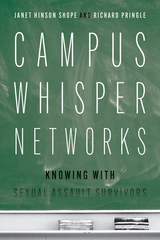
Campus Whisper Networks examines how personal knowledge about student sexual assault circulates within college campus communities. Based upon both qualitative and quantitative survey data, Janet Hinson Shope and Richard Pringle's research demonstrates that students who have been sexually assaulted tell someone—almost always a friend. Most college students know someone who has been assaulted. Simply knowing, by means of relationships, that one or more peers have been assaulted affects the knowers, and the effects reverberate unevenly across campuses.
Shope and Pringle highlight the structural properties that prohibit relational knowledge from becoming official institutional knowledge, confining it to whispers and secrecy within informal spheres of knowledge. The rules governing the circulation of such knowledge create an uneven epistemic field of sexual assault. This uneven field is consequential for the communities, affecting survivors and their confidants and shaping student views of the college community. Campus Whisper Networks demonstrates how personal and institutional avoidance, both the “need to not know” and “no need to know,” creates knowledge gaps that hide the community’s wounds and prevent personal knowledge from becoming social knowledge.
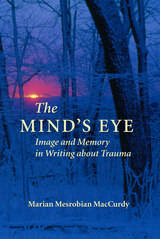
MacCurdy begins by discussing what trauma is, how traumatic memories are stored and accessed, and how writing affects them. She then focuses on the processes involved in translating traumatic images into narrative form, showing how the same patterns and problems emerge whether the writers are students or professionals. Using examples drawn from the classroom, MacCurdy investigates the beneficial effects of the study of trauma on communities as well as individuals, witnesses as well as writers, and explores the implications of these relationships for the world at large, particularly as they pertain to issues of justice, retribution, and forgiveness.
Throughout the volume the author draws on her own experience as teacher, writer, survivor, and descendant of survivors to explain how one can engage student work on difficult subjects without appropriating the texts or getting lost in the emotions generated by them. She further shows how appropriate safeguards can be put in place to protect both teacher and student writer. The end result of such a pedagogy, MacCurdy demonstrates, is not simply better writers but more integrated people, capable of converting their own losses and griefs into compassion for others.
READERS
Browse our collection.
PUBLISHERS
See BiblioVault's publisher services.
STUDENT SERVICES
Files for college accessibility offices.
RECENTLY PUBLISHED



UChicago Accessibility Resources
home | accessibility | search | about | contact us
BiblioVault ® 2001 - 2026
The University of Chicago Press