
 A SCHOLARLY BOOK REPOSITORY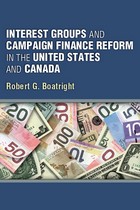
In the early 2000s, the United States and Canada implemented new campaign finance laws restricting the ability of interest groups to make political contributions and to engage in political advertising. Whereas both nations' legislative reforms sought to reduce the role of interest groups in campaigns, these laws have had opposite results in the two nations. In the United States, interest groups remained influential by developing broad coalitions aimed at mobilizing individual voters and contributors. In Canada, interest groups largely withdrew from election campaigns, and, thus, important voices in elections have gone silent. Robert G. Boatright explains such disparate results by placing campaign finance reforms in the context of ongoing political and technological changes.
Robert G. Boatright is Associate Professor of Political Science at Clark University.
Cover photo: © iStockphoto.com / alfabravoalpharomeo
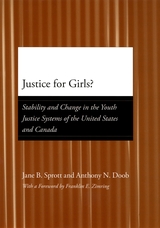
For over a century, as women have fought for and won greater freedoms, concern over an epidemic of female criminality, especially among young women, has followed. Fear of this crime wave—despite a persistent lack of evidence of its existence—has played a decisive role in the development of the youth justice systems in the United States and Canada. Justice for Girls? is a comprehensive comparative study of the way these countries have responded to the hysteria over “girl crime” and how it has affected the treatment of both girls and boys.
Tackling a century of historical evidence and crime statistics, Jane B. Sprott and Anthony N. Doob carefully trace the evolution of approaches to the treatment of young offenders. Seeking to keep youths out of adult courts, both countries have built their systems around rehabilitation. But, as Sprott and Doob reveal, the myth of the “girl crime wave” led to a punitive system where young people are dragged into court for minor offenses and girls are punished far more severely than boys. Thorough, timely, and persuasive, Justice for Girls? will be vital to anyone working with troubled youths.

READERS
Browse our collection.
PUBLISHERS
See BiblioVault's publisher services.
STUDENT SERVICES
Files for college accessibility offices.
RECENTLY PUBLISHED






UChicago Accessibility Resources
home | accessibility | search | about | contact us
BiblioVault ® 2001 - 2026
The University of Chicago Press