
 A SCHOLARLY BOOK REPOSITORY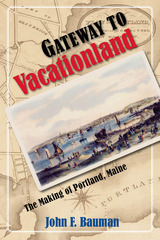
Situated on a peninsula jutting into picturesque Casco Bay, Portland has long been admired for its geographical setting—the “beautiful city by the sea,” as native son Henry Wadsworth Longfellow called it. At the same time, Portland's deep, ice-free port has made it an ideal site for the development of coastal commerce and industry. Much of the city's history, John F. Bauman shows, has been defined by the effort to reconcile the competing interests generated by these attributes—to balance the imperatives of economic growth with a desire to preserve Portland's natural beauty.
Caught in the crossfire of British and French imperial ambitions throughout the colonial era, Portland emerged as a prosperous shipbuilding center and locus of trade in the decades following the American Revolution. During the nineteenth century it became a busy railroad hub and winter port for Canadian grain until a devastating fire in 1866 reduced much of the city to ruins. Civic leaders responded by reinventing Portland as a tourist destination, building new hotels, parks, and promenades, and proclaiming it the “Gateway to Vacationland.”
After losing its grain trade in the 1920s and suffering through the Great Depression, Portland withered in the years following World War II as it wrestled with the problems of deindustrialization, suburbanization, and an aging downtown. Efforts at urban renewal met with limited success until the 1980s, when a concerted plan of historic preservation and the restoration of the Old Port not only revived the tourist trade but eventually established Portland as one of America's “most livable cities.”
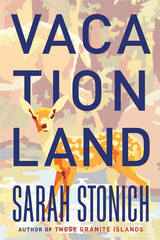
On a lake in northernmost Minnesota, you might find Naledi Lodge—only two cabins still standing, its pathways now trodden mostly by memories. And there you might meet Meg, or the ghost of the girl she was, growing up under her grandfather’s care in a world apart and a lifetime ago. Now an artist, Meg paints images “reflected across the mirrors of memory and water,” much as the linked stories of Vacationland cast shimmering spells across distance and time.
Those whose paths have crossed at Naledi inhabit Vacationland: a man from nearby Hatchet Inlet who knew Meg back when, a Sarajevo refugee sponsored by two parishes who can’t afford “their own refugee,” aged sisters traveling to fulfill a fateful pact once made at the resort, a philandering ad man, a lonely Ojibwe stonemason, and a haiku-spouting girl rescued from a bog.
Sarah Stonich, whose work has been described as “unexpected and moving” by the Chicago Tribune and “a well-paced feast” by the Los Angeles Times, weaves these tales of love and loss, heartbreak and redemption into a rich novel of interconnected and disjointed lives. Vacationland is a moving portrait of a place—at once timeless and of the moment, composed of conflicting dreams and shared experience—and of the woman bound to it by legacy and sometimes longing, but not necessarily by choice.
READERS
Browse our collection.
PUBLISHERS
See BiblioVault's publisher services.
STUDENT SERVICES
Files for college accessibility offices.
RECENTLY PUBLISHED






UChicago Accessibility Resources
home | accessibility | search | about | contact us
BiblioVault ® 2001 - 2026
The University of Chicago Press