
 A SCHOLARLY BOOK REPOSITORY
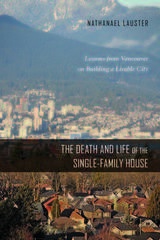
Vancouver today is recognized as one of the most livable cities in the world as well as an international model for sustainability and urbanism. Single-family homes in this city are “a dying breed.” Most people live in the various low-rise and high-rise urban alternatives throughout the metropolitan area.
The Death and Life of the Single-Family House explains how residents in Vancouver attempt to make themselves at home without a house. Local sociologist Nathanael Lauster has painstakingly studied the city’s dramatic transformation to curb sprawl. He tracks the history of housing and interviews residents about the cultural importance of the house as well as the urban problems it once appeared to solve.
Although Vancouver’s built environment is unique, Lauster argues that it was never predestined by geography or demography. Instead, regulatory transformations enabled the city to renovate, build over, and build around the house. Moreover, he insists, there are lessons here for the rest of North America. We can start building our cities differently, and without sacrificing their livability.


The entanglement of Vancouver’s infrastructure in settler colonialism and racialized exploitation
Vancouver, Canada, has long been held up as an environmentally conscious coastal refuge and model of progressive urban planning. Unpacking the troubling complexities that lie beneath the city’s otherwise tidy self-image, Terminal City reveals the long, recurring patterns of racialized violence and Indigenous dispossession crucial to its formation.
Examining the histories of Vancouver’s infrastructures, including railways, ports, the freeway system, fossil-fuel pipelines, and property, Michael Simpson details the various spatial manifestations of settler colonialism and racial capitalism that constitute the city’s urban environment—using it as a case study to reveal such tendencies around the world. Simpson exposes how the seizure of Indigenous lands and the destruction of Black communities has been foundational to the development of the city, and he highlights its structural dependency on these violent legacies, as well as the ongoing struggles to dismantle them.
Bringing together theoretical insights from the fields of urban geography, political ecology, and Indigenous studies, Simpson provides a distinctive intervention into contemporary debates around the material basis of logistics and circulation. At a time when massive upheavals to urban infrastructure are taking place in the hopes of establishing greater sustainability, Terminal City raises important questions about how this moment of transition might be harnessed to bring about decolonial abolitionist futures that redefine what a city can become.
Retail e-book files for this title are screen-reader friendly with images accompanied by short alt text and/or extended descriptions.

READERS
Browse our collection.
PUBLISHERS
See BiblioVault's publisher services.
STUDENT SERVICES
Files for college accessibility offices.
RECENTLY PUBLISHED




UChicago Accessibility Resources
home | accessibility | search | about | contact us
BiblioVault ® 2001 - 2026
The University of Chicago Press