
 A SCHOLARLY BOOK REPOSITORY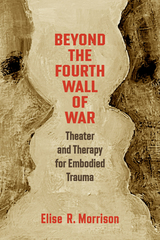
Beyond the Fourth Wall of War sheds light on forms of embodied performance that emerge in the aftermath of structural violence—war, displacement, and militarism—as individual bodies and bodies politic are shaped by communal disorders. As Elise R. Morrison argues that theater that addresses audiences directly by breaking the so-called “fourth wall”—which allows spectators to see but not interact with the events onstage—can offer embodied frameworks for reckoning with war trauma that move beyond traditions of illusionism and spectatorial distance.
Grounded in performance studies, this interdisciplinary study also draws deeply from digital media studies, peace studies, neuroscientific research in embodied cognition and trauma, and drama therapy. Through a comparative analysis of somatic, interactive methodologies in contemporary trauma-informed therapies, Morrison reveals the capacity of theatrical performance to model “somatic witnessing” and kinesthetic empathy and to cultivate communal practices of repair in response to state-sanctioned violence. Underlying this work is a broader inquiry into war’s performative nature, as participatory theater uniquely reorients spectatorship toward rehearsing “performative ethics” in representational and militarized “theaters of war.” Beyond the Fourth Wall of War makes novel interventions into discourses of contemporary warfare by extending the lens of trauma beyond the battlefield to civilian publics who observe conflict from a distance, yet remain entangled in its machinery.
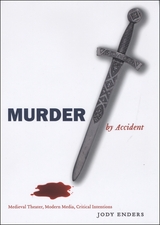
Over fifty years ago, it became unfashionable—even forbidden—for students of literature to talk about an author’s intentions for a given work. In Murder by Accident, Jody Enders boldly resurrects the long-disgraced concept of intentionality, especially as it relates to the theater.
Drawing on four fascinating medieval events in which a theatrical performance precipitated deadly consequences, Enders contends that the marginalization of intention in critical discourse is a mirror for the marginalization—and misunderstanding—of theater. Murder by Accident revisits the legal, moral, ethical, and aesthetic limits of the living arts of the past, pairing them with examples from the present, whether they be reality television, snuff films, the “accidental” live broadcast of a suicide on a Los Angeles freeway, or an actor who jokingly fired a stage revolver at his temple, causing his eventual death. This book will force scholars and students to rethink their assumptions about theory, intention, and performance, both past and present.

The so-called “New Russian Drama” emerged at the end of the twentieth century, following a long period of decline in dramatic writing in the late Soviet and post-Soviet era. In Performing Violence, Birgit Beumers and Mark Lipovetsky examine the representation of violence in these new dramatic works by young Russian playwrights. Reflecting the disappointment in Yeltsin’s democratic reforms and Putin’s neoconservative politics, the plays focus on political and social representations of violence, its performances, and its justifications.
As the first English-language study of Russian drama and theatre in the twenty-first century, Performing Violence seeks a vantage point for the analysis of brutality in post-Soviet culture. While previous generations had preferred poetry and prose, this new breed of authors—the Presnyakov brothers, Evgeni Grishkovets, and Vasili Sigarev among them—have garnered international recognition for their fierce plays. This book investigates the violent portrayal of the identity crisis of a generation as represented in their theatrical works, and will be a key text for students and scholars of drama, Russian studies, and literature.
READERS
Browse our collection.
PUBLISHERS
See BiblioVault's publisher services.
STUDENT SERVICES
Files for college accessibility offices.
RECENTLY PUBLISHED



UChicago Accessibility Resources
home | accessibility | search | about | contact us
BiblioVault ® 2001 - 2026
The University of Chicago Press