
 A SCHOLARLY BOOK REPOSITORY
Results by Title
2 books about Vogel, Paula
2 books about Vogel, Paula
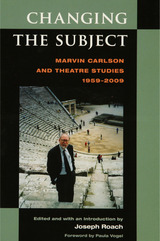
Changing the Subject
Marvin Carlson and Theatre Studies 1959-2009
Edited and with an Introduction by Joseph Roach
University of Michigan Press, 2009
The new field of theatre studies changed rapidly in the post-World War II, post-Sputnik expansion of higher education, driven by the expressive urgencies of the baby boom and the ferment of the revolutionary 1960s. Internationally focused, communicatively multilingual, and culturally provocative, theatre lent itself particularly well to the agendas of many constituencies, some of them violently opposed, in the arts and politics. The remarkable career of one theatre scholar has mapped the issues, ideas, and methods of this emerging discipline during the most fertile period of its formation. Marvin Carlson's distinguished record of scholarship includes fifteen books and more than a hundred articles on the Western European and Arabic-speaking stages; he has also been a prolific translator, editor, and reviewer and has taught and inspired generations of students, many of whom have become major scholars in their own right. Changing the Subject collects newly commissioned essays by eminent scholars to create a casebook on the changes in the field over the past fifty years. The elegant construction of this innovative collection allows readers to trace the evolution of major paradigms in theatre studies (including the drive to document historic performances, the rise of radical theatres and theatre artists, the application of theory to the field, and the birth of performance studies) while they simultaneously follow Marvin Carlson's development as a scholar, teacher, and mentor.
[more]
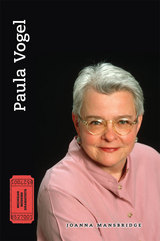
Paula Vogel
Joanna Mansbridge
University of Michigan Press, 2014
Paula Vogel’s plays, including the Pulitzer–prizewinning How I Learned to Drive, initiate a conversation with contemporary culture, staging vexed issues like domestic violence, pornography, and AIDS. She does not write "about" these concerns, but instead examines how they have become framed as “issues”–as sensationalized topics–focusing on the histories and discourses that have defined them and the bodies that bear their meanings. Mobilizing campy humor, keen insight, and nonlinear structure, her plays defamiliarize the identities and issues that have been fixed as "just the way things are." Vogel crafts collage-like playworlds that are comprised of fragments of history and culture, and that are simultaneously inclusive and alienating, familiar and strange, funny and disturbing. At the center of these playworlds are female characters negotiating with the images and discourses that circumscribe their lives and bodies.
In this, the first book-length study of Vogel and her work, Joanna Mansbridge explores how Vogel’s plays speak back to the canon, responding to and rewriting works by William Shakespeare, Edward Albee, Sam Shepard, and David Mamet, rearranging their plots, revising their conflicts, and recasting their dramatis personae. The book examines the theories shaping the playwright and her plays, the production and reception of her work, and the aesthetic structure of each play, grounding the work in cultural materialist, feminist and queer theory, and theater and performance studies scholarship.
[more]
READERS
Browse our collection.
PUBLISHERS
See BiblioVault's publisher services.
STUDENT SERVICES
Files for college accessibility offices.
RECENTLY PUBLISHED



UChicago Accessibility Resources
home | accessibility | search | about | contact us
BiblioVault ® 2001 - 2026
The University of Chicago Press