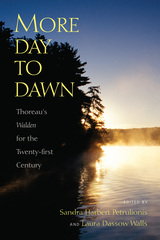
Walden is one of the most frequently assigned texts in literature classes across the country, and it might seem that little new could be said about such a popular book. But these essays demonstrate that scholarship on Henry David Thoreau continues to break new ground. Emerging new voices join senior scholars in exploring a range of topics: Walden's climb to fame; modes of representation in the text; the relationship between fact and truth; Thoreau and violence; Thoreau and evolutionary theory; the working community created by Thoreau's reading and labor; how women read Walden; and the relationship between politics, nature writing, and the science of ecology. The volume closes with an afterword suggesting directions for future research.
Thoreau asserted that the leaves of the earth's strata were not page upon page to be studied by geologists and antiquaries chiefly, "but living poetry like the leaves of a tree." The continuing vitality of Walden shows that it, too, is not a fossil but a living book, still putting out green leaves of insight.
Each decade since Walden was published in 1854 has seen the world grow more crowded and less "simple." What, in our consumerist, speed-of-light, hypermediated world would Thoreau have found worth pursuing? How would he structure his life so as to shut out the phones ringing, the cars honking, the litter trashing his beloved haunts? Readers still seek answers to such questions by picking up their dog-eared copy of Walden and immersing themselves yet again in its pages. Students convince us that this book still holds the power to change lives. These essays are written with the expectation that Thoreau in the new century can help us realize that there are more lives to live and more day to dawn—that "the sun is but a morning star."
Contributors include Nina Baym, Robert Cummings, Robert Oscar López, Lance Newman, H. Daniel Peck, Dana Phillips, Larry J. Reynolds, David M. Robinson, William Rossi, Robert Sattelmeyer, Sarah Ann Wider, and Michael G. Ziser.