
 A SCHOLARLY BOOK REPOSITORY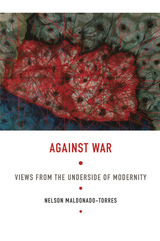
Considering Levinas’s critique of French liberalism and Nazi racial politics, and the links between them, Maldonado-Torres identifies a “master morality” of dominion and control at the heart of western modernity. This master morality constitutes the center of a warring paradigm that inspires and legitimizes racial policies, imperial projects, and wars of invasion. Maldonado-Torres refines the description of modernity’s war paradigm and the Levinasian critique through Fanon’s phenomenology of the colonized and racial self and the politics of decolonization, which he reinterprets in light of the Levinasian conception of ethics. Drawing on Dussel’s genealogy of the modern imperial and warring self, Maldonado-Torres theorizes race as the naturalization of war’s death ethic. He offers decolonial ethics and politics as an antidote to modernity’s master morality and the paradigm of war. Against War advances the de-colonial turn, showing how theory and ethics cannot be conceived without politics, and how they all need to be oriented by the imperative of decolonization in the modern/colonial and postmodern world.
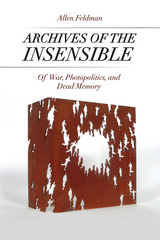
Excavating a scenography of trials—formal or covert, orchestrated or improvised, criminalizing or criminal—Feldman shows how the will to truth disappears into the very violence it interrogates. He maps the sensory inscriptions and erasures of war, highlighting war as a media that severs factuality from actuality to render violence just. He proposes that war promotes an anesthesiology that interdicts the witness of a sensory and affective commons that has the capacity to speak truth to war. Feldman uses layered deconstructive description to decelerate the ballistical tempo of war to salvage the embodied actualities and material histories that war reduces to the ashes of collateral damage, the automatism of drones, and the opacities of black sites. The result is a penetrating work that marries critical visual theory, political philosophy, anthropology, and media archeology into a trenchant dissection of emerging forms of sovereignty and state power that war now makes possible.
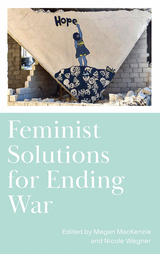
‘War is a man’s game,’ or so goes the saying. Whether this is true or not, patriarchal capitalism is certainly one of the driving forces behind war in the modern era. So can we end war with feminism? This book argues that this is possible, and is in fact already happening.
Each chapter provides a solution to war using innovative examples of how feminist and queer theory and practice inform pacifist treaties, movements and methods, from the international to the domestic spheres. Chapters propose a range of solutions that include arms abolition, centering Indigenous knowledge, economic restructuring, and transforming how we ‘count’ civilian deaths.
Ending war requires challenging complex structures, but the solutions found in this edition have risen to this challenge. By thinking beyond the violence of the capitalist patriarchy, this book makes the powerful case that the possibility of life without war is real.
Tracing war’s expansion beyond the battlefield to the concept of the human being itself
As military and other forms of political violence become the planetary norm, On Posthuman War traces the expansion of war beyond traditional theaters of battle. Drawing on counterinsurgency field manuals, tactical manifestos, data-driven military theory, and asymmetrical-war archives, Mike Hill delineates new “Areas of Operation” within a concept of the human being as not only a social and biological entity but also a technical one.
Delving into three human-focused disciplines newly turned against humanity, OnPosthuman War reveals how demography, anthropology, and neuroscience have intertwined since 9/11 amid the “Revolution in Military Affairs.” Beginning with the author’s personal experience training with U.S. Marine recruits at Parris Island, Hill gleans insights from realist philosophy, the new materialism, and computational theory to show how the human being, per se, has been reconstituted from neutral citizen to unwitting combatant. As evident in the call for “bullets, beans, and data,” whatever can be parted out, counted, and reassembled can become war materiel. Hill shows how visible and invisible wars within identity, community, and cognition shift public-sphere activities, like racial identification, group organization, and even thought itself, in the direction of war. This shift has weaponized social activities against the very notion of society.
On Posthuman War delivers insights on the latest war technologies, strategies, and tactics while engaging in questions poised to overturn the foundations of modern political thought.
Our Ancient Wars features essays by top scholars from across academic disciplines—classicists and historians, philosophers and political theorists, literary scholars, some with firsthand experience of war and some without—engaging with classical texts to understand how differently they were read in other times and places. Contributors articulate difficult but necessary questions about contemporary conceptions of war and conflict.

Warfare and the Dynamics of Political Control draws on a wealth of interdisciplinary perspectives to explore how conflict shapes the establishment and maintenance of political institutions, from small-scale societies to expansive empires. The book examines the material and ideological factors that drive warfare, the organization of combatants, the ways leaders use violence to consolidate power, and how groups resist political domination in times of conflict. By posing critical questions about the efficacy of strategies and the varied outcomes of conflict-driven power struggles, this volume offers profound insights into the dynamics of political control throughout history.
Bringing together case studies from diverse regions and time periods, Warfare and the Dynamics of Political Controlilluminates the multifaceted nature of political violence. The volume includes discussions of human sacrifice, slave-taking, ideological signaling, and military strategy and tactics. The case studies reveal how different forms of political violence influence societal structures. From the fortifications of the Māori in New Zealand to the city walls of early historic India, each contribution provides a detailed analysis of how warfare has been used to both to challenge and to establish political hierarchies. Featuring examples from small foraging communities to large empires across various regions and time periods, the book offers a wide-ranging exploration of how different groups have used and resisted political violence.
This essential work contributes to our understanding of the intersections between conflict and political power, making it a vital resource for scholars of anthropology, archaeology, political science, and history.
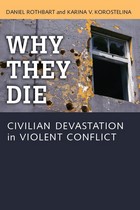
Why do civilians suffer most during times of violent conflict? Why are civilian fatalities as much as eight times higher, calculated globally for current conflicts, than military fatalities? In Why They Die, Daniel Rothbart and Karina V. Korostelina address these questions through a systematic study of civilian devastation in violent conflicts. Pushing aside the simplistic definition of war as a guns-and-blood battle between two militant groups, the authors investigate the identity politics underlying conflicts of many types. During a conflict, all those on the opposite side are perceived as the enemy, with little distinction between soldiers and civilians. As a result, random atrocities and systematic violence against civilian populations become acceptable.
Rothbart and Korostelina devote the first half of the book to case studies: deportation of the Crimean Tatars from the Ukraine, genocide in Rwanda, the Lebanon War, and the war in Iraq. With the second half, they present new methodological tools for understanding different types of violent conflict and discuss the implications of these tools for conflict resolution.
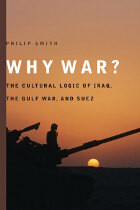
Comprised of case studies of the War in Iraq, the Gulf War, and the Suez Crisis, Why War? decodes the cultural logic of the narratives that justify military action. Each nation, Smith argues, makes use of binary codes—good and evil, sacred and profane, rational and irrational, to name a few. These codes, in the hands of political leaders, activists, and the media, are deployed within four different types of narratives—mundane, tragic, romantic, or apocalyptic. With this cultural system, Smith is able to radically recast our "war stories" and show how nations can have vastly different understandings of crises as each identifies the relevant protagonists and antagonists, objects of struggle, and threats and dangers.
The large-scale sacrifice of human lives necessary in modern war, according to Smith, requires an apocalyptic vision of world events. In the case of the War in Iraq, for example, he argues that the United States and Britain replicated a narrative of impending global doom from the Gulf War. But in their apocalyptic account they mistakenly made the now seemingly toothless Saddam Hussein once again a symbol of evil by writing him into the story alongside al Qaeda, resulting in the war's contestation in the United States, Britain, and abroad.
Offering an innovative approach to understanding how major wars are packaged, sold, and understood, Why War? will be applauded by anyone with an interest in military history, political science, cultural studies, and communication.
READERS
Browse our collection.
PUBLISHERS
See BiblioVault's publisher services.
STUDENT SERVICES
Files for college accessibility offices.
RECENTLY PUBLISHED




UChicago Accessibility Resources
home | accessibility | search | about | contact us
BiblioVault ® 2001 - 2025
The University of Chicago Press