
 A SCHOLARLY BOOK REPOSITORY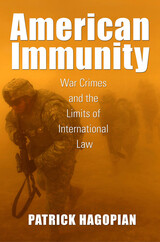
In 1955 the Supreme Court ruled that veterans of the U.S. armed forces could not be court-martialed for overseas crimes that were not detected until after they had left military service. Territorial limitations placed such acts beyond the jurisdiction of civilian courts, and there was no other American court in which they could be adjudicated. As a result, a jurisdictional gap emerged that for decades exempted former troops from prosecution for war crimes. “This was not merely a theoretical possibility,” Patrick Hagopian writes. Over a dozen former soldiers who participated in the My Lai massacre did in fact “get away with murder.” Further court rulings expanded the gap to cover civilian employees and contractors that accompanied the armed forces.
In American Immunity, Hagopian places what he calls the “superpower exemption” in the context of a long-standing tension between international law and U.S. sovereignty. He shows that despite the U.S. role in promulgating universal standards of international law and forming institutions where those standards can be enforced, the United States has repeatedly refused to submit its own citizens and troops to the jurisdiction of international tribunals and failed to uphold international standards of justice in its own courts.
In 2000 Congress attempted to close the jurisdictional gap with passage of the Military Extraterritorial Jurisdiction Act. The effectiveness of that legislation is still in question, however, since it remains unclear how willing civilian American juries will be to convict veterans for conduct in foreign war zones.
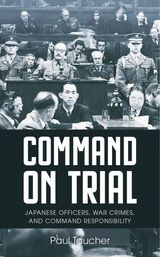
An examination of how the legal doctrine of command responsibility was applied during military tribunals for Japanese war criminals, often inconsistently and ineffectively.
Between 1945 and 1951, the Allied powers prosecuted over 5,700 suspected Japanese war criminals across the Asia-Pacific region before one international and many national tribunals using a new legal doctrine known as command responsibility. Command responsibility holds officers criminally liable for the crimes of their subordinates even if they did not order the crimes to occur. Allied authorities believed that the structure of the Japanese military had allowed the crimes to occur and that pursuing guilt for war crimes should extend beyond enlisted soldiers who were the direct perpetrators of war crimes to those who had been in a position of command.
Command on Trial shows that the application of command responsibility in the courtroom was highly unstable and open to manipulation, especially in the trials of lower-ranking officers, resulting in outcomes that were legally, morally, and philosophically inconsistent. A clear illustration of the pitfalls of command responsibility, this book shows that the trials—and command responsibility—did not achieve comprehensive justice and left unanswered the question of who was actually responsible for many of the war crimes that were perpetrated.
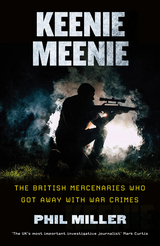
Like its mysterious name, Keenie Meenie Services escaped definition and to this day has evaded sanctions. Now explosive new evidence - only recently declassified - exposes the extent of these war crimes, and the British government's tacit support for the company's operations. Including testimonies from SAS veterans, spy chiefs and diplomats, we hear from key figures battle-hardened by the Troubles in Northern Ireland and the Iranian Embassy siege. Investigative journalist Phil Miller asks, who were these mercenaries: heroes, terrorists, freedom fighters or war criminals?
This book presents the first ever comprehensive case against Keenie Meenie Services, providing long overdue evidence on the crimes of the people who make a killing from killing.
READERS
Browse our collection.
PUBLISHERS
See BiblioVault's publisher services.
STUDENT SERVICES
Files for college accessibility offices.
RECENTLY PUBLISHED




UChicago Accessibility Resources
home | accessibility | search | about | contact us
BiblioVault ® 2001 - 2026
The University of Chicago Press