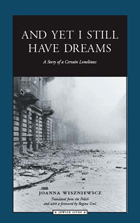
front cover of And Yet I Still Have Dreams
And Yet I Still Have Dreams
A Story of Certain Loneliness
Joanna Wiszniewicz
Northwestern University Press, 2004
And Yet I Still Have Dreams is a departure from many Holocaust memoirs and biographies. Based on interviews with "Alex," an anonymous survivor of the Warsaw Ghetto and three concentration camps, the story follows him from his assimilated childhood to his coming to terms with his memories of the Holocaust as an older man. Alex is angry, pugnacious, and contemptuous of the stereotypes found in some survivor literature and honest about the shortcomings of other works.

The book provides a connection to seldom discussed aspects of the Holocaust: the gulf between rich and poor Jews and how this translated into everyday survival; the refusal by Alex to see himself or Jews in general as heroes or victims; his own self-absorption as a teen in the ghetto; and his "priviliged" family's near-indifference to the suffering of those around them. Alex paints a picture of complex and diverse Jewish society in prewar Poland, revealing how, many years later and despite his determine to leave it in the past, the burdens of memory--and the dreams--linger.
 
[more]

front cover of Bread for the Departed
Bread for the Departed
Bogdan Wojdowski
Northwestern University Press, 1997
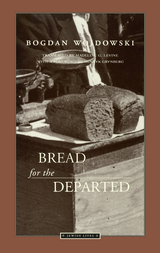
Bread for the Departed details the experience of the Jewish community in Warsaw between 1940 and 1942; the final chapters take place during the mass deportation of Warsaw's Jewish community to death camps. Episodic, chaotic as the teeming ghetto itself, the novel records the inexorable breakdown of morals and loyalties that accompanied the physical deterioration of the ghetto population.
[more]

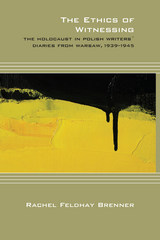
front cover of The Ethics of Witnessing
The Ethics of Witnessing
The Holocaust in Polish Writers' Diaries from Warsaw, 1939-1945
Rachel Feldhay Brenner
Northwestern University Press, 2014

Winner, 2015 USC Book Award in Literary and Cultural Studies, for outstanding monograph published on Russia, Eastern Europe or Eurasia in the fields of literary and cultural studies

The Ethics of Witnessing investigates the reactions of five important Polish diaristswriters—Jaroslaw Iwaszkiewicz, Maria Dabrowska, Aurelia Wylezynska, Zofia Nalkowska, and Stanislaw Rembek—during the period when the Nazis persecuted and murdered Warsaw’s Jewish population. The responses to the Holocaust of these prominent prewar authors extended from insistence on empathic interaction with victims to resentful detachment from Jewish suffering. Whereas some defied the dehumanization of the Jews and endeavored to maintain intersubjective relationships with the victims they attempted to rescue, others selfdeceptively evaded the Jewish plight. The Ethics of Witnessing examines the extent to which ideologies of humanism and nationalism informed the diarists’ perceptions, proposing that the reality of the Final Solution exposed the limits of both orientations and ultimately destroyed the ethical landscape shaped by the Enlightenment tradition, which promised the equality and fellowship of all human beings.

 
[more]

front cover of Making and Unmaking Literature in the Warsaw, Lodz, and Vilna Ghettos
Making and Unmaking Literature in the Warsaw, Lodz, and Vilna Ghettos
Sven-Erik Rose
Brandeis University Press, 2025

A study of literature written by Jewish authors while interned in Nazi ghettos emphasizes how authors processed their horrific experiences through poetry and prose.

Published in Association with the United States Holocaust Memorial Museum

This is the first study devoted to how little known but essential authors grappled with the destitution of ghetto existence by writing within, at the limits of, and against an array of literary scenarios, tropes, plot lines, and generic conventions, including those of nature lyric, modernist interior monologue, the realist social novel, the detective story, and the gothic horror tale. Contending with starvation, disease, desperate housing conditions and the looming threat of being murdered, inhabitants of ghettos in Poland nonetheless made them sites of rich Jewish cultural production. Rose’s readings of these literary works reveal how authors asserted their humanity by insisting on writing works of literature. In such radically dehumanizing circumstances, however, their recourse to established literary genres was not naive. Rather, ghetto authors brilliantly meditated on the grotesque incongruities between established literary models and the extreme conditions of ghetto existence.

[more]

front cover of Mapping Warsaw
Mapping Warsaw
The Spatial Poetics of a Postwar City
Ewa Wampuszyc
Northwestern University Press, 2018
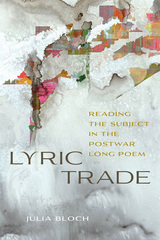
Inspired by the spatial turn in the humanities and social sciences, Mapping Warsaw is an interdisciplinary study that combines urban studies, cinema studies, cultural studies, history, literature, and photography. It examines Warsaw's post-World War II reconstruction through images and language.

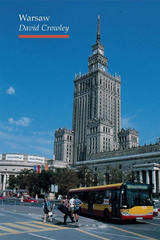
Juxtaposing close readings of photo books, socialist-era newsreels called the Polska Kronika Filmowa, the comedies of Leonard Buczkowski and Jan Fethke, the writing and films of Tadeusz Konwicki, and a case study on the Palace of Culture and Science—a "gift" from none other than Stalin—this study investigates the rhetorical and visual, rather than physical, reconstruction of Warsaw in various medias and genres. 

Ewa Wampuszyc roots her analysis in the historical context of the postwar decade and shows how and why Poland's capital became an essential part of a propaganda program inspired by communist ideology and the needs of a newly established socialist People's Republic. Mapping Warsaw demonstrates how physical space manifests itself in culture, and how culture, history, and politics leave an indelible mark on places. It points out ways in which we take for granted our perception of space and the meanings we assign to it.
 
[more]

front cover of Menachem Kipnis
Menachem Kipnis
Yiddish Folklore and Photographs from Interwar Poland
Sheila E. Jelen
Rutgers University Press, 2026

Menachem Kipnis (1878–1942) was one of the early twentieth-century’s greatest Jewish eastern European ethnomusicologists, folklorists, and photographers. He had a weekly column in the Warsaw Yiddish newspaper Haynt, retelling humorous old folk stories about the fictional Polish town of Chelm, populated exclusively by fools. At the same time, his photographs of Jewish life in eastern Europe regularly appeared in the Forverts (Forward), the most popular Yiddish daily newspaper in the United States. Now, for the first time, Kipnis’s stories and photographs are published together in a single book.

Menachem Kipnis brings these photographs and stories into dialogue with one another, bridging the Jewish communities in Poland and in America during the interwar period. This dialogue, between image and text, between European metropolis and American metropolis, captures a key historical moment when American Jews sought to imagine the lives of their coreligionists in the “Old Country” and eastern European urban Jews sought to distinguish themselves from their Jewish compatriots who were still living in the shtetl. Including an introductory essay, annotations, and an epilogue by Sheila E. Jelen, Menachem Kipnis suggests new ways of understanding both visual and literary depictions of eastern European Jewish culture between the two world wars.

[more]

front cover of The People's Uprising and the Fall of the Warsaw Ghetto, April 1942–June 1943
The People's Uprising and the Fall of the Warsaw Ghetto, April 1942–June 1943
Havi Ben-Sasson Dreifuss
Brandeis University Press, 2026
Examines the final years of the Warsaw ghetto, the uprising, and the varied, nuanced ways Jewish people resisted Nazi rule.
 
The People’s Uprising and the Fall of the Warsaw Ghetto, April 1942–June 1943 sheds light on the lives, choices, and experiences of the tens of thousands of Jews who were not part of the underground armed resistance but nonetheless supported the famed Warsaw Ghetto Uprising. This riveting and dramatic account focuses on the final year of the Warsaw ghetto, from the Great Deportation in the summer of 1942 through the suppression of the uprising in mid-1943. Drawing on powerful contemporary testimonies, diaries, and documents—many of them previously unexplored—Havi Ben-Sasson Dreifuss
reveals how members of the broader Jewish population struggled to survive, maintain family and community life, and make impossible moral decisions in the face of fear, hunger, and daily violence. Looking beyond the fighters themselves, the book offers a story of devastation, but also of resilience and human dignity.
 
Published in association with Yad Vashem.
[more]

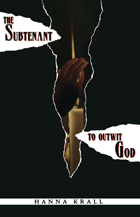
front cover of The Subtenant / To Outwit God
The Subtenant / To Outwit God
Hanna Krall
Northwestern University Press, 1992
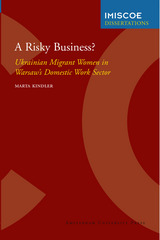
This volume presents two works by acclaimed Polish journalist Hanna Krall: The Subtenant, a semi-autobiographical novel, and To Outwit God, a remarkable interview with Marek Edelman, the last surviving leader of the Warsaw Ghetto uprising. The Subtenant explores the troubled and ever-shifting relationships between Poles and Jews, beginning with the author's concealment as a child during the Nazi years and ending in 1981 when martial law was declared in Poland. In To Outwit God, Edelman's words assault conventional assumptions about heroes and heroism, taking in his time not only in the Warsaw Ghetto but his careers as a physician and a Solidarity activist. Taken together, the two works form a powerful memoir of Jewish survival, a meditation on Polish-Jewish relations, and a commentary on the forces that have produced modern Polish opposition movements.
[more]

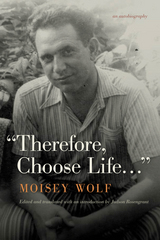
front cover of
"Therefore, Choose Life..."
An Autobiography
Moisey Wolf
Oregon State University Press, 2014
An annotated translation of the extraordinary autobiography of Dr. Moisey Wolf (1922-2007), “Therefore, Choose Life...” is an important addition to the literature of Jewish experience and deepens our understanding of the human condition in the twentieth century.

Wolf describes his Jewish childhood and youth in pre-war Poland, his escape from the Holocaust and subsequent medical service in the Soviet Army during World War II and the following decade, his distinguished career in psychiatry in post-Stalinist Soviet Russia, and his final years in Portland, Oregon, after his departure from the Soviet Union in 1992.

Wolf’s narrative skill and evocative personal insights, combined with Judson Rosengrant’s judicious editing and annotation and elegant translation, provide the reader with direct access to a world that has seemingly ceased to exist, yet continues to resonate and inform our own lives in powerful ways.

“Therefore, Choose Life…” will appeal to readers interested in the history of the East-European twentieth century, pre-Holocaust Jewish family life in Poland, and in the survival of a man of deep religious faith and cultivation in the face of the catastrophes and vicissitudes of his time and place.
[more]

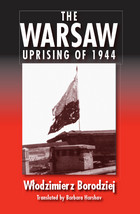
front cover of The Warsaw Uprising of 1944
The Warsaw Uprising of 1944
Wlodzimierz Borodziej
University of Wisconsin Press, 2006

The Warsaw Uprising of 1944 dramatically tells the largely unknown story of the Warsaw resistance movement during World War II. Desperate to free themselves from German military oppression but also hoping to show the advancing Soviets that they could not impose easy rule upon the citizens of Warsaw, the Poles launched an almost hopeless attack against the Germans on August 1, 1944.

    Wlodzimierz Borodziej presents an evenhanded account of what is commonly considered the darkest chapter in Polish history during World War II. In only sixty-three days, the Germans razed Warsaw to the ground and 200,000 people, mostly civilians, lost their lives. The result—a heroic and historically pivotal turning point—meant that the Poles would lose both their capital and an entire generation. This concise account of the trauma—little known to English-speaking readers—will appeal to anyone interested in the history of World War II in general and is a must-read for students of Polish history in particular.
[more]


Send via email Share on Facebook Share on Twitter