front cover of Japanese Law in Context
Japanese Law in Context
Readings in Society, the Economy, and Politics
Curtis J. Milhaupt
Harvard University Press, 2001
This is a wide-ranging selection of 130 readings in Japanese law. The essays, extracted from previously published books and articles, cover subjects including historical context, the civil law tradition, the legal services industry, dispute resolution, constitutional law, contracts, torts, criminal law, family law, employment law, corporate law, and economic regulation. This unique collection of readings is accompanied by the texts of the Japanese constitution and other basic laws.
[more]

front cover of Korean Political and Economic Development
Korean Political and Economic Development
Crisis, Security, and Institutional Rebalancing
Jongryn Mo and Barry R. Weingast
Harvard University Press

How do poor nations become rich, industrialized, and democratic? And what role does democracy play in this transition? To address these questions, Jongryn Mo and Barry R. Weingast study South Korea’s remarkable transformation since 1960. The authors concentrate on three critical turning points: Park Chung Hee’s creation of the development state beginning in the early 1960s, democratization in 1987, and the genesis of and reaction to the 1997 economic crisis. At each turning point, Korea took a significant step toward creating an open access social order.

The dynamics of this transition hinge on the inclusion of a wide array of citizens, rather than just a narrow elite, in economic and political activities and organizations. The political economy systems that followed each of the first two turning points lacked balance in the degree of political and economic openness and did not last. The Korean experience, therefore, suggests that a society lacking balance cannot sustain development. Korean Political and Economic Development offers a new view of how Korea was able to maintain a pro-development state with sustained growth by resolving repeated crises in favor of rebalancing and greater political and economic openness.
[more]

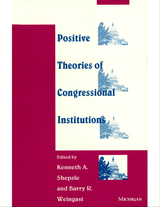
front cover of Positive Theories of Congressional Institutions
Positive Theories of Congressional Institutions
Kenneth A. Shepsle and Barry R. Weingast, Editors
University of Michigan Press, 1995
An ambitious synthesis, Positive Theories of Congressional Institutions attempts to reconcile a number of rational choice viewpoints to produce a comprehensive look at congressional institutions. While most theorists have presented their work as exclusive alternatives for understanding Congress, this volume reconsiders that basic premise. If, in fact, these approaches are mutually exclusive, what evidence favors one over the other? Could it be that these views focus on different aspects of a more complex puzzle? Kenneth A. Shepsle and Barry R. Weingast have assembled leading proponents of rational choice approaches to debate these issues. Some emphasize the problems of legislative decisionmaking under uncertainty and the role institutions play in providing incentives for relevant actors to provide information. Other theorists focus on political parties and emphasize the conditions under which parties exercise institutional authority and monitor institutional practices (or fail to do so). Still others investigate legislative delegation, both within and without the legislature. In debating the relationships between these research strands, the contributors not only provide powerful evidence for the power of formal modelling but also invite those involved in other modes of research to join the discussion. Thus the volume suggests how a more satisfying and complete model might emerge. Positive Theories of Congressional Institutions is a timely volume that will provide the foundation for all future work in this area. Contributors include John H. Aldrich, David P. Baron, Gary W. Cox, John A. Ferejohn, Morris P. Fiorina, Thomas W. Gilligan, Keith Krehbiel, John Londregan, Arthur Lupia, Mathew D. McCubbins, Forrest Maltzman, David W. Rohde, Kenneth A. Shepsle, Barbara Sinclair, Steven S. Smith, James Snyder, and Barry R. Weingast.
[more]

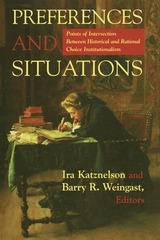
front cover of Preferences and Situations
Preferences and Situations
Points of Intersection Between Historical and Rational Choice In.
Ira Katznelson
Russell Sage Foundation, 2005
A scholarly gulf has tended to divide historians, political scientists, and social movement theorists on how people develop and act on their preferences. Rational choice scholars assumed that people—regardless of the time and place in which they live—try to achieve certain goals, like maximizing their personal wealth or power. In contrast, comparative historical scholars have emphasized historical context in explaining people's behavior. Recently, a common emphasis on how institutions—such as unions or governments—influence people's preferences in particular situations has emerged, promising to narrow the divide between the two intellectual camps. In Preferences and Situations, editors Ira Katnelson and Barry Weingast seek to expand that common ground by bringing together an esteemed group of contributors to address the ways in which institutions, in their wider historical setting, induce people to behave in certain ways and steer the course of history. The contributors examine a diverse group of topics to assess the role that institutions play in shaping people's preferences and decision-making. For example, Margaret Levi studies two labor unions to determine how organizational preferences are established. She discusses how the individual preferences of leaders crystallize and become cemented into an institutional culture through formal rules and informal communication. To explore how preferences alter with time, David Brady, John Ferejohn, and Jeremy Pope examine why civil rights legislation that failed to garner sufficient support in previous decades came to pass Congress in 1964. Ira Katznelson reaches back to the 13th century to discuss how the institutional development of Parliament after the signing of the Magna Carta led King Edward I to reframe the view of the British crown toward Jews and expel them in 1290. The essays in this book focus on preference formation and change, revealing a great deal of overlap between two schools of thought that were previously considered mutually exclusive. Though the scholarly debate over the merits of historical versus rational choice institutionalism will surely rage on, Preferences and Situations reveals how each field can be enriched by the other.
[more]


Send via email Share on Facebook Share on Twitter