
 A SCHOLARLY BOOK REPOSITORY

Although Charles Darwin never visited China, his ideas landed there with force. Darwinism was the first great Western theory to make an impact on the Chinese and, from 1895 until at least 1921, when Marxism gained a formal foothold, it was the dominant Western “ism” influencing Chinese politics and thought. The authority of Darwin, sometimes misinterpreted, influenced reformers and revolutionaries and paved the way for Chinese Marxism and the thought of Mao Tse-tung.
This study evaluates Darwin’s theory of evolution as a stimulus to Chinese political changes and philosophic challenge to traditional Chinese beliefs. James Pusey bases his analysis on a survey of journals issued from 1896 to 1910 and, after a break for revolutionary action, from 1915 to 1926, with emphasis on the era between the Sino–Japanese War and the Republican Revolution. The story of Darwinism in China involves, among others, the most famous figures of modern Chinese intellectual history.
China and the West brings together essays on centuries of Sino-Western musical exchange by musicologists, ethnomusicologists, and music theorists from around the world. It opens with a look at theoretical approaches of prior studies of musical encounters and a comprehensive survey of the intercultural and cross-cultural theoretical frameworks—exoticism, orientalism, globalization, transculturation, and hybridization—that inform these essays. Part I focuses on the actual encounters between Chinese and European musicians, their instruments and institutions, and the compositions inspired by these encounters, while Part II examines theatricalized and mediated East-West cultural exchanges, which often drew on stereotypical tropes, resulting in performances more inventive than accurate. Part III looks at the musical language, sonority, and subject matters of “intercultural” compositions by Eastern and Western composers. Essays in Part IV address reception studies and consider the ways in which differences are articulated in musical discourse by actors serving different purposes, whether self-promotion, commercial marketing, or modes of nationalistic—even propagandistic—expression. The volume’s extensive bibliography of secondary sources will be invaluable to scholars of music, contemporary Chinese culture, and the globalization of culture.
Wade examines the short history of the composer in Japanese society, looking at the creative and economic opportunities that have sprung up around them—or that they forged—during Japan’s astonishingly fast modernization. She shows that modernist Japanese composers have not bought into the high modernist concept of the autonomous artist, instead remaining connected to the people. Articulating Japanese modernism in this way, Wade tells a larger story of international musical life, of the spaces in which tradition and modernity are able to meet and, ultimately, where modernity itself has been made.
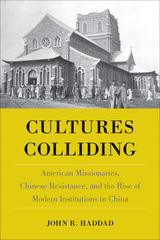
As incredible as it may seem, the American missionaries who journeyed to China in 1860 planning solely to spread the Gospel ultimately reinvented their entire enterprise. By 1900, they were modernizing China with schools, colleges, hospitals, museums, and even YMCA chapters. In Cultures Colliding, John R. Haddad nimbly recounts this transformative institution-building—how and why it happened—and its consequences.
When missionaries first traveled to rural towns atop mules, they confronted populations with entrenched systems of belief that embraced Confucius and rejected Christ. Conflict ensued as these Chinese viewed missionaries as unwanted disruptors. So how did this failing movement eventually change minds and win hearts? Many missionaries chose to innovate. They built hospitals and established educational institutions offering science and math. A second wave of missionaries opened YMCA chapters, coached sports, and taught college. Crucially, missionaries also started listening to Chinese citizens, who exerted surprising influence over the preaching, teaching, and caregiving, eventually running some organizations themselves. They embraced new American ideals while remaining thoroughly Chinese.
In Cultures Colliding, Haddad recounts the unexpected origins and rapid rise of American institutions in China by telling the stories of the Americans who established these institutions and the Chinese who changed them from within. Today, the impact of this untold history continues to resonate in China.
In Detective Fiction and the Rise of the Japanese Novel, Satoru Saito sheds light on the deep structural and conceptual similarities between detective fiction and the novel in prewar Japan. Arguing that the interactions between the two genres were not marginal occurrences but instead critical moments of literary engagement, Saito demonstrates how detective fiction provided Japanese authors with the necessary frameworks through which to examine and critique the nature and implications of Japan’s literary formations and its modernizing society.
Through a series of close readings of literary texts by canonical writers of Japanese literature and detective fiction, including Tsubouchi Shoyo, Natsume Soseki, Shimazaki Toson, Sato Haruo, Kuroiwa Ruiko, and Edogawa Ranpo, Saito explores how the detective story functioned to mediate the tenuous relationships between literature and society as well as between subject and authority that made literary texts significant as political acts. By foregrounding the often implicit and contradictory strategies of literary texts—choice of narrative forms, symbolic mappings, and intertextual evocations among others—this study examines in detail the intricate interactions between detective fiction and the novel that shaped the development of modern Japanese literature.
This study traces the shaping presence of cultural interactions, arguing that American literature has become a hybridization of Eastern and Western literary traditions. Cultural exchanges between the East and West began in the early decades of the nineteenth century as American transcendentalists explored Eastern philosophies and arts. Hakutani examines this influence through the works of Emerson, Thoreau, and Whitman. He further demonstrates the East-West exchange through discussions of the interactions by modernists such as Yone Noguchi, Yeats, Pound, Camus, and Kerouac.
Finally, he argues that African American literature, represented by Richard Wright, Ralph Ellison, Alice Walker, Toni Morrison, and James Emanuel, is postmodern. Their works exhibit their concerted efforts to abolish marginality and extend referentiality, exemplifying the postmodern East-West crossroads of cultures. A fuller understanding of their work is gained by situating them within this cultural conversation. The writings of Wright, for example, take on their full significance only when they are read, not as part of a national literature, but as an index to an evolving literature of cultural exchanges.
The notion of the individual was initially translated into Korean near the end of the nineteenth century and took root during the early years of Japanese colonial influence. Yoon Sun Yang argues that the first literary iterations of the Korean individual were prototypically female figures appearing in the early colonial domestic novel—a genre developed by reform-minded male writers—as schoolgirls, housewives, female ghosts, femmes fatales, and female same-sex partners. Such female figures have long been viewed as lacking in modernity because, unlike numerous male characters in Korean literature after the late 1910s, they did not assert their own modernity, or that of the nation, by exploring their interiority. Yang, however, shows that no reading of Korean modernity can ignore these figures, because the early colonial domestic novel cast them as individuals in terms of their usefulness or relevance to the nation, whether model citizens or iconoclasts.
By including these earlier narratives within modern Korean literary history and positing that they too were engaged in the translation of individuality into Korean, Yang’s study not only disrupts the canonical account of a non-gendered, linear progress toward modern Korean selfhood but also expands our understanding of the role played by translation in Korea’s construction of modern gender roles.
“Superb… A tour de force.”
—Ebrahim Moosa
“Provocative… Aydin ranges over the centuries to show the relative novelty of the idea of a Muslim world and the relentless efforts to exploit that idea for political ends.”
—Washington Post
When President Obama visited Cairo to address Muslims worldwide, he followed in the footsteps of countless politicians who have taken the existence of a unified global Muslim community for granted. But as Cemil Aydin explains in this provocative history, it is a misconception to think that the world’s 1.5 billion Muslims constitute a single entity. How did this belief arise, and why is it so widespread? The Idea of the Muslim World considers its origins and reveals the consequences of its enduring allure.
“Much of today’s media commentary traces current trouble in the Middle East back to the emergence of ‘artificial’ nation states after the fall of the Ottoman Empire… According to this narrative…today’s unrest is simply a belated product of that mistake. The Idea of the Muslim World is a bracing rebuke to such simplistic conclusions.”
—Times Literary Supplement
“It is here that Aydin’s book proves so valuable: by revealing how the racial, civilizational, and political biases that emerged in the nineteenth century shape contemporary visions of the Muslim world.”
—Foreign Affairs
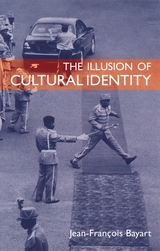
In this highly sophisticated book, Bayart shows that the very idea of cultural identity prevents us from grasping the cultural dimensions of political action and economic development. Identities, he argues, are fluid, never homogeneous, and sometimes invented. Political repertoires are instead created through imagined, highly ambiguous aspects of culture—what he calls "imaginaires." For instance, the long beards worn by men in some fundamentalist groups are thought to be key to their core identities and thus assumed to be in conflict with modern values. These beards, however, do not stand in the way of the men's use of technology or their embrace of capitalism—an example Bayart uses to demonstrate the equivocality of cultural identity. The theoretical implications of Bayart's analysis emerge from a fascinating collection of historical examples that often surprise and always instruct.
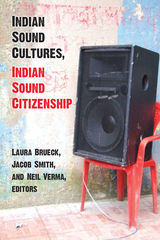
Indian Sound Cultures, Indian Sound Citizenship addresses the multifaceted roles sound plays in Indian cultures and media, and enacts a sonic turn in South Asian Studies by understanding sound in its own social and cultural contexts. “Scapes, Sites, and Circulations” considers the spatial and circulatory ways in which sound “happens” in and around Indian sound cultures, including diasporic cultures. “Voice” emphasizes voices that embody a variety of struggles and ambiguities, particularly around gender and performance. Finally, “Cinema Sound” make specific arguments about film sound in the Indian context, from the earliest days of talkie technology to contemporary Hindi films and experimental art installations.
Integrating interdisciplinary scholarship at the nexus of sound studies and South Asian Studies by questions of nation/nationalism, postcolonialism, cinema, and popular culture in India, Indian Sound Cultures, Indian Sound Citizenship offers fresh and sophisticated approaches to the sonic world of the subcontinent.
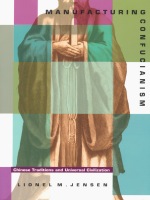
Tracing the history of the Jesuits’ invention of Confucius and of themselves as native defenders of Confucius’s teaching, Jensen reconstructs the cultural consequences of the encounter between the West and China. For the West, a principal outcome of this encounter was the reconciliation of empirical investigation and theology on the eve of the scientific revolution. Jensen also explains how Chinese intellectuals in the early twentieth century fashioned a new cosmopolitan Chinese culture through reliance on the Jesuits’ Confucius and Confucianism. Challenging both previous scholarship and widespread belief, Jensen uses European letters and memoirs, Christian histories and catechisms written in Chinese, translations and commentaries on the Sishu, and a Latin summary of Chinese culture known as the Confucius Sinarum Philosophus to argue that the national self-consciousness of Europe and China was bred from a cultural ecumenism wherein both were equal contributors.
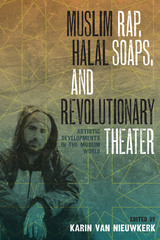
From "green" pop and "clean" cinema to halal songs, Islamic soaps, Muslim rap, Islamist fantasy serials, and Suficized music, the performing arts have become popular and potent avenues for Islamic piety movements, politically engaged Islamists, Islamic states, and moderate believers to propagate their religio-ethical beliefs. Muslim Rap, Halal Soaps, and Revolutionary Theater is the first book that explores this vital intersection between artistic production and Islamic discourse in the Muslim world.
The contributors to this volume investigate the historical and structural conditions that impede or facilitate the emergence of a "post-Islamist" cultural sphere. They discuss the development of religious sensibilities among audiences, which increasingly include the well-to-do and the educated young, as well as the emergence of a local and global religious market. At the heart of these essays is an examination of the intersection between cultural politics, performing art, and religion, addressing such questions as where, how, and why pop culture and performing arts have been turned into a religious mission, and whether it is possible to develop a new Islamic aesthetic that is balanced with religious sensibilities. As we read about young Muslims and their quest for a "cool Islam" in music, their struggle to quell their stigmatized status, or the collision of morals and the marketplace in the arts, a vivid, varied new perspective on Muslim culture emerges.
Pakistan’s presence in the outside world is dominated by images of religious extremism and violence. These images—and the narratives that interpret them—inform events in the international realm, but they also twist back around to shape local class politics. In The New Pakistani Middle Class, Ammara Maqsood focuses on life in contemporary Lahore, where she unravels these narratives to show how central they are for understanding competition and the quest for identity among middle-class groups.
Lahore’s traditional middle class has asserted its position in the socioeconomic hierarchy by wielding significant social capital and dominating the politics and economics of urban life. For this traditional middle class, a Muslim identity is about being modern, global, and on the same footing as the West. Recently, however, a more visibly religious, upwardly mobile social group has struggled to distinguish itself against this backdrop of conventional middle-class modernity, by embracing Islamic culture and values. The religious sensibilities of this new middle-class group are often portrayed as Saudi-inspired and Wahhabi.
Through a focus on religious study gatherings and also on consumption in middle-class circles—ranging from the choice of religious music and home décor to debit cards and the cut of a woman’s burkha—The New Pakistani Middle Class untangles current trends in piety that both aspire toward, and contest, prevailing ideas of modernity. Maqsood probes how the politics of modernity meets the practices of piety in the struggle among different middle-class groups for social recognition and legitimacy.
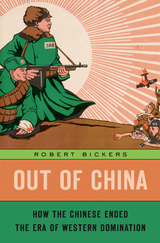
Nationalism matters in China, and what matters in China matters to everyone. China’s new nationalism, Robert Bickers shows, is rooted not in its present power but in shameful memories of its former weaknesses. Invaded, humiliated, and looted in the nineteenth and twentieth centuries by foreign powers, China looks out at the twenty-first century through the lens of the past. History matters deeply to Beijing’s current rulers, and Out of China explains why.
Bickers tracks the long, often agonizing process by which the Chinese regained control of their own country. He describes the corrupt, lurid modernity of prewar Shanghai, the often tiny patches of extraterritorial land controlled by foreign powers, the entrepôts of Hong Kong and Macao, and the myriad means—through armed threats, technology, and legal chicanery—by which China was kept subservient until, gradually, it emerged from Western control. This plural and partial subjugation of China is a story that involves not only European powers and Japan but also the United States.
This complex history must be grasped not to atone for the sins of the past but to recognize China’s internationalized landscapes with all their contradictions, violence, cosmopolitanism, and ambitions. The story of the foreign presence in China in the nineteenth and twentieth centuries is too important to be left in the hands of the Chinese party-state and its approved script. Out of China is essential reading for anyone wishing to understand what shapes China’s view of the world in the twenty-first century.
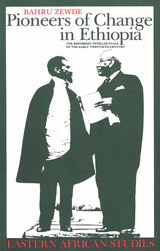
In this exciting new study, Bahru Zewde, one of the foremost historians of modern Ethiopia, has constructed a collective biography of a remarkable group of men and women in a formative period of their country’s history. Ethiopia’s political independence at the end of the nineteenth century put this new African state in a position to determine its own levels of engagement with the West. Ethiopians went to study in universities around the world. They returned with the skills of their education acquired in Europe and America, and at home began to lay the foundations of a new literature and political philosophy. Pioneers of Change in Ethiopia describes the role of these men and women of ideas in the social and political transformation of the young nation and later in the administration of Haile Selassie.
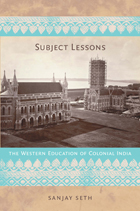
Drawing on history, political science, anthropology, and philosophy, Seth interprets the debates and controversies that came to surround western education. Central among these were concerns that Indian students were acquiring western education by rote memorization—and were therefore not acquiring “true knowledge”—and that western education had plunged Indian students into a moral crisis, leaving them torn between modern, western knowledge and traditional Indian beliefs. Seth argues that these concerns, voiced by the British as well as by nationalists, reflected the anxiety that western education was failing to produce the modern subjects it presupposed. This failure suggested that western knowledge was not the universal epistemology it was thought to be. Turning to the production of collective identities, Seth illuminates the nationalists’ position vis-à-vis western education—which they both sought and criticized—through analyses of discussions about the education of Muslims and women.
A Foreign Affairs Best Book of the Year
Winner of the AATSEEL Prize for Best Book in Cultural Studies
Winner of the Laura Shannon Prize in Contemporary European Studies
Winner of the Marshall D. Shulman Book Prize
Winner of the Wayne S. Vucinich Book Prize
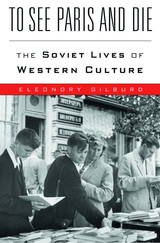
The Soviet Union was a notoriously closed society until Stalin’s death in 1953. Then, in the mid-1950s, a torrent of Western novels, films, and paintings invaded Soviet streets and homes, acquiring heightened emotional significance. To See Paris and Die is a history of this momentous opening to the West.
At the heart of this history is a process of translation, in which Western figures took on Soviet roles: Pablo Picasso as a political rabble-rouser; Rockwell Kent as a quintessential American painter; Erich Maria Remarque and Ernest Hemingway as teachers of love and courage under fire; J. D. Salinger and Giuseppe De Santis as saviors from Soviet clichés. Imported novels challenged fundamental tenets of Soviet ethics, while modernist paintings tested deep-seated notions of culture. Western films were eroticized even before viewers took their seats. The drama of cultural exchange and translation encompassed discovery as well as loss.
Eleonory Gilburd explores the pleasure, longing, humiliation, and anger that Soviet citizens felt as they found themselves in the midst of this cross-cultural encounter. The main protagonists of To See Paris and Die are small-town teachers daydreaming of faraway places, college students vicariously discovering a wider world, and factory engineers striving for self-improvement. They invested Western imports with political and personal significance, transforming foreign texts into intimate belongings.
With the end of the Soviet Union, the Soviet West disappeared from the cultural map. Gilburd’s history reveals how domesticated Western imports defined the last three decades of the Soviet Union, as well as its death and afterlife.
Highlighting the ways that Afro-Cuban discourses serve as a means of moral analysis of social action, Palmié suggests that the supposedly irrational premises of Afro-Cuban religious traditions not only rival Western rationality in analytical acumen but are integrally linked to rationality itself. Afro-Cuban religion is as “modern” as nuclear thermodynamics, he claims, just as the Caribbean might be regarded as one of the world’s first truly “modern” locales: based on the appropriation and destruction of human bodies for profit, its plantation export economy anticipated the industrial revolution in the metropolis by more than a century. Working to prove that modernity is not just an aspect of the West, Palmié focuses on those whose physical abuse and intellectual denigration were the price paid for modernity’s achievement. All cultures influenced by the transcontinental Atlantic economy share a legacy of slave commerce. Nevertheless, local forms of moral imagination have developed distinctive yet interrelated responses to this violent past and the contradiction-ridden postcolonial present that can be analyzed as forms of historical and social analysis in their own right.
READERS
Browse our collection.
PUBLISHERS
See BiblioVault's publisher services.
STUDENT SERVICES
Files for college accessibility offices.
RECENTLY PUBLISHED



UChicago Accessibility Resources
home | accessibility | search | about | contact us
BiblioVault ® 2001 - 2024
The University of Chicago Press