
 A SCHOLARLY BOOK REPOSITORY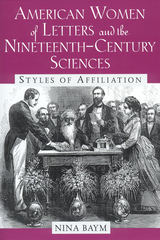
Choice Outstanding Academic Title
During the nineteenth century, the content and institutional organization of the sciences evolved dramatically, altering the public's understanding of knowledge. As science grew in importance, many women of letters tried to incorporate it into a female worldview. Nina Baym explores the responses to science displayed in a range of writings by American women. Conceding that they could not become scientists, women insisted, however, that they were capable of understanding science and participating in its discourse. They used their access to publishing to advocate the study and transmission of scientific information to the general public.
Bayms book includes biographies and a full exploration of these women's works. Among those considered are:
• Almira Phelps, author of Familiar Lectures on Botany (it sold 350,000 copies)
• Sarah Hale, who filled Godey's Lady's Book with science articles
• Catharine Esther Beecher, who based her domestic advice on scientific information
• Elizabeth Cary Agassiz, the actual ghostwriter of her husband's popular science essays
• Emily Dickinson, whose poetry is replete with scientific images.
Baym also investigates science in women's novels, writing by and about women doctors, and the scientific claims advanced by women's spiritualist movements. This book truly breaks new ground, outlining a field of inquiry that few have noted exists.

The era of the Scientific Revolution has long been epitomized by Galileo. Yet many women were at its vanguard, deeply invested in empirical culture. They experimented with medicine and practical alchemy at home, at court, and through collaborative networks of practitioners. In academies, salons, and correspondence, they debated cosmological discoveries; in their literary production, they used their knowledge of natural philosophy to argue for their intellectual equality to men.
Meredith Ray restores the work of these women to our understanding of early modern scientific culture. Her study begins with Caterina Sforza’s alchemical recipes; examines the sixteenth-century vogue for “books of secrets”; and looks at narratives of science in works by Moderata Fonte and Lucrezia Marinella. It concludes with Camilla Erculiani’s letters on natural philosophy and, finally, Margherita Sarrocchi’s defense of Galileo’s “Medicean” stars.
Combining literary and cultural analysis, Daughters of Alchemy contributes to the emerging scholarship on the variegated nature of scientific practice in the early modern era. Drawing on a range of under-studied material including new analyses of the Sarrocchi–Galileo correspondence and a previously unavailable manuscript of Sforza’s Experimenti, Ray’s book rethinks early modern science, properly reintroducing the integral and essential work of women.
Research frequently neglects the important ways that race and gender intersect within the complex structural dynamics of STEM. Diversifying STEM fills this void, bringing together a wide array of perspectives and the voices of a number of multidisciplinary scholars. The essays cover three main areas: the widely-held ideology that science and mathematics are “value-free,” which promotes pedagogies of colorblindness in the classroom as well as an avoidance of discussions around using mathematics and science to promote social justice; how male and female students of color experience the intersection of racist and sexist structures that lead to general underrepresentation and marginalization; and recognizing that although there are no quick fixes, there exists evidence-based research suggesting concrete ways of doing a better job of including individuals of color in STEM. As a whole this volume will allow practitioners, teachers, students, faculty, and professionals to reimagine STEM across a variety of educational paradigms, perspectives, and disciplines, which is critical in finding solutions that broaden the participation of historically underrepresented groups within the STEM disciplines.
The first large-scale empirical analysis of the gender gap in science, showing how the structure of scientific labor and rewards—publications, citations, funding—systematically obstructs women’s career advancement.
If current trends continue, women and men will be equally represented in the field of biology in 2069. In physics, math, and engineering, women should not expect to reach parity for more than a century. The gender gap in science and technology is narrowing, but at a decidedly unimpressive pace. And even if parity is achievable, what about equity?
Equity for Women in Science, the first large-scale empirical analysis of the global gender gap in science, provides strong evidence that the structures of scientific production and reward impede women’s career advancement. To make their case, Cassidy R. Sugimoto and Vincent Larivière have conducted scientometric analyses using millions of published papers across disciplines. The data show that women are systematically denied the chief currencies of scientific credit: publications and citations. The rising tide of collaboration only exacerbates disparities, with women unlikely to land coveted leadership positions or gain access to global networks. The findings are unequivocal: when published, men are positioned as key contributors and women are relegated to low-visibility technical roles. The intersecting disparities in labor, reward, and resources contribute to cumulative disadvantages for the advancement of women in science.
Alongside their eye-opening analyses, Sugimoto and Larivière offer solutions. The data themselves point the way, showing where existing institutions fall short. A fair and equitable research ecosystem is possible, but the scientific community must first disrupt its own pervasive patterns of gatekeeping.

Do women do science differently? And how about feminists--male or female? The answer to this fraught question, carefully set out in this provocative book, will startle and enlighten every faction in the "science wars."
Has Feminism Changed Science? is at once a history of women in science and a frank assessment of the role of gender in shaping scientific knowledge. Science is both a profession and a body of knowledge, and Londa Schiebinger looks at how women have fared and performed in both instances. She first considers the lives of women scientists, past and present: How many are there? What sciences do they choose--or have chosen for them? Is the professional culture of science gendered? And is there something uniquely feminine about the science women do? Schiebinger debunks the myth that women scientists--because they are women--are somehow more holistic and integrative and create more cooperative scientific communities. At the same time, she details the considerable practical difficulties that beset women in science, where domestic partnerships, children, and other demanding concerns can put women's (and increasingly men's) careers at risk.
But what about the content of science, the heart of Schiebinger's subject? Have feminist perspectives brought any positive changes to scientific knowledge? Schiebinger provides a subtle and nuanced gender analysis of the physical sciences, medicine, archaeology, evolutionary biology, primatology, and developmental biology. She also shows that feminist scientists have developed new theories, asked new questions, and opened new fields in many of these areas.
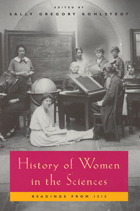
This book features some of the most influential and pioneering studies of women in the sciences, with a special focus on patterns of education, access, barriers, and opportunities for women's work in science. Spanning the 17th through the 20th centuries, the book demonstrates the meaning and power of gender experienced by women in the sciences.
Individual chapters focus on exceptional women whose unusual initiativee and particular circumstance led them to engage in science: Laura Bassi, Nettie Stevens, Maria Winkelmann, and others. Chapters on women's access to science discuss collaboration with family members in the domestic sphere, the impact of primers and popular science writing, and formal education in public schools and advanced research institutions. There are examinations of the reasons for clusters of women working in "female friendly" sciences such as botany and physiology in the 19th century and astronomy in the U.S. during the early 20th century.
This important and useful book provides a thoughtful and detailed overview for scholars and students in the history of science, as well as for feminist historians, scientists, and others who who want a comparative and historical analysis of women in the sciences.
Contributors include Janet Browne, Paula Findlen, Peggy Aldrich Kidwell, Ann Hibner Koblitz, M. Susan Lindee, Carolyn Merchant, Margaret W. Rossiter, Londa Schiebinger, Nancy Leys Stepan, and Deborah Jean Warner.
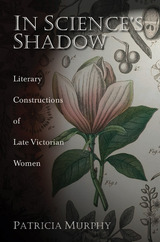
The Victorian era was characterized by great scientific curiosity—as exemplified by the publication of Darwin’s Descent of Man—as well as by new questions regarding the place of women in society. Patricia Murphy now explores the tenuous interplay of gender and science to show how the era’s literature both challenged and reinforced a constrictive role for Victorian women. Focusing on a specific body of literature involving women intensely associated with scientific pursuits, and examining selected noncanonical writings—both fictional and nonfictional representations of scientific women—Murphy demonstrates how these works informed the “Woman Question” by reinforcing or rejecting presumed truths about gender and science.
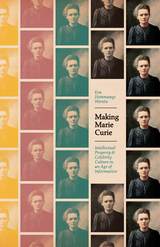
Making Marie Curie explores what went into the creation of this icon of science. It is not a traditional biography, or one that attempts to uncover the “real” Marie Curie. Rather, Eva Hemmungs Wirtén, by tracing a career that spans two centuries and a world war, provides an innovative and historically grounded account of how modern science emerges in tandem with celebrity culture under the influence of intellectual property in a dawning age of information. She explores the emergence of the Curie persona, the information culture of the period that shaped its development, and the strategies Curie used to manage and exploit her intellectual property. How did one create and maintain for oneself the persona of scientist at the beginning of the twentieth century? What special conditions bore upon scientific women, and on married women in particular? How was French identity claimed, established, and subverted? How, and with what consequences, was a scientific reputation secured?
In its exploration of these questions and many more, Making Marie Curie provides a composite picture not only of the making of Marie Curie, but the making of modern science itself.

Ajzenberg-Selove came to America at the age of 15 after narrowly escaping the Nazi takeover of France. She had planned to become an engineer like her father, but switched to physics after she was told the only engineering jobs open to women were in drafting: Marie Curie's example proved to her that women could do physics. Her first attempt at graduate work at Columbia University was a disaster, but she was sturck with the intellectual beauty of the field. After taking a Ph.D. in physics at University of Wisconsin, she did post-doctoral work with Thomas Lauritsen at the California Institute of Technology, where she began writing the first of a series of major review papers on the nuclear spectroscopy of the light nuclei, a subject of fundamental importance to nuclear physics, astrophysics, and applied physics. She continued this work and experimental research for thirty-eight years while teaching at Boston University, Haverford College, and the University of Pennsylvania.
During her early career, Ajzenberg-Selove was shielded by her male mentors from experiencing much of the discrimination directed against women in science. Her simultaneous battles to become a tenured professor and to overcome breast cancer opened her eyes and confirmed her as a feminist.
The lay reader and the scientist alike will be fascinated by Ajzenberg-Selove's clear portrayal of her interlinked lives as physicist, teacher, wife of particle physicist, Walter Selove, and a woman who relishes both competition and friendship in a male-dominated field. An invaluable book for anyone contemplating a career in science.
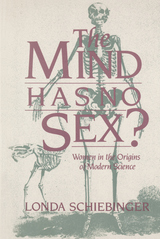
As part of his attempt to secure a place for women in scientific culture, the Cartesian François Poullain de la Barre asserted as long ago as 1673 that “the mind has no sex.” In this rich and comprehensive history of women’s contributions to the development of early modern science, Londa Schiebinger examines the shifting fortunes of male and female equality in the sphere of the intellect. Schiebinger counters the “great women” mode of history and calls attention to broader developments in scientific culture that have been obscured by time and changing circumstance. She also elucidates a larger issue: how gender structures knowledge and power.
It is often assumed that women were automatically excluded from participation in the scientific revolution of early modern Europe, but in fact powerful trends encouraged their involvement. Aristocratic women participated in the learned discourse of the Renaissance court and dominated the informal salons that proliferated in seventeenth-century Paris. In Germany, women of the artisan class pursued research in fields such as astronomy and entomology. These and other women fought to renegotiate gender boundaries within the newly established scientific academies in order to secure their place among the men of science. But for women the promises of the Enlightenment were not to be fulfilled. Scientific and social upheavals not only left women on the sidelines but also brought about what the author calls the “scientific revolution in views of sexual difference.”
While many aspects of the scientific revolution are well understood, what has not generally been recognized is that revolution came also from another quarter—the scientific understanding of biological sex and sexual temperament (what we today call gender). Illustrations of female skeletons of the ideal woman—with small skulls and large pelvises—portrayed female nature as a virtue in the private realm of hearth and home, but as a handicap in the world of science. At the same time, seventeenth- and eighteenth-century women witnessed the erosion of their own spheres of influence. Midwifery and medical cookery were gradually subsumed into the newly profess ionalized medical sciences. Scientia, the ancient female personification of science, lost ground to a newer image of the male researcher, efficient and solitary—a development that reflected a deeper intellectual shift. By the late eighteenth century, a self-reinforcing system had emerged that rendered invisible the inequalities women suffered. In reexamining the origins of modern science, Schiebinger unearths a forgotten heritage of women scientists and probes the cultural and historical forces that continue to shape the course of scientific scholarship and knowledge.
Describing the work of the post-Kuhnian science studies scholars Bruno Latour, Ulrich Beck, and the team of Michael Gibbons, Helga Nowtony, and Peter Scott, Harding reveals how, from different perspectives, they provide useful resources for rethinking the modernity versus tradition binary and its effects on the production of scientific knowledge. Yet, for the most part, they do not take feminist or postcolonial critiques into account. As Harding demonstrates, feminist science studies and postcolonial science studies have vital contributions to make; they bring to light not only the male supremacist investments in the Western conception of modernity and the historical and epistemological bases of Western science but also the empirical knowledge traditions of the global South. Sciences from Below is a clear and compelling argument that modernity studies and post-Kuhnian, feminist, and postcolonial sciences studies each have something important, and necessary, to offer to those formulating socially progressive scientific research and policy.
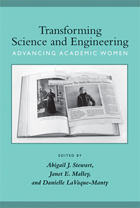
"If you have thrown up your hands in despair after trying to retain women science and engineering in the academy, read this book. It offers detailed descriptions of a wide array of tried-and-true programs that have been tested out by the NSF ADVANCE program."
---Joan C. Williams, 1066 Foundation Chair & Distinguished Professor of Law Director, Center for WorkLife Law University of California
"Solid and practical, this volume details the first years of NSF funded institutional change to remake gender dynamics inside U.S. science. What works? What doesn't? And why?"
---Londa Schiebinger, John L. Hinds Professor of History of Science and Barbara D. Finberg Director, Michelle R. Clayman Institute for Gender Research at Stanford University, and author of Has Feminism Changed Science?
"This book's time has come. Transforming Science and Engineering is important, and lots of people can learn from what has happened in the ADVANCE universities."
---Lotte Bailyn, Professor of Management, Behavioral and Policy Sciences Department, Sloan School of Management, MIT; author of Breaking the Mold: Redesigning Work for Productive and Satisfying Lives; and coauthor of Beyond Work-Family Balance: Advancing Gender Equity and Workplace Performance
"This collection profiles 16 NSF ADVANCE grant successes, sandwiched between an interview with Dr. Alice Hogan and Dr. Lee Harle's summary of cost-effective practices from ADVANCE programs, giving so many 'biggest bang for the buck' examples in so few pages that it will easily justify both the cost of the book and the reading time. These accounts do not continue the too-common vague referrals to 'unhealthy environment' or 'chilly climate,' but rather expound the situations before and after the interventions, something necessary in order to transplant the programs, or even to use the programs for idea generation. Transforming Science and Engineering is a model of excellence, and will be extremely useful for those women, men, faculty, or administrators wanting to help their universities move into the 21st century and attract to their campuses qualified women and men who want opportunities to attain their full potentials."
---Donna J. Nelson, Associate Professor of Chemistry, University of Oklahoma
In 2001, the National Science Foundation's ADVANCE Institutional Transformation program began awarding five-year grants to colleges and universities to address a common problem: how to improve the work environment for women faculty in science and engineering. Drawing on the expertise of scientists, engineers, social scientists, specialists in organizational behavior, and university administrators, this collection is the first to describe the variety of innovative efforts academic institutions around the country have undertaken.
Focusing on a wide range of topics, from how to foster women's academic success in small teaching institutions, to how to use interactive theater to promote faculty reflection about departmental culture, to how a particular department created and maintained a healthy climate for women's scientific success, the contributors discuss both the theoretical and empirical aspects of the initiatives, with emphasis on the practical issues involved in creating these approaches. The resulting evidence shows that these initiatives have the desired effects. The cases represented in this collection depict the many issues women faculty in science and engineering face, and the solutions that are presented can be widely accepted at academic institutions around the United States. The essays in Transforming Science and Engineering illustrate that creating work environments that sustain and advance women scientists and engineers benefits women, men, and underrepresented minorities.
Abigail J. Stewart is Sandra Schwartz Tangri Distinguished University Professor of Psychology and Women's Studies at the University of Michigan.
Janet E. Malley is a psychologist and Associate Director of the Institute for Research on Women and Gender at the University of Michigan.
Danielle LaVaque-Manty, former Research Associate at the Institute for Research on Women and Gender at the University of Michigan, teaches composition at U-M's Sweetland Writing Center.
Cover photo: Joanne Leonard
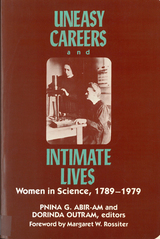
An international group of historians of science discuss a wide range of European and American women scientists--from early nineteenth-century English botanists to Marie Curie to the twentieth-century theoretical biologist, Dorothy Wrinch.
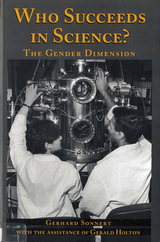
Why don’t more women become scientists? And why do those who do become scientists often face more difficulties than their male counterparts? Every year, about a quarter of a million young men and women in the United States receive their first academic degree in science, mathematics, or engineering. A small fraction will eventually become research scientists. But many who start out with that goal fail to reach it––for reasons that may have less to do with their scientific ability than with their gender.
Drawing on a wealth of information (699 questionnaires and 200 interviews) from men and women who gave every promise of scientific achievement, Gerhard Sonnert and Gerald Holton illuminate the partly gender-driven dynamics of “the leaky scientific pipeline.” At the heart of this book are gripping personal life stories of ten women and ten men: half became highly successful scientists, the rest left research science. In their own voices, they talk candidly about their career paths, the obstacles and assists they encountered, the difficulties and rewards of attempting to combine a family life with a science career.
This highly readable analysis of the gender dimension in scientific careers––and its clear-headed advice––will be of great interest to everyone considering a career in science as well as to teachers, parents, and active scientists. Academics in sociology of science and gender studies as well as decision-makers in the areas of human resources and science policy will also welcome its discussions of general issues and policy recommendations.
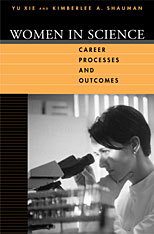
Why do so few women choose a career in science--even as they move into medicine and law in ever-greater numbers? In one of the most comprehensive studies of gender differences in science careers ever conducted, Women in Science provides a systematic account of how U.S. youth are selected into and out of science education in early life, and how social forces affect career outcomes later in the science labor market.
Studying the science career trajectory in its entirety, the authors attend to the causal influences of prior experiences on career outcomes as well as the interactions of multiple life domains such as career and family. While attesting to the progress of women in science, the book also reveals continuing gender differences in mathematics and science education and in the progress and outcomes of scientists' careers. The authors explore the extent and causes of gender differences in undergraduate and graduate science education, in scientists' geographic mobility, in research productivity, in promotion rates and earnings, and in the experience of immigrant scientists. They conclude that the gender gap in parenting responsibilities is a critical barrier to the further advancement of women in science.
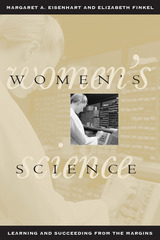
Women's Science offers a dramatic counterpoint not only to these findings but also to the related, narrow assumption that "real science" only occurs in research and laboratory investigation. This book describes women engaged with science or engineering at the margins: an innovative high school genetics class; a school-to-work internship for prospective engineers, an environmental action group, and a nonprofit conservation agency. In these places—where people use or rely on science for public, social, or community purposes—the authors found a remarkably high proportion of women. Moreover, these women were successful at learning and using technical knowledge, they advanced in roughly equal percentages to men, and they generally enjoyed their work.
Yet, even in these more marginal workplaces, women had to pay a price. Working outside traditional laboratories, they enjoy little public prestige and receive significantly less financial compensation. Although most employers claimed to treat men and women equally, women in fact only achieved success when they acted like male professionals.
Women's Science is an original and provocative contribution that expands our conception of scientific practice as it reconfigures both women's role in science and the meaning of science in contemporary society.
READERS
Browse our collection.
PUBLISHERS
See BiblioVault's publisher services.
STUDENT SERVICES
Files for college accessibility offices.
RECENTLY PUBLISHED




UChicago Accessibility Resources
home | accessibility | search | about | contact us
BiblioVault ® 2001 - 2024
The University of Chicago Press