front cover of Adolescent Relations with Mothers, Fathers and Friends
Adolescent Relations with Mothers, Fathers and Friends
James Youniss and Jacqueline Smollar
University of Chicago Press, 1987
After interviews with teenagers, Youniss and Smollar find that, though adolescents seek independence from the parent-child bond, they do not abandon the relationship.

"A must for anyone interested in adolescent behavior."—Edward Z. Dager, Contemporary Sociology
[more]

front cover of The Age of Sex
The Age of Sex
Custom, Law, and Ritual in Twentieth-Century East Africa
Corrie Decker
University of Wisconsin Press, 2025
As in much of the world, societies in precolonial East Africa—what is now Kenya, Tanzania, and Uganda—used rites of passage to chart an individual’s social and developmental progress toward adulthood. Under European colonialism, from the 1890s to the 1960s, colonial judicial systems and the emerging genre of ethnography converged to subject African people to standardized definitions of childhood and adulthood. The coexistence of rites of passage and chronological age regulations generated confusion well into the postcolonial era, and the question of when childhood ends sparked extensive debates about gender, race, and development. Corrie Decker argues that ultimately these debates came down to “the age of sex.”

In The Age of Sex, Decker demonstrates how maturation became defined as the hypothetical moment when a girl becomes a woman capable of engaging in heterosexual activity and a boy becomes a man imbued with the right and responsibility to have heterosexual intercourse. Colonial ethnographic studies reduced complex precolonial rites of passage to “puberty rites” fixated on these sexual transformations. The resulting stereotypes influenced, in turn, how colonial and postcolonial court officials decided age-of-consent and other sex crime cases. Court rituals thus legally transformed girls into women by ruling on their sexual maturity and boys into men by sentencing them to corporal punishment, marking their acceptance of heterosexual responsibilities.
[more]

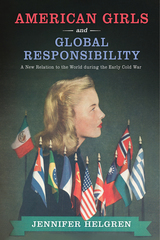
front cover of American Girls and Global Responsibility
American Girls and Global Responsibility
A New Relation to the World during the Early Cold War
Helgren, Jennifer
Rutgers University Press, 2017
American Girls and Global Responsibility brings together insights from Cold War culture studies, girls’ studies, and the history of gender and militarization to shed new light on how age and gender work together to form categories of citizenship.
 
Jennifer Helgren argues that a new internationalist girl citizenship took root in the country in the years following World War II in youth organizations such as Camp Fire Girls, Girl Scouts, YWCA Y-Teens, schools, and even magazines like Seventeen. She shows the particular ways that girls’ identities and roles were configured, and reveals the links between internationalist youth culture, mainstream U.S. educational goals, and the U.S. government in creating and marketing that internationalist girl, thus shaping the girls’ sense of responsibilities as citizens. 
[more]

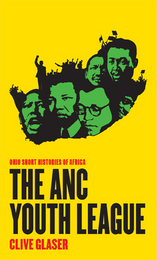
front cover of The ANC Youth League
The ANC Youth League
Clive Glaser
Ohio University Press, 2012

This brilliant little book tells the story of the African National Congress (ANC) Youth League from its origins in the 1940s to the present and the controversies over Julius Malema and his influence in contemporary youth politics. Glaser analyzes the ideology and tactics of its founders, some of whom (notably Nelson Mandela and Oliver Tambo) later became iconic figures in South African history as well as inspirational figures such as A. P. Mda (father of author Zakes Mda) and Anton Lembede. It shows how the early Youth League gave birth not only to the modern ANC but also to its rival, the Pan Africanist Congress. Dormant for many years, the Youth League reemerged in the transition era under the leadership of Peter Mokaba—infused with the tradition of the militant youth politics of the 1980s. Throughout its history the Youth League has tried to “dynamize” and criticize the ANC from within, while remaining devoted to the mother body and struggling to find a balance between loyalty and rebellion.

[more]

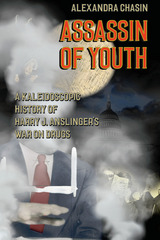
front cover of Assassin of Youth
Assassin of Youth
A Kaleidoscopic History of Harry J. Anslinger’s War on Drugs
Alexandra Chasin
University of Chicago Press, 2016
Commissioner of the Federal Bureau of Narcotics from its establishment in 1930 until his retirement in 1962, Harry J. Anslinger is the United States’ little known first drug czar. Anslinger was a profligate propagandist with a flair for demonizing racial and immigrant groups and perhaps best known for his zealous pursuit of harsh drug penalties and his particular animus for marijuana users. But what made Anslinger who he was, and what cultural trends did he amplify and institutionalize? Having just passed the hundredth anniversary of the Harrison Act—which consolidated prohibitionist drug policy and led to the carceral state we have today—and even as public doubts about the drug war continue to grow, now is the perfect time to evaluate Anslinger’s social, cultural, and political legacy.

In Assassin of Youth, Alexandra Chasin gives us a lyrical, digressive, funny, and ultimately riveting quasi-biography of Anslinger. Her treatment of the man, his times, and the world that arose around and through him is part cultural history, part kaleidoscopic meditation. Each of the short chapters is anchored in a historical document—the court decision in Webb v. US (1925), a 1935 map of East Harlem, FBN training materials from the 1950s, a personal letter from the Treasury Department in 1985—each of which opens onto Anslinger and his context. From the Pharmacopeia of 1820 to death of Sandra Bland in 2015, from the Pennsylvania Railroad to the last passenger pigeon, and with forays into gangster lives, CIA operatives, and popular detective stories, Chasin covers impressive ground. Assassin of Youth is as riotous and loose a history of drug laws as can be imagined—and yet it culminates in an arresting and precise revision of the emergence of drug prohibition.

Today, even as marijuana is slowly being legalized, we still have not fully reckoned with the racist and xenophobic foundations of our cultural appetite for the severe punishment of drug offenders. In Assassin of Youth, Chasin shows us the deep, twisted roots of both our love and our hatred for drug prohibition.

[more]


Send via email Share on Facebook Share on Twitter