front cover of Safed, Zionist Culture, and Jewish History
Safed, Zionist Culture, and Jewish History
Toward a New Historical Perspective
Amnon Raz-Krakotzkin
Brandeis University Press, 2026

Brings the legacy of sixteenth-century Safed into modern scholarship on Zionism to propose a new model of Jewish existence.

Sixteenth-century Safed was one of the most important centers of thought and learning in Jewish history, yet Zionist historical narratives, which emphasize the continuity of Jewish presence in Palestine, have consistently downplayed or ignored it. Amnon Raz-Krakotzkin investigates this strange contradiction. His new book argues that Safed articulates a model of early modern Jewish national revival, one closely connected to the land and its material geography, yet radically different from the Zionist model that emerged in the late nineteenth century. While Zionism set out to restore Biblical Jewish sovereignty, rabbinic Safed’s emphasis on the Mishnah proposed a non-sovereign Jewish connection to the land.

As much a polemic as a historical and theological analysis, Safed, Zionist Culture, and Jewish History offers a provocative new perspective on questions related to nationalism, Judaism, and Israel.


[more]

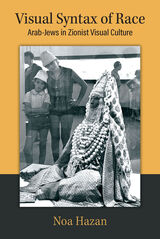
front cover of Visual Syntax of Race
Visual Syntax of Race
Arab-Jews in Zionist Visual Culture
Noa Hazan
University of Michigan Press, 2022

Analyzing the visual syntax and display rhetoric applied in newspaper photos, national historical albums, and museum exhibitions, Noa Hazan shows that although racial thought was and still is verbally suppressed in Israel, it is vividly present in its nonverbal official and public visual sphere. The racist perspective of newspaper editors, book publishers, photographers, and museum curators were morally justified in its time by such patronizing ideals as realistic news coverage or the salvation of Jewish heritage assets. Although their perspectives played a dominant role in establishing a visual syntax of race in Israel, they were not seen as racially discriminating at the time. The racist motifs and actions are revealed here by colligating multiple cases into a coherent narrative in retrospect. 

This book points to a direct influence of the anti-Semitic discourse in Europe toward Mizrahim in Israel, highlighting the shared visual stereotypes used in both Europe and the fledgling state of Israel. Engraved in their body, these cultural traits were depicted and understood as racial-biological qualities and were visually manipulated to silo Ashkenazim and Mizrahim in Israel as distinct racial types. 

[more]


Send via email Share on Facebook Share on Twitter