
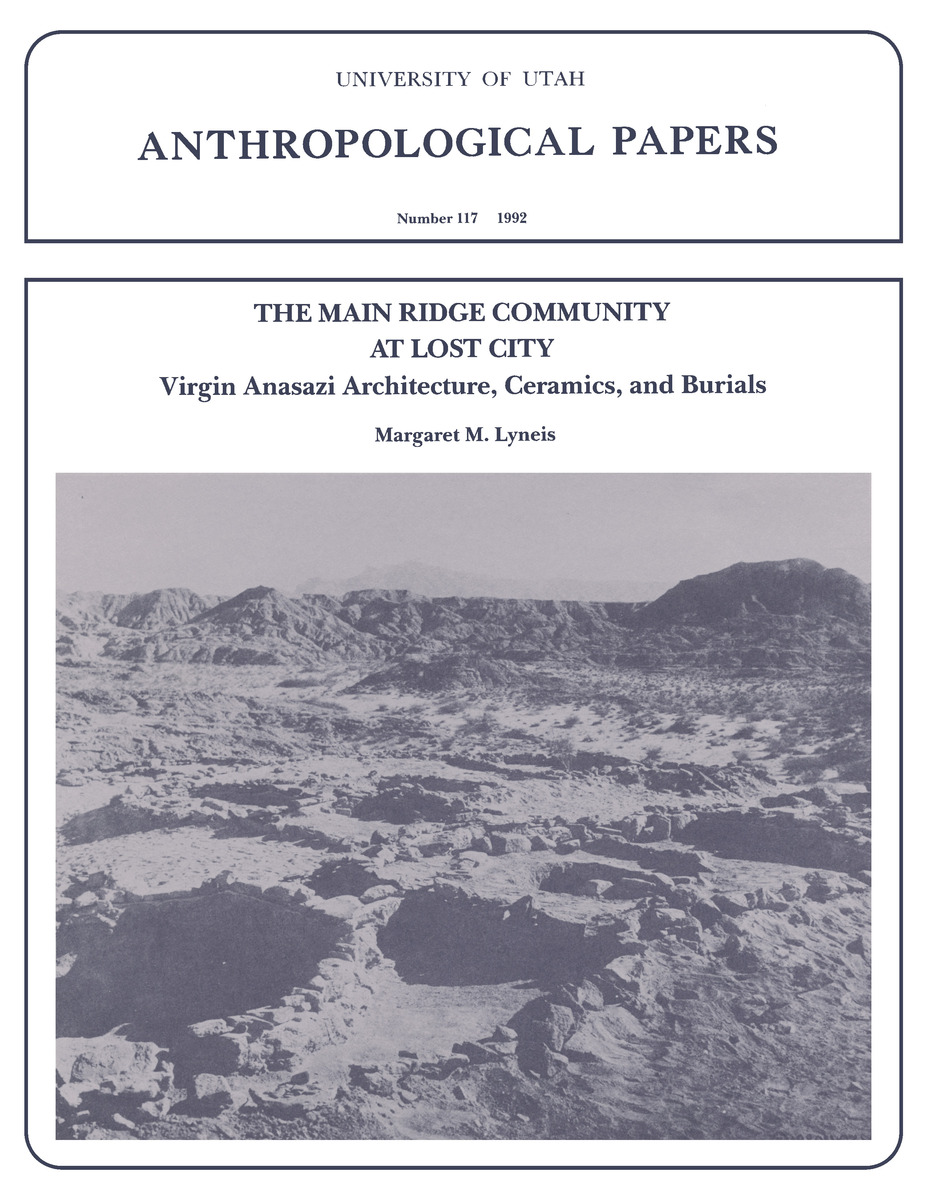
Main Ridge Community At Lost City: Virgin Anazazi Architecture, Ceramics, and Burials
by Margaret Lyneis
University of Utah Press, 1992
Paper: 978-0-87480-411-9
Library of Congress Classification E99.P9L98 1992
Dewey Decimal Classification 979.313
TOC
- Contents
- Figures
- Tables
- Acknowledgments
- Chapter 1.
- Introduction
- History of Lost City Investigations
- Mark Raymond Harrington and Lost City
- Subsequent Study of Lost City
- Regional Chronology
- Main Ridge: The Site and Its Setting
- Sites and Houses
- Recent Work at Main Ridge
- A Framework for Analysis
- Chapter 2.
- Site Layout and Architecture
- Site Layout
- The Houses
- Construction Materials and Techniques
- Interior Facilities
- House Layouts
- Rooms
- Room Sizes
- Fireplaces
- Floors
- A Functional Classification of Rooms
- The Composition of Houses
- Habitation/Storage Ratios
- Evidence of Social Organization and Integration
- Chronology and Superposition
- Summary and Discussion
- Chapter 3.
- Ceramics: Questions of Contemporaneity of Structures and Burials
- Classification of the Pottery
- Tusayan Gray Ware, Virgin Series
- Tusayan White Ware, Virgin Series
- Logandale Gray Ware
- Moapa Gray Ware
- Shivwits Plain
- Red Wares
- Tsegi Orange Ware
- San Juan Red Ware
- Sand-Tempered Red Ware
- Ceramic Chronology
- Wares
- Surface Treatment (Corrugated)
- Jar Rim Form
- Design Styles and Elements
- Black Mesa Analogues (St. George Style)
- Sosi/Dogoszhi Analogues (North Creek Style)
- Outline of a Pueblo II Ceramic Chronology for the Moapa Valley
- Burial Chronology
- The Sherd Collections
- Summary and Discussion
- Chapter 4.
- Variability in Main Ridge Ceramics
- Tusayan Gray and White Wares
- Implications for Ceramic Production
- Implications for Analytic Methods
- Moapa Gray Ware
- Shivwits Plain
- Shivwits Plain: Description
- Shivwits Plain Vessel Forms
- A Comparison of the Gray Ware Vessels Represented by Sherds
- Estimate Interior Orifice Diameters
- Rim Forms
- Differences between the Suites of Pottery Represented by the Three Wares
- A Comparison of Black-on-Gray Bowl Sherds of Tusayan White Ware and Moapa Gray Ware
- Paste Texture
- Firing Cores
- Size and Quantity of Temper
- Paste Colors
- Thickness
- Design Elements
- Rim Elements
- Other Elements
- Observations Regarding Black-on-Gray Jars.
- Explanations for Contrasts between Designs on Tusayan White Ware and Painted Moapa Gray Ware from Main Ridge
- Comparison of Design Elements, Main Ridge and Adam 2: Implications for Ceramic Chronology
- Black Mesa Black-on-White and the Problem of Other Black-on-White and Black-on-Gray Trade Wares
- Red Wares
- Painted Designs on Red Wares and Their Chronological Implications
- Dimensional Characteristics of Whole Vessels
- Summary
- Chapter 5.
- The Burials and Their Associations
- Mortuary Practices
- Age and Gender of the Individuals
- Locations of the Burials
- Burial Position
- Burial Orientation
- Quantity and Kinds of Grave Goods
- Social Differentiation
- Burials and the Presence of Unused Rooms
- Summary and Discussion
- Chapter 6.
- Local Products and Nonlocal Goods
- Materials with Extra-Local Origins
- Minerals and Artifacts Made from Minerals
- Selenite and Gypsum
- Magnesite and “Kaolinite”
- Turquoise
- Copper Ore
- Marine Shell Beads and Ornaments
- Ceramics
- Foods and Textiles
- Foods
- Cotton and Textiles
- Summary and Discussion
- Chapter 7.
- A Summary of Main Ridge
- Chapter 8.
- The Far Western Anasazi, a.d. 1050–1200
- The Moapa Valley in Mid-to-Late Pueblo II Times: Issues of Subsistence, Sedentism, and Settlement Pattern
- Subsistence
- Sedentism
- Settlement Patterns and Site Hierarchy in the Moapa Valley
- Issues in Organization and Interaction within and beyond the Virgin Anasazi in Mid-to-Late Pueblo II Times
- Moapa Valley Salt and Turquoise Production
- Regional Linkages
- Regional Settlement Pattern and Site Hierarchy
- Kivas and Kayenta-Style Architecture
- Change and Abandonment
- Literature Cited
See other books on: Ceramics | Funeral customs and rites | Nevada | Pueblo Indians | Social archaeology
See other titles from University of Utah Press