
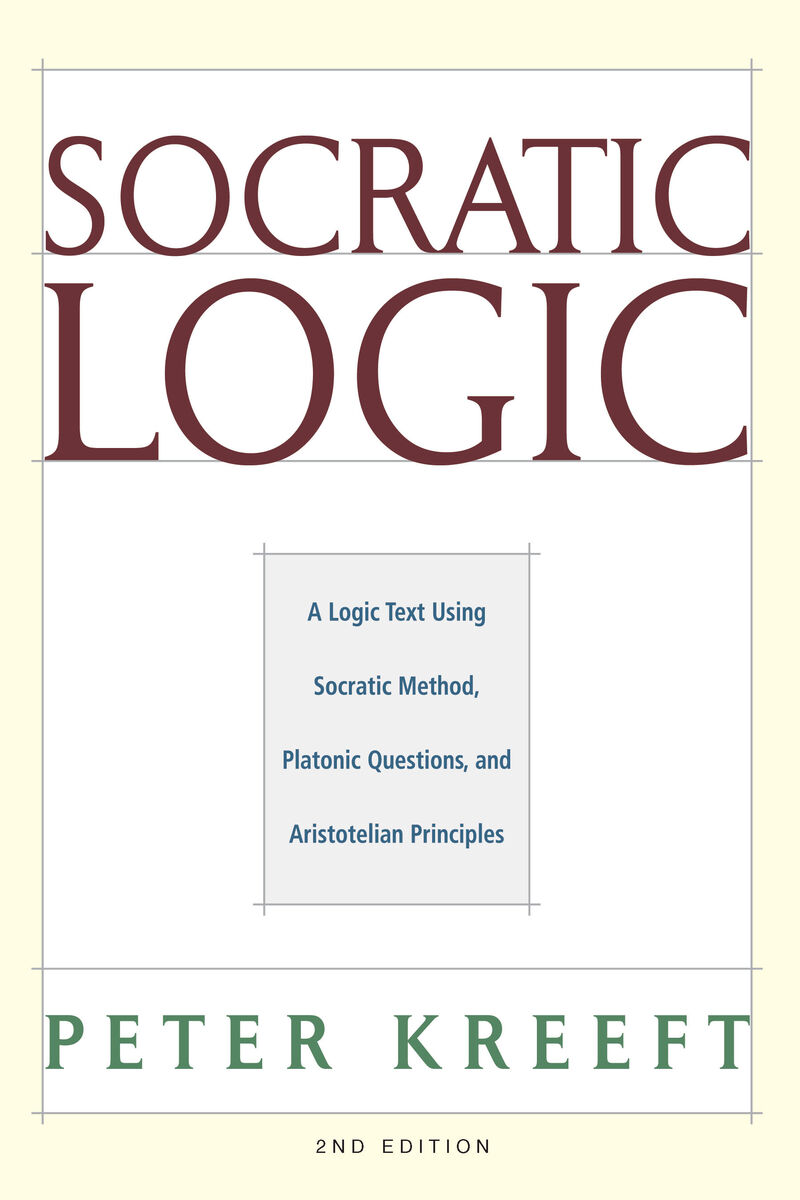
Socratic Logic 2e paper
by Peter Kreeft
St. Augustine's Press, 2005
Cloth: 978-1-58731-800-9 | Paper: 978-1-58731-806-1
Library of Congress Classification BC108.K67 2005
Dewey Decimal Classification 160
TOC
Contents
PREFACE	ix
INTRODUCTION	1
	1. What good is logic?	1
	2. Seventeen ways this book is different	9
	3. The two logics (P)*	15
	4. All of logic in two pages: an overview (B)*	26
	5. The three acts of the mind (B)	28
I. THE FIRST ACT OF THE MIND: UNDERSTANDING	35
	1. Understanding: the thing that distinguishes man from
 both beast and computer (P)	35
	2. Concepts, terms and words (P)	40
	3. The ¿problem of universals¿ (P)	41
	4. The comprehension and extension of terms (B)	43
II. TERMS	47
	1. Classifying terms	47
	2. Categories (P)	54
	3. Predicables (B)	56
	4. Division (B)	62
III. MATERIAL FALLACIES	68
	1. Fallacies of language	71
	2. Fallacies of diversion	80
	3. Fallacies of oversimplification	86
	4, Fallacies of argumentation	92
	5. Inductive fallacies	100
	6, Procedural fallacies	104
	7. Metaphysical fallacies 	109
	8. Short Story: ¿Love Is a Fallacy¿	114
IV. DEFINITION 	123
	1. The nature of definition (B)	123
	2. The rules of definition (B)	124
	3. The kinds of definition	124
	4, The limits of definition	129
V. SECOND ACT OF THE MIND: JUDGMENT	138
	1. Judgments, propositions, and sentences	138
	2. What is truth? (P) 	143
	3. The four kinds of categorical propositions (B)	145
	4. Logical form (B)	147
	5. Euler¿s circles	152
	6. Tricky propositions	153
	7. The distribution of terms	163
VI. CHANGING PROPOSITIONS	166
	1. Immediate inference	166
	2. Conversion (B)	167
	3. Obversion (B)	170
	4. Contraposition	171
VII. CONTRADICTION	173
	1. What is contradiction? (B)	173
	2. The Square of Opposition (B)	174
	3. Existential import (P)	179
	4. Tricky propositions on the Square	181
	5. Some practical uses of the Square of Opposition	183
VIII. THE THIRD ACT OF THE MIND: REASONING	186
	1. What does ¿reason¿ mean? (P)	186
	2. The ultimate foundations of the syllogism (P)	187
	3. How to detect arguments	190
	4. Arguments vs. explanations	193
	5. Truth and validity	194
IX. DIFFERENT KINDS OF ARGUMENTS	200
	1. Three meanings of ¿because¿	200
	2. The four causes (P)	202
	3. A classification of arguments	205
	4. Simple argument maps (B)	206
	5. Deductive and inductive arguments (B)	210
	6. Combining deduction and induction: Socratic method (P)	211
X. SYLLOGISMS	215
	1. The structure and strategy of the syllogism (B)	215
	2. The skeptic¿s objection to the syllogism (P)	219
	3. The empiricist¿s objection to the syllogism (P)	222
	4. Demonstrative syllogisms	230
	5. How to construct convincing syllogisms (B)	232
XI. CHECKING SYLLOGISMS FOR VALIDITY	237
	1. By Euler¿s Circles (B)	237
	2. By Aristotle¿s six rules (B)	242
	3. ¿Barbara Celarent¿: mood and figure	257
	4. Venn Diagrams 	258
XII. MORE DIFFICULT SYLLOGISMS 	264
	1. Enthymemes: abbreviated syllogisms (B)	264
	2. Sorites: chain syllogisms	275
	3. Epicheiremas: multiple syllogisms (B)	279
	4. Complex argument maps 	282
XIII. COMPOUND SYLLOGISMS	289
	1. Hypothetical syllogisms (B)	289
	2. ¿Reductio ad absurdum¿ arguments	294
	3. The practical syllogism: arguing about means and ends	296
	4. Disjunctive syllogisms (B)	301
	5. Conjunctive syllogisms (B)	303
	6. Dilemmas (B)	306
XIV. INDUCTION	313
	1. What is induction?	313
	2. Generalization 	315
	3. Causal induction: Mill¿s methods 	319
	4. Scientific hypotheses 	325
	5. Statistical probability	328
	6. Arguments from analogy 	329
	7. A fortiori and a minore arguments	335
XV. SOME PRACTICAL APPLICATIONS OF LOGIC	342
	1. How to write a logical essay	342
	2. How to write a Socratic dialogue	344
	3. How to have a Socratic debate	347
	4. How to use Socratic method on difficult people	350
	5. How to read a book Socratically	356
XVI. SOME PHILOSOPHICAL APPLICATIONS OF LOGIC 	358
	1. Logic and theology (P)	358
	2. Logic and metaphysics (P)	359
	3. Logic and cosmology (P)	360
	4. Logic and philosophical anthropology (P)	360
	5. Logic and epistemology (P)	362
	6. Logic and ethics (P)	362
APPENDIX: SOME PROBLEMS WITH MODERN LOGIC	364
	1. Basic modern logic	364
	2. The paradoxes of material implication	366
	3. Responses to the paradoxes of material implication	367
ANSWERS TO EVEN-NUMBERED EXERCISES	370
INDEX OF PRINCIPAL NAMES	398
See other titles from St. Augustine's Press