Results by title
4917 books match the query 'Philosophy' and 406 start with a
A Basic Christian Theology
A. J. Conyers
St. Augustine's Press, 2019
A. J. Conyers was an evangelical, Baptist theologian who helped found Truett Seminary at Baylor university. Conyers’s theology drank deeply from the wells of the Christian tradition. In this volume, he provides what he found to be the most basic elements of Christian theology and demonstrates a methodology that is biblically informed, traditionally grounded, and contextually aware. this revised edition makes this excellent work available again, with some modified study questions, additional unpublished material from Conyers’s archives, and helpful reflection and tributes from two of Conyers’s best students—Brian Brewer and Brad Green—who carry on his legacy

A Book of Consolation
Seeing Our Quests for Love, Success, and Meaning in a New LightAndrew Stark
University of Chicago Press, 2027
An invitation to rest in the mystery that there is no single route to fulfillment, but many—often contradictory, unpredictable, endlessly available.
Our lives are restless. Though we strive for meaning, we are often unfulfilled: our loves fail, our careers stall, and our purpose eludes us. We may temporarily ease our frustration by blaming our methods or embracing our limitations, and we may even embrace the self-defeating lie that we must discover the one, linear path for success in love, work, or life. In A Book of Consolation, Andrew Stark offers a liberating third way between self-abandonment and complacency, revealed through a simple mystery: for each road where someone found fulfillment, someone else walked the opposite path to the same end.
Drawing on literature, popular culture, philosophy, and more, A Book of Consolation invites us to appreciate, even marvel at, the possibility that the routes to love, success, and meaning are so various that even inverse lives can satisfy us. Stark holds up a series of opposing journeys for consideration—from the contradictory loves in modern romantic comedies, to the regrets of Dolly Parton and Ernest Hemingway, to the mindsets behind Tiger Woods and Richard Nixon’s success. In juxtaposing these lives, Stark expands our sense of what counts as fulfillment and what alternatives may be available when our own paths falter. Rich in possibility but without prescription, A Book of Consolation encourages us to navigate the frustrations of our finitude by cultivating a faith that the paths to fulfillment are far more pluralized—and often more contradictory—than we know.
A Book of Waves
Stefan Helmreich
Duke University Press, 2023
A Brief Apology for a Catholic Moment
Jean-Luc Marion
University of Chicago Press, 2021
A Clearing in the Forest
Law, Life, and MindSteven L. Winter
University of Chicago Press, 2001
Drawing on work in philosophy, psychology, anthropology, linguistics, and literary theory, Steven L. Winter has created nothing less than a tour de force of interdisciplinary analysis. A Clearing in the Forest rests on the simple notion that the better we understand the workings of the mind, the better we will understand all its products-especially law. Legal studies today focus on analytic skills and grand normative theories. But, to understand how real-world, legal actors reason and decide, we need a different set of tools. Cognitive science provides those tools, opening a window on the imaginative, yet orderly mental processes that animate thinking and decisionmaking among lawyers, judges, and lay persons alike. Recent findings about how humans actually categorize and reason make it possible to explain legal reasoning in new, more cogent, more productive ways.
A Clearing in the Forest is a compelling meditation on both how the law works and what it all means. In uncovering the irrepressibly imaginative, creative quality of human reason, Winter shows how what we are learning about the mind changes not only our understanding of law, but ultimately of ourselves. He charts a unique course to understanding the world we inhabit, showing us the way to the clearing in the forest.
A Commentary on Cicero, De Officiis
Andrew R. Dyck
University of Michigan Press, 1997
Composed in haste shortly before Cicero's death, de Officiis has exercised enormous influence over the centuries. It is all the more surprising that Andrew R. Dyck's volume is the first detailed English commentary on the work written in this century. It deals with the problems of the Latin text (taking account of Michael Winterbottom's new edition), it delineates the work's structure and sometimes elusive train of thought, clarifies the underlying Greek and Latin concepts, and provides starting points for approaching the philosophical and historical problems that de Officiis raises.
A work of major importance for classicists, philosophers, and ancient historians, this Commentary will be an invaluable companion to all readers of Cicero's last philosophical work.
Andrew R. Dyck is Professor of Classics, University of California, Los Angeles.
Publication of this volume is supported by a grant from the National Endowment for the Humanities.
A Commentary on Jean-Paul Sartre's Being and Nothingness
Joseph S. Catalano
University of Chicago Press, 1985
A Commentary on Jean-Paul Sartre's Critique of Dialectical Reason, Volume 1, Theory of Practical Ensembles
Joseph S. Catalano
University of Chicago Press, 1986
A Commentary on Kant's Critique of Practical Reason
Lewis White Beck
University of Chicago Press, 1996
This Critique is the only writing in which Kant weaves his thoughts on practical reason into a unified argument. Lewis White Beck offers a classic examination of this argument and expertly places it in the context of Kant's philosophy and of the moral philosophy of the eighteenth century.
A Commentary on Plato's Meno
Jacob Klein
University of Chicago Press, 1989
"A major addition to the literature on the Meno and necessary reading for every student of the dialogue."—Alexander Seasonske, Philosophical Review
"There exists no other commentary on Meno which is so thorough, sound, and enlightening."—Choice
Jacob Klein (1899-1978) was a student of Martin Heidegger and a tutor at St. John's College from 1937 until his death. His other works include Plato's Trilogy: Theaetetus, the Sophist, and the Statesman, also published by the University of Chicago Press.
A Common Human Ground
Universality and Particularity in a Multicultural WorldClaes G. Ryn
University of Missouri Press, 2019
A Companion to Ancient Philosophy
Edited and with an introduction by Sean D. Kirkland and Eric Sanday
Northwestern University Press, 2018
Rather than offering synoptic and summary treatments of preestablished positions and themes, these essays engage with the ancient texts directly, focusing attention on concepts that emerge as urgent in the readings themselves and then clarifying those concepts interpretively. Indeed, this is a companion volume that takes a very serious and considered approach to its designated task—accompanying readers as they move through the most crucial passages of the infinitely rich and compelling texts of the ancients. Each essay provides a tutorial in close reading and careful interpretation.
Because it offers foundational treatments of the most important works of ancient philosophy and because it, precisely by doing so, arrives at numerous original interpretive insights and suggests new directions for research in ancient philosophy, this volume should be of great value both to students just starting off reading the ancients and to established scholars still fascinated by philosophy's deepest abiding questions.
A Companion to John Dewey's "Democracy and Education"
D. C. Phillips
University of Chicago Press, 2016
Phillips bridges several critical pitfalls of Democracy and Education that often prevent contemporary readers from fully understanding it. Where Dewey sorely needs a detailed example to illustrate a point—and the times are many—Phillips steps in, presenting cases from his own classroom experiences. Where Dewey casually refers to the works of people like Hegel, Herbart, and Locke—common knowledge, apparently, in 1916—Phillips fills in the necessary background. And where Dewey gets convoluted or is even flat-out wrong, Phillips does what few other scholars would do: he takes Dewey to task. The result is a lively accompaniment that helps us celebrate and be enriched by some of the most important ideas ever offered in education.
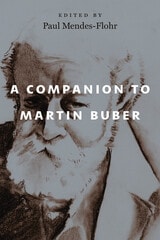
A Companion to Martin Buber
Edited by Paul Mendes-Flohr
University of Chicago Press, 2025
In his 1923 essay, I and Thou, the philosopher, theologian, and activist Martin Buber introduced a philosophy of dialogue that achieved a global, interdisciplinary resonance. For Buber, dialogue was more than a conversation; dialogue discloses something essential about our orientation and our lives with one another. This companion assembles twenty-six scholars from a dozen countries to explore Buber’s international reputation and legacy in education, interfaith relations, Judaism, philosophy, politics, and psychology. The result is an essential guide to one of the most influential Jewish thinkers of the twentieth century.
A Contemporary Introduction to Thomistic Metaphysics
Michael Gorman
Catholic University of America Press, 2023
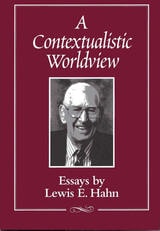
A Contextualistic Worldview
Essays by Lewis E. HahnLewis E. Hahn
Southern Illinois University Press, 2001
This selection of articles by Lewis E. Hahn addresses the philosophical school of contextualism and four contemporary American philosophers: John Dewey, Henry Nelson Wieman, Stephen C. Pepper, and Brand Blanshard.
Stressing the relatively recent contextualistic worldview, which he considers one of the best world hypotheses, Hahn seeks to achieve a broad perspective within which all things may be given their due place. After providing a brief outline, Hahn explains contextualism in relation to other philosophies. In his opening chapter, as in later chapters, he expresses contextualism as a form of pragmatic naturalism. In spite of Hahn’s high regard for contextualism, however, he does not think it would be good if we were limited to a single worldview. “The more different views we have and the more different sources of possible light we have, the better our chances that some of these cosmic maps will shed light on our world and our place in it.”
A Course on Perception
1964-1965Gilbert Simondon
University of Minnesota Press, 2027
The first English translation of Gilbert Simondon’s wide-ranging course on the philosophical and scientific histories of perception
Translated into English for the first time, Gilbert Simondon’s A Course on Perception: 1964–1965 engages in a wide-ranging inquiry into the structure, operation, and activity of perception. Investigating its history throughout the centuries, Simondon shows how perception continually shapes and is reshaped by various strands of philosophical and scientific thought.
Prior to the advent of the natural sciences, perception functioned as the foundation of philosophical reflection and the sole instrument for acquiring knowledge and truth. Tracing his subject from these roots in antiquity, Simondon’s course draws on the work of other prominent philosophers such as Spinoza, Berkeley, Hume, and Bergson to follow the evolving trajectory of perception in the wake of classical Cartesian rationalism. As the realms of biology, physiology, and positivism in the natural sciences emerged with the Modern epoch, perception became a necessary theoretical starting point for philosophical investigations of an organism’s relation to its particular milieu.
Emerging from a course delivered at the Sorbonne in Paris between 1964 and 1965, Simondon utilizes a transdisciplinary approach to better understand the sensitivities that various life forms use to orient themselves in the world, offering a nuanced examination of perception in all its philosophical complexity.
Retail e-book files for this title are screen-reader friendly with images accompanied by short alt text and/or extended descriptions.
A Decent Life
Morality for the Rest of UsTodd May
University of Chicago Press, 2019
In a world full of suffering and deprivation, it’s easy to despair—and it’s also easy to judge ourselves for not doing more. Even if we gave away everything we own and devoted ourselves to good works, it wouldn’t solve all the world’s problems. It would make them better, though. So is that what we have to do? Is anything less a moral failure? Can we lead a fundamentally decent life without taking such drastic steps?
Todd May has answers. He’s not the sort of philosopher who tells us we have to be model citizens who display perfect ethics in every decision we make. He’s realistic: he understands that living up to ideals is a constant struggle. In A Decent Life, May leads readers through the traditional philosophical bases of a number of arguments about what ethics asks of us, then he develops a more reasonable and achievable way of thinking about them, one that shows us how we can use philosophical insights to participate in the complicated world around us. He explores how we should approach the many relationships in our lives—with friends, family, animals, people in need—through the use of a more forgiving, if no less fundamentally serious, moral compass. With humor, insight, and a lively and accessible style, May opens a discussion about how we can, realistically, lead the good life that we aspire to.
A philosophy of goodness that leaves it all but unattainable is ultimately self-defeating. Instead, Todd May stands at the forefront of a new wave of philosophy that sensibly reframes our morals and redefines what it means to live a decent life.
A Defense of Judgment
Michael W. Clune
University of Chicago Press, 2021
Michael W. Clune’s provocative book challenges these objections to judgment and offers a positive account of literary studies as an institution of aesthetic education. It is impossible, Clune argues, to separate judgments about literary value from the practices of interpretation and analysis that constitute any viable model of literary expertise. Clune envisions a progressive politics freed from the strictures of dogmatic equality and enlivened by education in aesthetic judgment, transcending consumer culture and market preferences. Drawing on psychological and philosophical theories of knowledge and perception, Clune advocates for the cultivation of what John Keats called “negative capability,” the capacity to place existing criteria in doubt and to discover new concepts and new values in artworks. Moving from theory to practice, Clune takes up works by Keats, Emily Dickinson, Gwendolyn Brooks, Samuel Beckett, and Thomas Bernhard, showing how close reading—the profession’s traditional key skill—harnesses judgment to open new modes of perception.
A Deleuzian Century?
Ian Buchanan, ed.
Duke University Press, 1999
Originally published as a special issue of South Atlantic Quarterly (Summer 1997), this volume includes essays from some of the most prominent American, Australian, British, and French scholars and translators of Deleuze’s writing. These essays, ranging from film, television, art, and literature to philosophy, psychoanalysis, geology, and cultural studies, reflect the broad interests of Deleuze himself. Providing both an introduction and critique of Deleuze, this volume will engage those readers interested in literary and cultural theory, philosophy, and the future of those areas of study in which Deleuze worked.
Contributors. Ronald Bogue, Ian Buchanan, André Pierre Colombat, Tom Conley, Manuel DeLanda, Tessa Dwyer, Jerry Aline Flieger, Eugene Holland, Fredric Jameson, Jean-Clet Martin, John Mullarkey, D. N. Rodowick, Horst Ruthrof, Charles J. Stivale
A Democracy of Distinction
Aristotle and the Work of PoliticsJill Frank
University of Chicago Press, 2004
Moving back and forth between Aristotle's writings and contemporary legal and political theory, Frank breathes new life into our conceptions of property, justice, and law by viewing them not only as institutions but as dynamic activities as well. Frank's innovative approach to Aristotle stresses his appreciation of the tensions and complexities of politics so that we might rethink and reorganize our own political ideas and practices. A Democracy of Distinction will be of enormous value to classicists, political scientists, and anyone interested in revitalizing democratic theory and practice.
A Democratic Enlightenment
The Reconciliation Image, Aesthetic Education, Possible PoliticsMorton Schoolman
Duke University Press, 2020
A Democratic Theory of Judgment
Linda M. G. Zerilli
University of Chicago Press, 2016
Zerilli deftly outlines the limitations of existing debates, both those that concern themselves with the impossibility of judging across cultures and those that try to find transcendental, rational values to anchor judgment. Looking at Kant through the lens of Arendt, Zerilli develops the notion of a public conception of truth, and from there she explores relativism, historicism, and universalism as they shape feminist approaches to judgment. Following Arendt even further, Zerilli arrives at a hopeful new pathway—seeing the collapse of philosophical criteria for judgment not as a problem but a way to practice judgment anew as a world-building activity of democratic citizens. The result is an astonishing theoretical argument that travels through—and goes beyond—some of the most important political thought of the modern period.
A Democratic Theory of Truth
Linda M. G. Zerilli
University of Chicago Press, 2025
We say that we live in a “post-truth” era because disinformation threatens our confidence in the existence of a shared public world. Affirming objective truth may, therefore, seem necessary to save democracy. According to political theorist Linda M. G. Zerilli, such affirmation can stifle political debate and silence dissent. In fact, Zerilli argues that the unqualified insistence on objective truth is as dangerous for democracy as denying it.
Drawing on Arendt, Foucault, and Wittgenstein, A Democratic Theory of Truth challenges the concept of truth presupposed by the post-truth debate. It argues that we, the people, have an essential role in discovering and evaluating any truth relevant to the political realm. The result is a striking defense of plurality, dissent, and opinion in contemporary democratic societies.
A Dialogue between a Philosopher and a Student of the Common Laws of England
Thomas Hobbes
University of Chicago Press, 1997
"Hobbes students are indebted to Professor Cropsey for this scholarly and accessible edition of Dialogue."—J. Roland Pennock, American Political Science Review
"An invaluable aid to the study of Hobbes."—Review of Metaphysics
A Dictatorship of Relativism ?
Symposium in Response to Cardinal Ratzinger’s Last Homily, Volume 13Jeffrey M. Perl, ed.
Duke University Press, 0
One essay relates the arguments of Ratzinger to those of two other German scholars—the conservative political theorist Ernst Wolfgang Böckenförde and the liberal philosopher and sociologist Jürgen Habermas—since all three men assume that social order depends on the existence of doctrinal authority (divine or otherwise). The contributors here argue for an intellectual and social life free of the desire for an “infantilizing” authority. One proposes that the Christian god is a relativist who prefers limitation and ambiguity; another, initially in agreement with Ratzinger about the danger relativism poses to faith and morals, then argues that this danger is what makes relativism valuable. The issue closes with the first English translation of an extract from a book on Catholic-Jewish relations by Cardinal Carlo Maria Martini, one of the Catholic Church’s most progressive figures.
Contributors. David Bloor, Daniel Boyarin, Mary Baine Campbell, Lorraine Daston, Arnold I. Davidson, John Forrester, Kenneth J. Gergen, Simon Goldhill, Jeffrey F. Hamburger, Julia Kristeva, Carlo Maria Cardinal Martini, Christopher Norris, Joseph Cardinal Ratzinger, Richard Shusterman, Barbara Herrnstein Smith, Jeffrey Stout, Gianni Vattimo
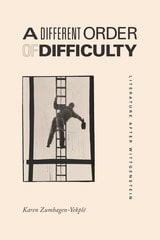
A Different Order of Difficulty
Literature after WittgensteinKaren Zumhagen-Yekplé
University of Chicago Press, 2020
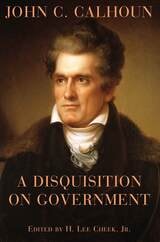
A Disquisition on Government
John C. Calhoun
St. Augustine's Press, 2007
This volume provides the most economical and textually accurate version of Calhoun’s Disquisition available today. As a treatise, the Disquisition is one of the greatest and most enduring works of American politial thought, and a text of seminal importance to all students of American politics, history, philosophy, and law. In the Disquisition, Calhoun believed he had laid a “solid foundation for political science” through revitalizing popular rule. To complete his theoretical and practical mission, Calhoun attempts to explain the best example of the diffusion of authority and cultivation of liberty: the American Constitution. The fundamental law of the American republic provided, after all, the “interior structure” for regulating the shape and scope of government. As a guide for the states and the general government, the Constitution was also part of the “organism” that limited the centralization of authority and allowed for genuine popular rule; and it was Calhoun’s exposition of the connection between the moral demands of a properly constituted concept of popular rule and the need for practical ordering principles that is articulated in this book.
Calhoun presents a theory of politics that is both original and in accord with the mainstream of the American political tradition. More than any other thinker of his period, Calhoun sought to explain the enduring qualities of American political thought in light of the troubled world of the mid-nineteenth century. Unlike other theorists who had preceded and would follow Calhoun, both American and European, he did not seek to invent a new mode of philosophical speculation or a “grand theory” for the human sciences. Instead, he attempted to offer a refinement of classical, medieval, and modern notions regarding the relationship between government and the social order. As an effort in philosophical retrenchment, the Disquisition strengthened many pre-existing conceptions regarding political liberty and popular rule within the American regime, while offering such insight with a view toward the future that awaited America. Calhoun’s attempt in the Disquisition to reconcile the good of popular rule with ethical requirements have singular relevance to the many nations in the twenty-first century now engaged, despite the ethnic animosities threatening their destruction, in building post-ideological, civilized political and social orders, especially the peoples of Central and Eastern Europe, Russia, and Africa.

A Field Guide to a New Meta-field
Bridging the Humanities-Neurosciences DivideEdited by Barbara Maria Stafford
University of Chicago Press, 2011
Barbara Stafford is a pioneering art historian whose research has long helped to bridge the divide between the humanities and cognitive sciences. In A Field Guide to a New Meta-Field, she marshals a distinguished group of thinkers to forge a ground-breaking dialogue between the emerging brain sciences, the liberal arts, and social sciences.
Stafford’s book examines meaning and mental function from this dual experimental perspective. The wide-ranging essays included here—from Frank Echenhofer’s foray into shamanist hallucinogenic visions to David Bashwiner’s analysis of emotion and danceability—develop a common language for implementing programmatic and institutional change. Demonstrating how formerly divided fields are converging around shared issues, A Field Guide to a New Meta-Field maps a high-level, crossdisciplinary adventure from one of our leading figures in visual studies.
A Final Story
Science, Myth, and BeginningsNasser Zakariya
University of Chicago Press, 2017
In A Final Story, Nasser Zakariya delves into the origins and ambitions of these scientific epics, from the nineteenth century to the present, to see what they reveal about the relationship between storytelling, integrated scientific knowledge, and historical method. While seeking to transcend the perspectives of their own eras, the authors of the epics and the debates surrounding them are embedded in political and social struggles of their own times, struggles to which the epics in turn respond. In attempts to narrate an approach to a final, true account, these synthesizing efforts shape and orient scientific developments old and new. By looking closely at the composition of science epics and the related genres developed along with them, we are able to view the historical narrative of science as a form of knowledge itself, one that discloses much about the development of our understanding of and relationship to science over time.

A Foray into the Worlds of Animals and Humans
with A Theory of MeaningJakob von Uexküll
University of Minnesota Press, 2010
A key document in the genealogy of posthumanist thought, A Foray into the Worlds of Animals and Humans advances Uexküll's revolutionary belief that nonhuman perceptions must be accounted for in any biology worth its name; it also contains his arguments against natural selection as an adequate explanation for the present orientation of a species' morphology and behavior. A Theory of Meaning extends his thinking on the umwelt, while also identifying an overarching and perceptible unity in nature. Those coming to Uexküll's work for the first time will find that his concept of the umwelt holds out new possibilities for the terms of animality, life, and the whole framework of biopolitics itself.
A Fragile Life
Accepting Our VulnerabilityTodd May
University of Chicago Press, 2017
It is perhaps our noblest cause, and certainly one of our oldest: to end suffering. Think of the Buddha, Chuang Tzu, or Marcus Aurelius: stoically composed figures impervious to the torments of the wider world, living their lives in complete serenity—and teaching us how to do the same. After all, isn’t a life free from suffering the ideal? Isn’t it what so many of us seek? Absolutely not, argues Todd May in this provocative but compassionate book. In a moving examination of life and the trials that beset it, he shows that our fragility, our ability to suffer, is actually one of the most important aspects of our humanity.
May starts with a simple but hard truth: suffering is inevitable. At the most basic level, we suffer physically—a sprained ankle or a bad back. But we also suffer insults and indifference. We suffer from overburdened schedules and unforeseen circumstances, from moral dilemmas and emotional heartaches. Even just thinking about our own mortality—the fact that we only live one life—can lead us to tremendous suffering. No wonder philosophies such as Buddhism, Taosim, Stoicism, and even Epicureanism—all of which counsel us to rise above these plights—have had appeal over the centuries. May highlights the tremendous value of these philosophies and the ways they can guide us toward better lives, but he also exposes a major drawback to their tenets: such invulnerability is too emotionally disengaged from the world, leading us to place too great a distance between ourselves and our experience. Rather than seeking absolute immunity, he argues most of us just want to hurt less and learn how to embrace and accept what suffering we do endure in a meaningful way.
A Fragile Life
Accepting Our VulnerabilityTodd May
University of Chicago Press, 2017
This is an auto-narrated audiobook edition of this book.
May starts with a simple but hard truth: suffering is inevitable. At the most basic level, we suffer physically—a sprained ankle or a bad back. But we also suffer insults and indifference. We suffer from overburdened schedules and unforeseen circumstances, from moral dilemmas and emotional heartaches. Even just thinking about our own mortality—the fact that we only live one life—can lead us to tremendous suffering. No wonder philosophies such as Buddhism, Taosim, Stoicism, and even Epicureanism—all of which counsel us to rise above these plights—have had appeal over the centuries. May highlights the tremendous value of these philosophies and the ways they can guide us toward better lives, but he also exposes a major drawback to their tenets: such invulnerability is too emotionally disengaged from the world, leading us to place too great a distance between ourselves and our experience. Rather than seeking absolute immunity, he argues most of us just want to hurt less and learn how to embrace and accept what suffering we do endure in a meaningful way.
Offering a guide on how to positively engage suffering, May ultimately lays out a new way of thinking about how we exist in the world, one that reassures us that our suffering, rather than a failure of physical or psychological resilience, is a powerful and essential part of life itself.

A Friendly Companion to Plato's Gorgias
George Kimball Plochmann and Franklin E. Robinson
Southern Illinois University Press, 1987
A comprehensive study of “one of the most elusive and subtle” of all the Platonic dialogues.
The Gorgias begins with a discussion of the nature and value of rhetoric and develops into an impassioned argument for the primacy of absolute right (as expressed by conscience) in the regulation of both public and private life. Plochmann and Robinson closely analyze this great dialogue in the first two-thirds of their book, turning in the final four chapters to a broader discussion of its unity, sweep, and philosophic implications.
A Friendship That Lasted a Lifetime
The Correspondence Between Alfred Schutz and Eric VoegelinEdited by Gerhard Wagner and Gilbert Weiss, Translated by William Petropulos
University of Missouri Press, 2011
A Gabriel Marcel Reader
Gabriel Marcel
St. Augustine's Press, 2011
A Geology of Media
Jussi Parikka
University of Minnesota Press, 2015
Media history is millions, even billions, of years old. That is the premise of this pioneering and provocative book, which argues that to adequately understand contemporary media culture we must set out from material realities that precede media themselves—Earth’s history, geological formations, minerals, and energy. And to do so, writes Jussi Parikka, is to confront the profound environmental and social implications of this ubiquitous, but hardly ephemeral, realm of modern-day life.
Exploring the resource depletion and material resourcing required for us to use our devices to live networked lives, Parikka grounds his analysis in Siegfried Zielinski’s widely discussed notion of deep time—but takes it back millennia. Not only are rare earth minerals and many other materials needed to make our digital media machines work, he observes, but used and obsolete media technologies return to the earth as residue of digital culture, contributing to growing layers of toxic waste for future archaeologists to ponder. He shows that these materials must be considered alongside the often dangerous and exploitative labor processes that refine them into the devices underlying our seemingly virtual or immaterial practices.
A Geology of Media demonstrates that the environment does not just surround our media cultural world—it runs through it, enables it, and hosts it in an era of unprecedented climate change. While looking backward to Earth’s distant past, it also looks forward to a more expansive media theory—and, implicitly, media activism—to come.
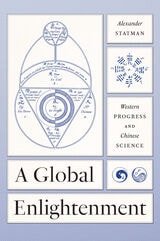
A Global Enlightenment
Western Progress and Chinese ScienceAlexander Statman
University of Chicago Press, 2023
The Enlightenment gave rise not only to new ideas of progress but consequential debates about them. Did distant times and places have anything to teach the here and now? Voltaire could believe that they did; Hegel was convinced that they did not. Early philosophes praised Chinese philosophy as an enduring model of reason. Later philosophes rejected it as stuck in the past. Seeking to vindicate ancient knowledge, a group of French statesmen and savants began a conversation with the last great scholar of the Jesuit mission to China. Together, they drew from Chinese learning to challenge the emerging concept of Western advancement.
A Global Enlightenment traces this overlooked exchange between China and the West to make compelling claims about the history of progress, notions of European exceptionalism, and European engagement with Chinese science. To tell this story, Alexander Statman focuses on a group of thinkers he terms “orphans of the Enlightenment,” intellectuals who embraced many of their contemporaries’ ideals but valued ancient wisdom. They studied astronomical records, gas balloons, electrical machines, yin-yang cosmology, animal magnetism, and Daoist medicine. And their inquiries helped establish a new approach to the global history of science.
Rich with new archival research and fascinating anecdotes, A Global Enlightenment deconstructs two common assumptions about the early to late modern period. Though historians have held that the idea of a mysterious and inscrutable East was inherent in Enlightenment progress theory, Statman argues that it was the orphans of the Enlightenment who put it there: by identifying China as a source of ancient wisdom, they turned it into a foil for scientific development. But while historical consensus supposes that non-Western ideas were banished from European thought over the course of the Enlightenment, Statman finds that Europeans became more interested in Chinese science—as a precursor, then as an antithesis, and finally as an alternative to modernity.
A God Torn to Pieces
The Nietzsche CaseGiuseppe Fornari
Michigan State University Press, 2013
Giuseppe Fornari’s groundbreaking inquiry shows that Friedrich Nietzsche’s neglected importance as a religious thinker and his “untimeliness” place him at the forefront of modern thought. Capable of exploiting his own failures as a cognitive tool to discover what other philosophers never wanted to see, Nietzsche ultimately drove himself to mental collapse. Fornari analyzes the tragic reports of Nietzsche’s madness and seeks out the cause of this self-destructive destiny, which, he argues, began earlier than his rivalry with the composer and polemicist Richard Wagner, dating back to the premature loss of Nietzsche’s father. Dramatic experience enabled Nietzsche to detect a more general tendency of European culture, leading to his archaeological and prophetic discovery of the death of God, which he understood as a primordial assassination from which all humankind took its origin. Fornari concludes that Nietzsche’s fatal rebellion against a Christian awareness, which he identified as the greatest threat to his plan, led him to become one and the same not only with Dionysus but also with the crucified Christ. His effort, Fornari argues, was a dramatic way to recognize the silent, inner meaning of Christ’s figure, and perhaps to be forgiven.
A Guerrilla Guide to Refusal
Andrew Culp
University of Minnesota Press, 2022
A field guide to a nonfascist life at the end of the world as we know it
A Guerrilla Guide to Refusal is an unexpected approach to philosophy from a guerrilla-logic point of view. Harnessing critical theory to creatively reimagine counterinsurgency, guerrilla warfare, and interventions beyond the political mainstream, it takes us on a journey through anarchist infowar, queer outlaws, and black insurgency—through a subterranean network of communiques, military documents, contemporary art, political slogans, adversarial blogs, and captive media. In doing so, it provides powerful new insight into contemporary political movements that pose no demands, refuse labels, and offer no solutions.
Written to both inspire and provoke, A Guerrilla Guide to Refusal urges us to think through the refusal to participate in politics as usual. Author Andrew Culp demonstrates how evasion can combatively deny the existing order its power. Focusing on punk cinema, anarchist pamphlets, feminist art projects, hacker manifestos, and guerrilla manuals, he foregrounds invisibility as a novel force of disruption. He draws on concepts of criminality, fugitivity, and anonymity to bring a more nuanced understanding of how power makes things—and people—visible.
The book’s unique format is that of a theoretical manual, comprising freestanding segments instead of blueprints. Poised to reach beyond the academy into activist circles, this potent theory-in-action intervention forces us to reconsider the terrain upon which our struggles against patriarchy, anti-Blackness, capitalism, and the state operate.
A Guide to Eric Voegelin's Political Reality
Montgomery Erfourth
St. Augustine's Press, 2014
A Guilted Age
Apologies for the PastAshraf A. H. Rushdy
Temple University Press, 2015
Public apologies have become increasingly common scenes and representative moments in what appears to be a global process of forgiveness. The apology-forgiveness dynamic is familiar to all of us, but what do these rituals of atonement mean when they are applied to political and historical events?
In his timely, topical, and incisive book A Guilted Age, Ashraf Rushdy argues that the proliferation of apologies by politicians, nations, and churches for past events—such as American slavery or the Holocaust—can be understood as a historical phenomenon. In our post–World War II world, Rushdy claims that we live in a “guilted age.”
A Guilted Age identifies the two major forms of apologies—political and historical—and Rushdy defines the dynamics and strategies of each, showing how the evolution of one led to the other. In doing so, he reveals what apology and forgiveness do to the past events they respectively apologize for and forgive—and what happens when they fail.
A History of Anthropology
Thomas Hylland Eriksen and Finn Sivert Nielsen
Pluto Press, 2013
This is a thoroughly updated and revised edition of a popular classic of modern anthropology. The authors provide summaries of ‘Enlightenment’, ‘Romantic’ and ‘Victorian’ anthropology, from the cultural theories of Morgan and Taylor to the often neglected contributions of German scholars. The ambiguous relationship between anthropology and national cultures is also considered.
The book provides an unparalleled account of theoretical developments in anthropology from the 1920s to the present, including functionalism, structuralism, hermeneutics, neo-Marxism and discourse analysis. There are brief biographies of major anthropologists and coverage of key debates including totemism, kinship and globalisation.
This essential text on anthropology is highly engaging, authoritative and suitable for students at all levels.
A History of Religious Ideas, Volume 1
From the Stone Age to the Eleusinian MysteriesMircea Eliade
University of Chicago Press, 1978
A History of Trust in Ancient Greece
Steven Johnstone
University of Chicago Press, 2011
A Journey to Point Omega
Autobiography from 1964Josef Pieper
St. Augustine's Press, 2018
Themes with which the reader of his previous works would be well acquainted recur in this volume. The dedicated Catholic philosopher, who preferred his independence as a trainer of teachers to the less independent role of a professor in a Catholic university, was quite prepared to criticize developments in the Church which resulted from Vatican II. In his defense of the sacred, which he deemed threatened by popularizing trends in the Church, he criticized what he saw as the watered down language in modern German translations of Church liturgical texts; the growing preference for secular garb; and the compromising developments which saw the sacramental signs – surrounding baptism, for instance – being reduced to such an extent that they no longer had the power to signify their sacred meaning even to a well-intentioned congregation.
A great lover of the philosophy of Plato, Augustine, and Aquinas – among many others –, Pieper highlighted the need for living a life of truth. He did not consider truth to be merely something abstract but as something to be lived existentially. While he could explain his philosophy in clear rational terms, something which especially stood to him in his post-war lectures to eager students who were hungry for intellectual guidance and leadership, the great interest of his philosophy was, possibly, his preoccupation with mystery – that which impinges on our inner lives but frustrates all our attempts to account for it in purely rational terms.
As a philosopher – one might say a Christian philosopher – Pieper seems to have observed the traditional boundaries drawn between philosophy and theology. His generation was exposed to the modernist debates in the Church. It would have been deemed heretical to say that the Divine could be grasped by our purely human thought processes – access to the Divine being only possible through faith and grace. Pieper was no heretic. But he was also not altogether conservative. In fact, his philosophy, closely allied to existentialism – despite his care, for instance, to distance himself from the negative existentialism of Sartre – focused on the individual’s inner existential grasp of the most profound reality. Truth is to be found within us, even if it remains a mystery. What lies beyond death is, for the individual, the ultimate mystery.
A Key to Whitehead's Process and Reality
Donald W. Sherburne
University of Chicago Press, 1981
"The Key renders Process and Reality pedagogically accessible for the first time."—Journal of Religion
A Land of Two Peoples
Martin Buber on Jews and ArabsMartin Buber
University of Chicago Press, 2025
The theologian and philosopher Martin Buber (1878–1965) was committed to radical socioeconomic reconstruction in pursuit of international peace. His voluminous writings on Arab-Jewish relations in Palestine interweave his religious and philosophical teachings with his politics, each essential to Buber’s vision of democratic and religious life.
A Land of Two Peoples collects the letters, talks, and essays in which Buber advocated for a binationalism that reconciled Arabs and Jews as a solution to the conflict in the Middle East. As relevant today as when it was first published nearly fifty years ago, this edition of A Land of Two Peoples includes two forewords from the preeminent Jewish and Palestinian scholars Paul Mendes-Flohr and Raef Zreik.
A Language of Its Own
Sense and Meaning in the Making of Western Art MusicRuth Katz
University of Chicago Press, 2009
The Western musical tradition has produced not only music, but also countless writings about music that remain in continuous—and enormously influential—dialogue with their subject. With sweeping scope and philosophical depth, A Language of Its Own traces the past millennium of this ongoing exchange.
Ruth Katz argues that the indispensible relationship between intellectual production and musical creation gave rise to the Western conception of music. This evolving and sometimes conflicted process, in turn, shaped the art form itself. As ideas entered music from the contexts in which it existed, its internal language developed in tandem with shifts in intellectual and social history. Katz explores how this infrastructure allowed music to explain itself from within, creating a self-referential and rational foundation that has begun to erode in recent years.
A magisterial exploration of a frequently overlooked intersection of Western art and philosophy, A Language of Its Own restores music to its rightful place in the history of ideas.
A Leftist Ontology
Beyond Relativism and Identity PoliticsCarsten Strathausen
University of Minnesota Press, 2009
A new ontology for a globalized world
Rich with analyses of concepts from deconstruction, systems theory, and post-Marxism, with critiques of fundamentalist thought and the war on terror, this volume argues for developing a philosophy of being in order to overcome the quandary of postmodern relativism. Undergirding the contributions are the premises that ontology is a vital concept for philosophy today, that an acceptable leftist ontology must avoid the kind of identity politics that has dominated recent cultural studies, and that a new ontology must be situated within global capitalism.
A Leftist Ontology offers a timely intervention in political philosophy, featuring some of the leading voices of our time.Contributors: Bruno Bosteels, Cornell U; Christopher Breu, Illinois State U; Nicholas Brown, U of Illinois at Chicago; Sorin Radu Cucu, Manhattan College; George Edmondson, Dartmouth College; Eva Geulen, U of Bonn; Philip Goldstein, U of Delaware; Klaus Mladek, Dartmouth College; Alberto Moreiras, U of Aberdeen; Jeffrey T. Nealon, Pennsylvania State U; William Rasch, Indiana U; Ben Robinson, Indiana U; Imre Szeman, McMaster U; Roland Vegso, U of Tennessee, Knoxville.