Results by title
977 books match the query 'American literature' and 4 start with a non-letter
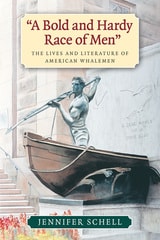
"A Bold and Hardy Race of Men"
The Lives and Literature of American WhalemenJennifer Schell
University of Massachusetts Press, 2013
In his novel Miriam Coffin, or The Whale-Fishermen (1834), Joseph C. Hart proclaimed that his characters were “a bold and hardy race of men,” who deserved the “expressive title of American Whale-Fishermen.” Hart was not the only American author to applaud these physical laborers as the embodiment of national manhood. Heroic portraits of whalers first appeared in American literature during the 1780s, and they proliferated across time. Writers as various as Lydia Howard Huntley Sigourney, Frederick Douglass, and Walt Whitman celebrated the talents of the seafarers who transformed the New England whale fishery into a globally dominant industry. But these images did not go unchallenged. Alternative visions—some of which undermined the iconic status of the trade and its workers—began to proliferate. Even so, these depictions did very little to dismantle the notion that whaling men were prime exemplars of a proud American work ethic.
To explain why this industry had such a widespread and enduring impact on American literature, Jennifer Schell juxtaposes and analyzes a wide array of eighteenth- and nineteenth-century whaling narratives. Drawing on various studies of masculinity, labor history, and transnationalism, Schell shows how this particular type of maritime work, and the traits and values associated with it, helped to shape the American literary, cultural, and historical imagination. In the process, she reveals the diverse, flexible, and often contradictory meanings of gender, class, and nation in nineteenth-century America.
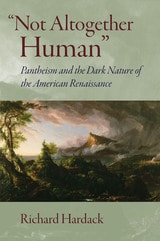
"Not Altogether Human"
Pantheism and the Dark Nature of the American RenaissanceRichard Hardack
University of Massachusetts Press, 2012
Many leading American thinkers in the nineteenth century, who accepted the premises of Emersonian transcendentalism, valued the basic concept of pantheism: that God inheres in nature and in all things, and that a person could achieve a sense of belonging she or he lacked in society by seeking a oneness with all of nature. As Richard Hardack shows, however, writers such as Ralph Waldo Emerson, Nathaniel Hawthorne, and Herman Melville conceived of nature as everything “Other”—other than the white male Protestant culture of which they were a part. This conception of nature, then, became racialized, and the divine became associated with African American and Native American identities, as well as with femininity.
In "Not Altogether Human," Hardack reevaluates transcendentalism in the context of nineteenth-century concerns about individual and national racial identity. Elucidating the influence of pantheism, Hardack draws on an array of canonical and unfamiliar materials to remap the boundaries of what has long been viewed as white male transcendental discourse.
This book significantly revises notions of what transcendentalism and pantheism mean and how they relate to each other. Hardack's close analysis of pantheism and its influence on major works and lesser known writing of the nineteenth century opens up a new perspective on American culture during this key moment in the country's history.
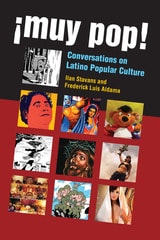
¡Muy Pop!
Conversations on Latino Popular CultureIlan Stavans and Frederick Luis Aldama
University of Michigan Press, 2013
Although investigations of Hispanic popular culture were approached for decades as part of folklore studies, in recent years scholarly explorations—of lucha libre, telenovelas, comic strips, comedy, baseball, the novela rosa and the detective novel, sci-fi, even advertising—have multiplied. What has been lacking is an overarching canvas that offers context for these studies, focusing on the crucial, framing questions: What is Hispanic pop culture? How does it change over time and from region to region? What is the relationship between highbrow and popular culture in the Hispanic world? Does it make sense to approach the whole Hispanic world as homogenized when understanding Hispanic popular culture? What are the differences between nations, classes, ethnic groups, religious communities, and so on? And what distinguishes Hispanic popular culture in the United States?
In ¡Muy Pop!, Ilan Stavans and Frederick Luis Aldama carry on a sustained, free-flowing, book-length conversation about these questions and more, concentrating on a wide range of pop manifestations and analyzing them at length. In addition to making Hispanic popular culture visible to the first-time reader, ¡Muy Pop! sheds new light on the making and consuming of Hispanic pop culture for academics, specialists, and mainstream critics.
“We Must Document Ourselves Now”
Black Lesbian Cultural Legacies and the Politics of Self-RepresentationStephanie Andrea Allen
The Ohio State University Press, 2026
A long-overdue analysis of how Black lesbians have asserted their lived experience through creative practice, pushing back against heteropatriarchal systems that deny them visibility.
“We Must Document Ourselves Now” examines the essential but oft-ignored importance of Black lesbian literature and film in queer literary and film histories, arguing that Black lesbian cultural texts reflect creators’ lived experiences and resist the heteropatriarchal systems that deny Black lesbians visibility in popular culture. Stephanie Andrea Allen contends that these texts have three goals: to lay bare the experiences of Black lesbians in a raced, gendered, classed, and homophobic society; to challenge the notion that claiming Black lesbian identity is marginal or forbidden; and to take care of Black lesbians by bearing witness to their experiences through creative practice.
Insisting that Black feminist creative practice is an integral form of self and community care, Allen weaves analysis of cultural output spanning key sociocultural moments from 1974 to 2020 with interviews with Black lesbian cultural workers. “We Must Document Ourselves Now” examines the Black Arts / Black Power movement, the “boom” in lesbian and gay publishing, the so-called golden era of Black film, and twenty-first-century visual media to demonstrate how representations of Black lesbians, or lack thereof, were vital to constructing a cultural canon that focused on illuminating Black lesbian experiences in the United States.