Results by title
208 books match the query 'Autobiography' and 3 start with a non-letter

"Other Sheep I Have" The Autobiography of Father Paul M. Washington
Paul Washington
Temple University Press, 1994
Father Paul M. Washington rose to local and nation prominence as an unflagging supporter of civil and women's rights. One of a handful of black priests in a traditionally white church, he fought for understanding among all people, eventually serving twenty-five years as the Rector of the Episcopal Church of the Advocate in an inner-city Philadelphia neighborhood. Though his ideas about equality often went against the views of the Episcopal church leadership, he rejected threats of withdrawn funding or retaliation to follow his heart and his theology.
Father Washington's story is a window of insight into the struggles for justice and dignity in the latter half of the twentieth century. In the tumultuous 1960s he supported the Black Power movement, the Black Panther Party, and many other groups working for peace and justice, providing meeting places and guidance. He often found himself in the midst of racial disturbances—the riots on Susquehanna Avenue in 1963 and on Columbia Avenue in 1964, in front of the Board of Education where high school students protested the Eurocentric curriculum, and outside the walls of Girard College where citizens and civic leaders demonstrated against the school's exclusion of black children. In the 1980s, he helped Philadelphia city officials negotiate with MOVE members and was a vocal supporter of Ramona Africa, fighting for her release from prison. It was in his church on the corner of 18th and Diamond Streets that women were first ordained a priests in the Episcopal church. And it was one of his congregation, Barbara Harris, who became the first female Episcopal bishop.
In his evocative voice, Father Washington describes the pivotal events of his life and how each impacted upon his evolving ideas of the relationship between religion and justice. Spanning seven decades, his account is at once an insightful and unique historical account of political action, of the reformation of the church, of the changing urban landscape, and of a life graced by leadership and spiritual enlightenment.
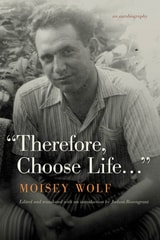
"Therefore, Choose Life..."
An AutobiographyMoisey Wolf
Oregon State University Press, 2014
Wolf describes his Jewish childhood and youth in pre-war Poland, his escape from the Holocaust and subsequent medical service in the Soviet Army during World War II and the following decade, his distinguished career in psychiatry in post-Stalinist Soviet Russia, and his final years in Portland, Oregon, after his departure from the Soviet Union in 1992.
Wolf’s narrative skill and evocative personal insights, combined with Judson Rosengrant’s judicious editing and annotation and elegant translation, provide the reader with direct access to a world that has seemingly ceased to exist, yet continues to resonate and inform our own lives in powerful ways.
“Therefore, Choose Life…” will appeal to readers interested in the history of the East-European twentieth century, pre-Holocaust Jewish family life in Poland, and in the survival of a man of deep religious faith and cultivation in the face of the catastrophes and vicissitudes of his time and place.
5 Years of 4th Genre
Martha Bates
Michigan State University Press, 2006
In 1999, Michigan State University Press launched Fourth Genre: Explorations in Creative Nonfiction, a journal that began with and has maintained a devotion to publishing notable, innovative work in nonfiction. The title reflects an intent to give nonfiction its due as a literary genre—to give writers of the 'fourth genre' a showcase for their work and to give readers a place to find the liveliest and most creative works in the form.
Given the genre's flexibility and expansiveness, journal editors Michael Steinberg and David Cooper have welcomed a variety of works— ranging from personal essays and memoirs to literary journalism and personal criticism. The essays are lyrical, self-interrogative, meditative, and reflective, as well as expository, analytical, exploratory, or whimsical. In short, Fourth Genre encourages a writer- to-reader conversation, one that explores the markers and boundaries of literary/creative nonfiction.
Since its inaugural issue, contributors have earned many literary awards: 5 Notable Essays of the Year (Best American Essay); the Lowell Thomas Travel Journalism Award; Notable Essay of the Year (Best American Travel Writing); and 4 Pushcart Prizes. Five Years of 4th Genre is a celebration of this significant literary journal. Culling a selection of some of the most creative of Fourth Genre’s first five years—the Pushcart winners are here, as well as those essays that are unique, those that tell us something new, those that startle us, and those that touch our hearts —this volume presents a representative sampling.