Results by title
212 books match the query 'Colonial Period (1600-1775)' and 4 start with a non-letter
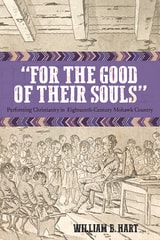
"For the Good of Their Souls"
Performing Christianity in Eighteenth-Century Mohawk CountryWilliam B. Hart
University of Massachusetts Press, 2020
In 1712, the Society for the Propagation of the Gospel in Foreign Parts opened its mission near present-day Albany, New York, and began baptizing residents of the nearby Mohawk village Tiononderoge, the easternmost nation of the Haudenosaunee (Iroquois) Confederacy. Within three years, about one-fifth of the Mohawks in the area began attending services. They even adapted versions of the service for use in private spaces, which potentially opened a door to an imagined faith community with the Protestants.
Using the lens of performance theory to explain the ways in which the Mohawks considered converting and participating in Christian rituals, historian William B. Hart contends that Mohawks who prayed, sang hymns, submitted to baptism, took communion, and acquired literacy did so to protect their nation's sovereignty, fulfill their responsibility of reciprocity, serve their communities, and reinvent themselves. Performing Christianity was a means of "survivance," a strategy for sustaining Mohawk life and culture on their terms in a changing world.
Using the lens of performance theory to explain the ways in which the Mohawks considered converting and participating in Christian rituals, historian William B. Hart contends that Mohawks who prayed, sang hymns, submitted to baptism, took communion, and acquired literacy did so to protect their nation's sovereignty, fulfill their responsibility of reciprocity, serve their communities, and reinvent themselves. Performing Christianity was a means of "survivance," a strategy for sustaining Mohawk life and culture on their terms in a changing world.
[more]
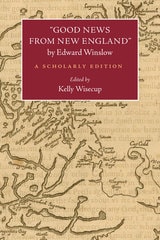
"Good News from New England" by Edward Winslow
A Scholarly EditionKelly Wisecup
University of Massachusetts Press, 2014
First published in 1624, Edward Winslow's Good News from New England chronicles the early experience of the Plimoth colonists, or Pilgrims, in the New World. For several years Winslow acted as the Pilgrims' primary negotiator with New England Algonquians, including the Wampanoag, Massachusett, and Narragansett Indians. During this period he was credited with having cured the Wampanoag sachem Massasoit, one of the colonists' most valuable allies, of an apparently life-threatening illness, and he also served as the Pilgrims' chief agent in England.
It was in the context of all of these roles that Winslow wrote Good News in an attempt to convince supporters in England that the colonists had established friendly relations with Native groups and, as a result, gained access to trade goods. Although clearly a work of diplomacy, masking as it did incidents of brutal violence against Indians as well as evidence of mutual mistrust, the work nevertheless offers, according to Kelly Wisecup, a more complicated and nuanced representation of the Pilgrims' first years in New England and of their relationship with Native Americans than other primary documents of the period.
In this scholarly edition, Wisecup supplements Good News with an introduction, additional primary texts, and annotations to bring to light multiple perspectives, including those of the first European travelers to the area, Native captives who traveled to London and shaped Algonquian responses to colonists, the survivors of epidemics that struck New England between 1616 and 1619, and the witnesses of the colonists' attack on the Massachusetts.
[more]
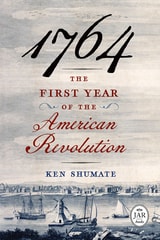
1764—The First Year of the American Revolution
Ken Shumate
Westholme Publishing, 2021
How the American Response to British Plans for Parliamentary Taxation Set in Motion the Movement for Independence
The year 1764 is of extraordinary importance to the history of the American Revolution. It was a watershed year in the relationship between Great Britain and its North American colonies.
In 1763, the British began to strictly enforce the laws of trade in order to advance a newly formulated colonial policy that included use of customs duties as a means of drawing revenue from the colonies. Americans early in 1764 protested that the laws being enforced were economically unsound and would be destructive to the trade of the colonies. Despite knowing of the American discontent, British officials moved forward with their new colonial policy. Resolutions made by the House of Commons in March 1764 not only codified a more restrictive trade policy, but revealed a plan to impose direct parliamentary taxation. A resolution to levy stamp duties brought forth a storm of American petitions and essays in late 1764 that constitute the beginning of what has become known as the Stamp Act Crisis.
In 1764: The First Year of the American Revolution, Ken Shumate presents the American arguments against the new British policy. The most prominent protests against direct parliamentary taxation were made by New York, Massachusetts, Virginia, Connecticut, and Rhode Island. Supporting the petitions were thoughtful essays by James Otis, Oxenbridge Thacher, Richard Bland, Thomas Fitch, and Stephen Hopkins. Shumate demonstrates the importance of these petitions and essays, written before the passage of the Stamp Act in 1765, as establishing the constitutional basis for the heated protests of that year and the following decade. The British interpretation of these writings as rejecting the supremacy of Parliament—even the sovereignty of Great Britain—further motivated the need for the Stamp Act as a demonstration of the fundamental right of Parliament to levy such taxes.
[more]
1777
The Year of the HangmanJohn S. Pancake
University of Alabama Press, 1977
A detailed study of the British invasion from Canada during the War of Independence
No one who has read the history of the War of Independence can fail to be fascinated by the campaign of Gentleman Johnny Burgoyne. The story evokes pictures in the mind's eye: scarlet-coated Englishmen; the green and blue uniforms of the German mercenaries; the flash of brass and silver and steel accoutrements; the swarms of Indians in their war paint; the whole moving through the green forests or sailing the blue waters of lakes and rivers. Even the names have a lyrical tone: Richelieu, Champlain, Oriskany, Ticonderoga, and La Chine.
Part of this fascination is the fact that the fate of the expedition marked a turning point in the history of the war. It is not surprising that there has been a host of chroniclers, scholars, and novelists, and those who fall in a category somewhere between because their artistry bridges the gaps that footnoted facts cannot, and so allows some scope for imagination (and may teach more history than the rest).
This fascination was partly responsible for Pancake’s exploration of this particular part of the history of the war. There was also the fact that no scholar since Hoffman Nickerson in his Turning Point of the Revolution (1926) has attempted a detailed study of the British invasion from Canada, although there has been a vast amount of literature on specific aspects of the campaign. No study to date has attempted to link the Canadian expedition to the concurrent operation of General Sir William Howe in Pennsylvania in such a way as to present a complete story of the campaign of 1777. From the point of its inception and launching by the American Secretary, Lord George Germain, to the point where it was reduced to a shambles at the end of the year.
[more]