Results by title
1882 books match the query 'Criticism and interpretation' and 9 start with a non-letter
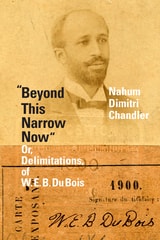
"Beyond This Narrow Now"
Or, Delimitations, of W. E. B. Du BoisNadhum Dimitri Chandler
Duke University Press, 2022
"Long Years of Neglect"
The Work and Reputation of William Gilmore SimmsJohn Caldwell Guilds
University of Arkansas Press, 1988
With this collection of essays, the literary record of one of the first and most important men of letters from the South is finally reevaluated from the critical perspective time provides.
William Gilmore Simms (1806-1870) was a poet, critic, novelist, and correspondent whose accomplishment has long been overshadowed by the events of history. As a leading writer and advocate of the antebellum south, Simms suffered from the mercurial judgments of the established publishing and literary circles of the North. Since his death he has slipped into relative obscurity with the inability or unwillingness of most of his critics to separate Simms’s artistic achievements from what have been perceived as flaws in his character.
Together witht he collected letters of Simms—coedited by T.C. Duncan Eaves, to whose memory this book is dedicated—the essays included in Long Years of Neglect can now begin to rectify the damage done over time to the reputation of Simms and his writing, to supersede the options of the past with scholarly and critical appraisal of the work itself, and to offer fresh insight into William Gilmore Simms as a significant and intriguing figure in early American letters.
As editor Guilds speculates in his introduction, “It is conceivable that replacing myth with fact will become fashionable in Simms scholarship, and, even more important, that reading the works—instead of reading the reasons they should be avoided—will become standard practice for Simms as it is for other authors of his stamp.” It was the aim of this book to initiate the realization of that goal.
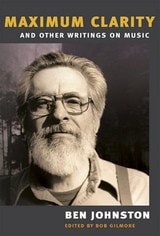
"Maximum Clarity" and Other Writings on Music
Ben Johnston. Edited by Bob Gilmore
University of Illinois Press, 2022
This collection spans forty years and brings together forty-one of Johnston's most important writings, including many rare and several previously unpublished selections. They include position papers, theoretical treatises, program notes, historical reflections, lectures, excerpts from interviews, and letters, and they cover a broad spectrum of concerns--from the technical exegesis of microtonality to the personal and the broadly humanistic. A discography of commercially available recordings of Johnston's music closes out the collection.
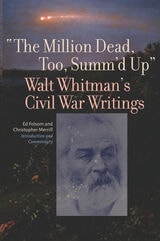
"The Million Dead, Too, Summ'd Up"
Walt Whitman's Civil War WritingsWalt Whitman
University of Iowa Press, 2021
The real democratic reader, Whitman said, “must himself or herself construct indeed the poem, argument, history, metaphysical essay—the text furnishing the hints, the clue, the start or frame-work,” because what is needed for democracy to flourish is “a nation of supple and athletic minds.” Folsom and Merrill model this kind of active reading and encourage both seasoned and new readers of Whitman’s war writings to enter into the challenging and exhilarating mode of talking back to Whitman, arguing with him, and learning from him.
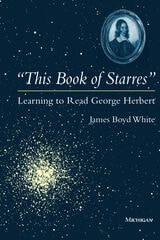
"This Book of Starres"
Learning to Read George HerbertJames Boyd White
University of Michigan Press, 1995
"This Book of Starres" is one of those all-too-rare books in which an author's love of someone's work--in this case, the seventeenth-century English poet George Herbert--leads to a journey of exploration.
Herbert's poetry presents a special set of challenges: It is to the modern ear archaic, difficult in thought and structure, and entirely theological in character. Yet no poet is more deeply admired by those who know him well. "This Book of Starres" is meant to engage the reader in a process of reading by which this verse can be seen to be vivid and alive. It is the record of one person's life-changing involvement with the poetry of George Herbert; in this it is about not only how, but why we read great poetry.
"It is a joy to experience Herbert's poetry in the company of James Boyd White, whose affinity for the work is always convincing and seems at times preternatural. 'This Book of Starres' is a necessary pleasure: all readers of poetry, whether expert or inexpert, will find it enriching." --Alice Fulton
". . . both a delight to read, and one of the most instructive exercises in literature and theology I have read for a long time. . . . Herbert emerges as one of the greatest, a writer to test and change the imagination, the very way in which we think about the world and that which is beyond it." --Literature and Theology
James Boyd White is Hart Wright Professor of Law, Professor of English, and Adjunct Professor of Classical Studies, University of Michigan.
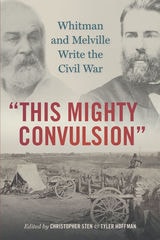
"This Mighty Convulsion"
Whitman and Melville Write the Civil WarChristopher Sten and Tyler Hoffman
University of Iowa Press, 2019
This is the first book exclusively devoted to the Civil War writings of Walt Whitman and Herman Melville, arguably the most important poets of the war. The essays brought together in this volume add significantly to recent critical appreciation of the skill and sophistication of these poets; growing recognition of the complexity of their views of the war; and heightened appreciation for the anxieties they harbored about its aftermath. Both in the ways they come together and seem mutually influenced, and in the ways they disagree, Whitman and Melville grapple with the casualties, complications, and anxieties of the war while highlighting its irresolution. This collection makes clear that rather than simply and straightforwardly memorializing the events of the war, the poetry of Whitman and Melville weighs carefully all sorts of vexing questions and considerations, even as it engages a cultural politics that is never pat.
Contributors: Kyle Barton, Peter Bellis, Adam Bradford, Jonathan A. Cook, Ian Faith, Ed Folsom, Timothy Marr, Cody Marrs, Christopher Ohge, Vanessa Steinroetter, Sarah L. Thwaites, Brian Yothers
"We, the Barbarians"
Three Mexican Writers in the Twenty-First CenturyMabel Moraña; Translated by Stephanie L. Kirk
Vanderbilt University Press, 2024
Characterized by the fragmentation of civil society and the decomposition of the myths that accompanied the consolidation of the modern nation, Mexican visual and literary arts have explored a myriad of representational avenues to approach the phenomena of violence, institutional decay, and political instability. The critical and theoretical approaches in “We, the Barbarians” explore a variety of alternative symbolic representations of topics such as nationalism, community, and affect in times impacted by systemic violence, precariousness, and radical inequality. Moraña perceives the negotiations between regional/local imaginaries and global scenarios characterized by the devaluation and resignification of life, both at individual and collective levels. Though it uses three authors as its focus, this book seeks to more broadly theorize the question of the relationship between literature and the social in the twenty-first century.
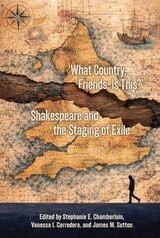
"What Country, Friends, is This?"
Shakespeare and the Staging of ExileEdited by Vanessa I. Corredera, Stephanie E. Chamberlain, and James M. Sutton
Arizona Center for Medieval and Renaissance Studies, 2026
This compelling collection of fourteen essays explores the enduring theme of exile in Shakespeare’s works and their global afterlives, offering a timely and thought-provoking response to the modern age of displacement. Building on Edward Said’s observation that exile today is marked by its unprecedented scale—driven by war, imperialism, totalitarianism, climate change, and systemic injustice—this volume traces the ideological and cultural forces that shape experiences of exile across time and geography.
Shakespeare’s plays, deeply haunted by exile in its many guises—political, religious, cultural, and gendered—serve as a rich site for interrogating identity, belonging, and otherness.
“IN THE LIGHT OF LIKENESS—TRANSFORMED”
THE LITERARY ART OF LEON FORRESTDana A. Williams
The Ohio State University Press, 2005
“In the Light of Likeness—Transformed”, by Dana A. Williams, looks critically at the work of contemporary African American author Leon Forrest. Not only does she bring to the critical table a well-known but as yet understudied modernist author—an important endeavor in and of itself—but she also explores Forrest’s novels’ cultural dialogue with black ethnic culture and other African American authors, as well as provides in-depth readings of his prose and interpretations of his narrative style. Highly touted by both his literary forebear Ralph Ellison, who wrote the foreword to Forrest’s first novel, and his literary contemporary Toni Morrison, who edited his first three novels and wrote the foreword to his third, Leon Forrest is among the most gifted African American writers of our time. Yet, he is also among our most difficult.
Forrest's highly experimental narrative style, his reinterpretation of modernism, and his transformations of black cultural traditions into literary aesthetics often pose challenges of interpretation for the reader and the scholar alike. As the first single-authored book-length study of Forrest’s novel, this book offers readers pathways into his fiction. What this culturalist approach to the novels reveals is that Forrest’s fiction was foremost concerned with investigating ways for the African American to survive in the contemporary moment. Through a variety of characters, the novels reveal the African American’s art of transformation—the ability to find ways to make the wretchedness of the past work in positive ways.