Results by title
1726 books match the query 'Film' and 6 start with a non-letter

"Baad Bitches" and Sassy Supermamas
Black Power Action FilmsStephane Dunn
University of Illinois Press, 2008
Blaxploitation action narratives as well as politically radical films like Sweet Sweetback's Baadasssss Song typically portrayed black women as trifling "bitches" compared to the supermacho black male heroes. But starting in 1973, the emergence of "baad bitches" and "sassy supermamas" reversed the trend as self-assured, empowered, and tough black women took the lead in the films Cleopatra Jones, Coffy, and Foxy Brown.
Stephane Dunn unpacks the intersecting racial, sexual, and gender politics underlying the representations of racialized bodies, masculinities, and femininities in early 1970s black action films, with particular focus on the representation of black femininity. Recognizing a distinct moment in the history of African American representation in popular cinema, Dunn analyzes how it emerged from a radical political era influenced by the Black Power movement and feminism. Dunn also engages blaxploitation's legacy in contemporary hip-hop culture, as suggested by the music’s disturbing gender politics and the "baad bitch daughters" of Foxy Brown and Cleopatra Jones, rappers Foxy Brown and Lil' Kim.
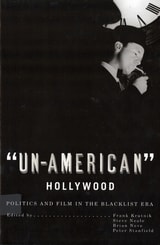
'Un-American' Hollywood
Politics and Film in the Blacklist EraStanfield, Peter
Rutgers University Press, 2007
The concept of “un-Americanism,” so vital to the HUAC crusade of the 1940s and 1950s, was resoundingly revived in the emotional rhetoric that followed the September 11th terrorist attacks. Today’s political and cultural climate makes it more crucial than ever to come to terms with the consequences of this earlier period of repression and with the contested claims of Americanism that it generated.
“Un-American” Hollywood reopens the intense critical debate on the blacklist era and on the aesthetic and political work of the Hollywood Left. In a series of fresh case studies focusing on contexts of production and reception, the contributors offer exciting and original perspectives on the role of progressive politics within a capitalist media industry.
Original essays scrutinize the work of individual practitioners, such as Robert Rossen, Joseph Losey, Jules Dassin, and Edward Dmytryk, and examine key films, including The Robe, Christ in Concrete, The House I Live In, The Lawless, The Naked City, The Prowler, Body and Soul, and FTA.

2001 and Counting
Kubrick, Nietzsche, and AnthropologyBruce Kapferer
Prickly Paradigm Press, 2014
In 2001 and Counting, renowned anthropologist Bruce Kapferer revisits 2001: A Space Odyssey, making a compelling case for its continued cultural relevance. While the film’s earliest audiences considered it to be a critical examination of European and American realities at the height of the Cold War, Kapferer shows that Kubrick’s masterwork speaks equally well to concerns of the contemporary world, including the Iraq War, the 2008 financial crisis, and the material and political effects of neoliberalism. Kapferer explores Kubrick’s central theme—the ever-changing relationship between humanity and technology—both with regard to current events and through the lens of Nietzsche’s Thus Spoke Zarathustra and the mythical concept of the eternal return.
A thought-provoking exploration of the cultural power of cinema, this volume by one of anthropology’s most insightful and imaginative thinkers will appeal to anthropologists and cineastes alike.
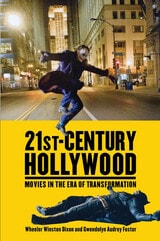
21st-Century Hollywood
Movies in the Era of TransformationDixon, Wheeler Winston
Rutgers University Press, 2011
They are shot on high-definition digital cameras—with computer-generated effects added in postproduction—and transmitted to theaters, websites, and video-on-demand networks worldwide. They are viewed on laptop, iPod, and cell phone screens. They are movies in the 21st century—the product of digital technologies that have revolutionized media production, content distribution, and the experience of moviegoing itself.
21st-Century Hollywood introduces readers to these global transformations and describes the decisive roles that Hollywood is playing in determining the digital future for world cinema. It offers clear, concise explanations of a major paradigm shift that continues to reshape our relationship to the moving image. Filled with numerous detailed examples, the book will both educate and entertain film students and movie fans alike.
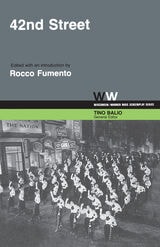
42nd Street
Edited by Rocco Fumento; Tino T. Balio, Series Editor
University of Wisconsin Press, 1980
This screenplay of 42nd Street, along with Rocco Fumento's thorough and engrossing introduction, takes the reader behind the scenes to see how the Warners studio took a dismal novel and, working within severe financial constraints brought on by the Great Depression, turned out a smash musical hit.
42nd Street is a watershed film, one that resuscitated the Hollywood musical during troubled times. Yet 42nd Street wasn't merely a Depression tonic, its multiple plot line was half-comic, half-serious. It was a fast-paced, energetic, and the first musical not to shrink away from the fact that a Depression was going on. The film is an odd, and oddly successful, fusion of the real with the fantastic.
43 Ways to Finance Your Feature Film
A Comprehensive Analysis of Film FinanceJohn W. Cones
Southern Illinois University Press, 2008
John W. Cones has updated his now classic 43 Ways toFinance Your Feature Film: A Comprehensive Analysis of Film Finance with a substantially reorganized and expanded third edition.
An essential reference guide for film professionals on every side of film financing, 43 Ways answers the question that every filmmaker and producer ultimately faces, the issue that can make or break any venture into the film industry: How do I finance my feature film? The third edition includes updated information and coverage of new options for financing.
In his clear and concise style and with expertise amassed over his nearly twenty years of experience in the film finance industry, Cones breaks financing options down into six main areas: gifts and grants, investor financing, domestic government subsidies and tax incentive programs, lender financing, international finance options, and studio or industry financing. Beginning with the forms of financing most likely to be accessible to independent feature film producers, Cones proceeds to other forms that become increasingly available as the producer’s career matures.
As an objective adviser, Cones provides specific, concise information regarding the many possible financing strategies and lists the distinct pros and cons of each strategy. This guide covers the options for film financing in rich detail so that even first-time producers and filmmakers will be able to make educated and informed decisions about the best approaches to financing their films. An extensive bibliography contains additional information about each form of film finance. Cones also counters much of the bad advice being provided by pseudoprofessional film finance consultants and points out scams that may separate unwary film producers from their money.
Although the book focuses on financing feature films, much of its information is relevant to the financing of other kinds of projects, such as short films, documentaries, videos, and multimedia and theatrical endeavors. Anyone considering making or investing in a feature film will be well served by this practical and helpful guide.