Results by title
7 books match the query 'Far'
As Far as the Eye Can See
Stephen Pradarelli
University of Iowa Press, 2019
Far From Respectable
Dave Hickey and His ArtDaniel Oppenheimer
University of Texas Press, 2021
Finalist, 2021 Writers’ League of Texas Book Award
Regarded as both a legend and a villain, the critic Dave Hickey has inspired generations of artists, art critics, musicians, and writers. His 1993 book The Invisible Dragon became a cult hit for its potent and provocative critique of the art establishment and its call to reconsider the role of beauty in art. His next book, 1997’s Air Guitar, introduced a new kind of cultural criticism—simultaneously insightful, complicated, vulnerable, and down-to-earth—that propelled Hickey to fame as an iconoclastic thinker, loved and loathed in equal measure, whose influence extended beyond the art world.
Far from Respectable is a focused, evocative exploration of Hickey’s work, his impact on the field of art criticism, and the man himself, from his Huck Finn childhood to his drug-fueled periods as both a New York gallerist and Nashville songwriter to, finally, his anointment as a tenured professor and MacArthur Fellow. Drawing on in-person interviews with Hickey, his friends and family, and art world comrades and critics, Daniel Oppenheimer examines the controversial writer’s distinctive takes on a broad range of subjects, including Norman Rockwell, Robert Mapplethorpe, academia, Las Vegas, basketball, country music, and considers how Hickey and his vision of an “ethical, cosmopolitan paganism” built around a generous definition of art is more urgently needed than ever before.
Far from Atlantis
PoemsRaymond Luczak
Gallaudet University Press, 2023
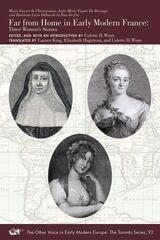
Far from Home in Early Modern France
Three Women’s StoriesMarie Guyart de l’Incarnation, Anne-Marie Fiquet du Boccage, and Henriette-Lucie Dillon de la Tour du Pin
Iter Press, 2022
This book showcases three Frenchwomen who ventured far from home at a time when such traveling was rare. In 1639, Marie de l’Incarnation embarked for New France where she founded the first Ursuline monastery in present-day Canada. In 1750, Madame du Boccage set out at the age of forty on her first “grand tour.” She visited England, the Netherlands, and Italy where she experienced firsthand the intellectual liberty offered there to educated women. As the Reign of Terror gripped France, the Marquise de la Tour du Pin fled to America with her husband and their two young children, where they ran a farm from 1794 to 1796. The writings these women left behind detailing their respective journeys abroad represent significant contributions to early modern travel literature. This book makes available to anglophone readers three texts that are rich in both historical and literary terms.

Far from Home
Memories of World War II and AfterwardMary Herring Wright
Gallaudet University Press, 2005
“She’s got no more business there than a pig has with a Bible.” That’s what her father said when Mary Herring announced that she would be moving to Washington, DC, in late 1942. Recently graduated from the North Carolina School for Black Deaf and Blind Students, Mary had been invited to the nation’s capital by a cousin to see a specialist about her hearing loss. Though nothing could be done about her deafness, Mary quickly proved her father wrong by passing the civil service examination with high marks. Far from Home: Memories of World War II and Afterward, the second installment of her autobiography, describes her life from her move to Washington to the present.
Mary soon became a valued employee for the Navy, maintaining rosters for the many servicemen in war theaters worldwide. Her remarkable gift for detail depicts Washington in meticulous layers, a sleepy Southern town force-grown into a dynamic geopolitical hub. Life as a young woman amid the capital’s Black middle class could be warm and fun, filled with visits from family and friends, and trips home to Iron Mine for tearful, joyous reunions. But the reality of the times was never far off. On many an idyllic afternoon, she and her friends found somber peace in Arlington Cemetery, next to the grave of the sole Unknown Soldier at that time. During an evening spent at the U.S.O., one hearing woman asked how people like her could dance, and Mary answered, “With our feet.” She became a pen pal to several young servicemen, but did not want to know why some of them suddenly stopped writing.
Despite the close friends and good job that she had in Washington, the emotional toll caused Mary to return to her family home in Iron Mine, NC. There, she rejoined her family and resumed her country life. She married and raised four daughters, and recounts the joys and sorrows she experienced through the years, particularly the loss of her parents. Her blend of the gradual transformation of Southern rural life with momentous events such as Hurricane Hazel creates an extraordinary narrative history. The constant in Far from Home remains the steady confidence that Mary Herring Wright has in herself, making her new memoir a perfect companion to her first.
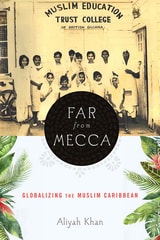
Far from Mecca
Globalizing the Muslim CaribbeanAliyah Khan
Rutgers University Press, 2020
Far from Mecca: Globalizing the Muslim Caribbean is the first academic work on Muslims in the English-speaking Caribbean. Khan focuses on the fiction, poetry, and music of Islam in Guyana, Trinidad, and Jamaica. Combining archival research, ethnography, and literary analysis, Khan argues for a historical continuity of Afro- and Indo-Muslim presence and cultural production in the Caribbean. Case studies explored range from Arabic-language autobiographical and religious texts written by enslaved Sufi West Africans in nineteenth-century Jamaica, to early twentieth-century fictions of post-indenture South Asian Muslim indigeneity and El Dorado, to the attempted government coup in 1990 by the Jamaat al-Muslimeen in Trinidad, as well as the island’s calypso music, to contemporary judicial cases concerning Caribbean Muslims and global terrorism. Khan argues that the Caribbean Muslim subject, the “fullaman,” a performative identity that relies on gendering and racializing Islam, troubles discourses of creolization that are fundamental to postcolonial nationalisms in the Caribbean.
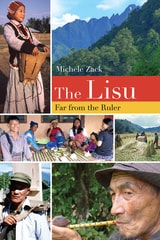
Lisu
Far from the RulerMichele Zack
University Press of Colorado, 2017
This book brings the ironic worldview of the Lisu to life through vivid, often amusing accounts of individuals, communities, regions, and practices. One of the smallest and last groups of stateless people, and the most egalitarian of all Southeast Asian highland minorities, the Lisu have not only survived extremes at the crossroads of civil wars, the drug trade, and state-sponsored oppression but adapted to modern politics and technology without losing their identity.
The Lisu weaves a lively narrative that condenses humanity’s transition from border-free tribal groupings into today’s nation-states and global market economy. Journalist and historian Michele Zack first encountered the Lisu in the 1980s and conducted research and fieldwork among them in the 1990s. In 2014 she again traveled extensively in tribal areas of Thailand, Myanmar, and China, when she documented the transformative changes of globalization. Some Lisu have adopted successful new urban occupations in business and politics, while most continue to live as agriculturists “far from the ruler.”
The cohesiveness of Lisu culture has always been mysterious—they reject hierarchical political organization and traditionally had no writing system—yet their culture provides a particular skillset that has helped them navigate the terrain of the different religious and political systems they have recently joined. They’ve made the transition from living in lawless, self-governing highland peripheries to becoming residents and citizens of nation-states in a single generation.
Ambitious and written with journalist’s eye for detail and storytelling, The Lisu introduces the unique and fascinating culture of this small Southeast Asian minority. Their path to national and global citizenship illustrates the trade-offs all modern people have made, and their egalitarian culture provides insight into current political choices in a world turning toward authoritarianism.