Results by title
5448 books match the query 'History and criticism' and 24 start with a non-letter
"A Bold and Hardy Race of Men"
The Lives and Literature of American WhalemenJennifer Schell
University of Massachusetts Press, 2013
In his novel Miriam Coffin, or The Whale-Fishermen (1834), Joseph C. Hart proclaimed that his characters were “a bold and hardy race of men,” who deserved the “expressive title of American Whale-Fishermen.” Hart was not the only American author to applaud these physical laborers as the embodiment of national manhood. Heroic portraits of whalers first appeared in American literature during the 1780s, and they proliferated across time. Writers as various as Lydia Howard Huntley Sigourney, Frederick Douglass, and Walt Whitman celebrated the talents of the seafarers who transformed the New England whale fishery into a globally dominant industry. But these images did not go unchallenged. Alternative visions—some of which undermined the iconic status of the trade and its workers—began to proliferate. Even so, these depictions did very little to dismantle the notion that whaling men were prime exemplars of a proud American work ethic.
To explain why this industry had such a widespread and enduring impact on American literature, Jennifer Schell juxtaposes and analyzes a wide array of eighteenth- and nineteenth-century whaling narratives. Drawing on various studies of masculinity, labor history, and transnationalism, Schell shows how this particular type of maritime work, and the traits and values associated with it, helped to shape the American literary, cultural, and historical imagination. In the process, she reveals the diverse, flexible, and often contradictory meanings of gender, class, and nation in nineteenth-century America.
"A Mirror for Magistrates" and the Politics of the English Reformation
Scott Lucas
University of Massachusetts Press, 2009
In a striking departure from previous scholarship, Scott Lucas shows that modern critics have misconstrued the purpose of the tragic verse narratives of the Mirror, approaching them primarily as uncontroversial meditations on abstract political and philosophical doctrines. Lucas revises this view, revealing many of the Mirror tragedies to be works topically applicable in form and politically contentious in nature.
Lucas returns the earliest poems of A Mirror for Magistrates to the troubled context of their production, the tumultuous reign of the Catholic Queen Mary (1553–1558). As Protestants suffering from the traumatic collapse of King Edward VI's "godly" rule (1547–1553) and from the current policies of Mary's government, the Mirror authors radically reshaped their poems' historical sources in order to craft emotionally moving narratives designed to provide models for interpreting the political failures of Edward VI's reign and to offer urgent warnings to Marian magistrates.
Lucas's study also reveals how, in later poems, the Mirror authors issued oblique appeals to Queen Elizabeth's officers, boldly demanding that they allow the realm of "the literary" to stand as an unfettered discursive arena of public controversy. Lucas thus provides a provocative new approach to this seminal but long-misunderstood collection, one that restores the Mirror to its rightful place as one of the greatest works of sixteenth-century English political literature.

"A Truthful Impression of the Country"
British and American Travel Writing in China, 1880-1949Nicholas R. Clifford
University of Michigan Press, 2001
Nicholas R. Clifford argues that, for a variety of reasons, travel accounts during this time claimed a particular kind of veracity that distinguished them from the work of other writers--scholars, journalists, diplomats, policymakers, or memoir-writing expatriates--who also sought to represent an unfamiliar China to the West. Yet even as the genre claims to be a "truthful impression," it contains an implicit warning that the traveler's own sensibility enters into the account and into the representation of the unfamiliar and the exotic.
"A Truthful Impression of the Country" will appeal not only to those interested in the broad phenomenon of imperialism but also to those interested in cultural studies and post-colonialism. It will likewise prove accessible to the general reader exploring Sino-Western interactions or in travel writing as a particular genre.
Nicholas R. Clifford is College Professor Emeritus, Middlebury College. He is also the author of the novel The House of Memory and of the monographs Shanghai, 1925: Urban Nationalism and the Defense of Foreign Privilege and Spoilt Children of Empire: Westerners in Shanghai and the Chinese Revolution of 1925--1927.
"After Mecca"
Women Poets and the Black Arts MovementClarke, Cheryl
Rutgers University Press, 2004
In "After Mecca," Cheryl Clarke explores the relationship between the Black Arts Movement and black women writers of the period. Poems by Gwendolyn Brooks, Ntozake Shange, Audre Lorde, Nikki Giovanni, Sonia Sanchez, Jayne Cortez, Alice Walker, and others chart the emergence of a new and distinct black poetry and its relationship to the black community's struggle for rights and liberation. Clarke also traces the contributions of these poets to the development of feminism and lesbian-feminism, and the legacy they left for others to build on.
She argues that whether black women poets of the time were writing from within the movement or writing against it, virtually all were responding to it. Using the trope of "Mecca," she explores the ways in which these writers were turning away from white, western society to create a new literacy of blackness.
"Baad Bitches" and Sassy Supermamas
Black Power Action FilmsStephane Dunn
University of Illinois Press, 2008
Blaxploitation action narratives as well as politically radical films like Sweet Sweetback's Baadasssss Song typically portrayed black women as trifling "bitches" compared to the supermacho black male heroes. But starting in 1973, the emergence of "baad bitches" and "sassy supermamas" reversed the trend as self-assured, empowered, and tough black women took the lead in the films Cleopatra Jones, Coffy, and Foxy Brown.
Stephane Dunn unpacks the intersecting racial, sexual, and gender politics underlying the representations of racialized bodies, masculinities, and femininities in early 1970s black action films, with particular focus on the representation of black femininity. Recognizing a distinct moment in the history of African American representation in popular cinema, Dunn analyzes how it emerged from a radical political era influenced by the Black Power movement and feminism. Dunn also engages blaxploitation's legacy in contemporary hip-hop culture, as suggested by the music’s disturbing gender politics and the "baad bitch daughters" of Foxy Brown and Cleopatra Jones, rappers Foxy Brown and Lil' Kim.
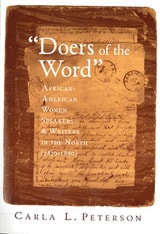
"Doers of the Word"
African-American Women Speakers and Writers in the North (1830-1880)Peterson, Carla L
Rutgers University Press, 1998
In situating these women within the emerging African-American urban communities of the free North, Doers of the Word provides an important counterweight to the vast scholarship on Southern slavery and argues that black "Civil Rights movements" cannot be seen as a purely modern phenomenon. In particular, the book examines the ways in which this Northern black population, despite its heterogeneity, came together and established social organizations that would facilitate community empowerment; yet Peterson's analysis also acknowledges, and seeks to explain, the highly complex relationship of black women to these institutions, a relationship that rendered their stance as public intellectuals all the more bold and defiant.
Peterson begins her study in the 1830s, when a substantial body of oratory and writing by black women first emerged, and traces the development of this writing through the shifting political climate up to the end of Reconstruction. She builds her analyses upon Foucault's interdisciplinary model of discourse with an explicitly feminist approach, drawing upon sermons, spiritual autobiographies, travel and slave narratives, journalism, essays, poetry, speeches, and fiction. From these, Peterson is able to answer several key questions. First, what empowered these women to act, to speak out, and to write? Why, and in what ways, were they marginalized within both the African-American and larger American communities? Where did they act, speak, and write from?
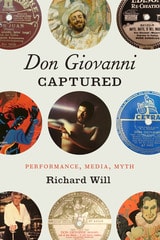
"Don Giovanni" Captured
Performance, Media, MythRichard Will
University of Chicago Press, 2022
Mozart’s opera Don Giovanni has long inspired myths about eros and masculinity. Over time, its performance history has revealed a growing trend toward critique—an increasing effort on the part of performers and directors to highlight the violence and predatoriness of the libertine central character, alongside the suffering and resilience of his female victims.
In “Don Giovanni” Captured, Richard Will sets out to analyze more than a century’s worth of recorded performances of the opera, tracing the ways it has changed from one performance to another and from one generation to the next. Will consults audio recordings, starting with wax cylinders and 78s, as well as video recordings, including DVDs, films, and streaming videos. As Will argues, recordings and other media shape our experience of opera as much as live performance does. Seen as a historical record, opera recordings are also a potent reminder of the refusal of works such as Don Giovanni to sit still. By choosing a work with such a rich and complex tradition of interpretation, Will helps us see Don Giovanni as a standard-bearer for evolving ideas about desire and power, both on and off the stage.
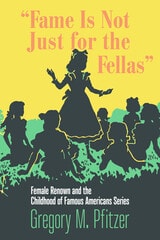
"Fame Is Not Just for the Fellas"
Female Renown and the Childhood of Famous Americans SeriesGregory M. Pfitzer
University of Massachusetts Press, 2022
Finalist of the 2023 SHARP History of the Book Prize
Between 1932 and 1958, thousands of children read volumes in the book series Childhood of Famous Americans. With colorful cover art and compelling—and often highly fictionalized—narrative storylines, these biographies celebrated the national virtues and achievements of famous women like Betsy Ross, Louisa May Alcott, and Amelia Earhart. Employing deep archival research, Gregory M. Pfitzer examines the editorial and production choices of the publisher and considers the influence of the series on readers and American culture more broadly.
In telling the story of how female subjects were chosen and what went into writing these histories for young female readers of the time, Pfitzer illustrates how these books shaped children’s thinking and historical imaginations around girlhood using tales from the past. Utilizing documented conversations and disagreements among authors, editors, readers, reviewers, and sales agents at Bobbs-Merrill, “Fame Is Not Just for the Fellas” places the series in the context of national debates around fame, gender, historical memory, and portrayals of children and childhood for a young reading public—charged debates that continue to this day.
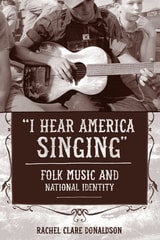
"I Hear America Singing"
Folk Music and National IdentityRachel Clare Donaldson
Temple University Press, 2014
In "I Hear America Singing," Rachel Donaldson traces the vibrant history of the twentieth-century folk music revival from its origins in the 1930s through its end in the late 1960s. She investigates the relationship between the revival and concepts of nationalism, showing how key figures in the revival--including Pete Seeger , Alan Lomax, Moses Asch, and Ralph Rinzler--used songs to influence the ways in which Americans understood the values, the culture, and the people of their own nation.
As Donaldson chronicles how cultural norms were shaped over the course of the mid-twentieth century, she underscores how various groups within the revival and their views shifted over time. "I Hear America Singing" provides a stirring account of how and why the revivalists sustained their culturally pluralist and politically democratic Americanism over this tumultuous period in American history.
"Long Years of Neglect"
The Work and Reputation of William Gilmore SimmsJohn Caldwell Guilds
University of Arkansas Press, 1988
With this collection of essays, the literary record of one of the first and most important men of letters from the South is finally reevaluated from the critical perspective time provides.
William Gilmore Simms (1806-1870) was a poet, critic, novelist, and correspondent whose accomplishment has long been overshadowed by the events of history. As a leading writer and advocate of the antebellum south, Simms suffered from the mercurial judgments of the established publishing and literary circles of the North. Since his death he has slipped into relative obscurity with the inability or unwillingness of most of his critics to separate Simms’s artistic achievements from what have been perceived as flaws in his character.
Together witht he collected letters of Simms—coedited by T.C. Duncan Eaves, to whose memory this book is dedicated—the essays included in Long Years of Neglect can now begin to rectify the damage done over time to the reputation of Simms and his writing, to supersede the options of the past with scholarly and critical appraisal of the work itself, and to offer fresh insight into William Gilmore Simms as a significant and intriguing figure in early American letters.
As editor Guilds speculates in his introduction, “It is conceivable that replacing myth with fact will become fashionable in Simms scholarship, and, even more important, that reading the works—instead of reading the reasons they should be avoided—will become standard practice for Simms as it is for other authors of his stamp.” It was the aim of this book to initiate the realization of that goal.
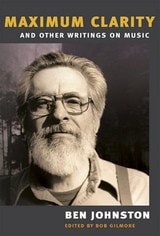
"Maximum Clarity" and Other Writings on Music
Ben Johnston. Edited by Bob Gilmore
University of Illinois Press, 2022
This collection spans forty years and brings together forty-one of Johnston's most important writings, including many rare and several previously unpublished selections. They include position papers, theoretical treatises, program notes, historical reflections, lectures, excerpts from interviews, and letters, and they cover a broad spectrum of concerns--from the technical exegesis of microtonality to the personal and the broadly humanistic. A discography of commercially available recordings of Johnston's music closes out the collection.
"Not Altogether Human"
Pantheism and the Dark Nature of the American RenaissanceRichard Hardack
University of Massachusetts Press, 2012
Many leading American thinkers in the nineteenth century, who accepted the premises of Emersonian transcendentalism, valued the basic concept of pantheism: that God inheres in nature and in all things, and that a person could achieve a sense of belonging she or he lacked in society by seeking a oneness with all of nature. As Richard Hardack shows, however, writers such as Ralph Waldo Emerson, Nathaniel Hawthorne, and Herman Melville conceived of nature as everything “Other”—other than the white male Protestant culture of which they were a part. This conception of nature, then, became racialized, and the divine became associated with African American and Native American identities, as well as with femininity.
In "Not Altogether Human," Hardack reevaluates transcendentalism in the context of nineteenth-century concerns about individual and national racial identity. Elucidating the influence of pantheism, Hardack draws on an array of canonical and unfamiliar materials to remap the boundaries of what has long been viewed as white male transcendental discourse.
This book significantly revises notions of what transcendentalism and pantheism mean and how they relate to each other. Hardack's close analysis of pantheism and its influence on major works and lesser known writing of the nineteenth century opens up a new perspective on American culture during this key moment in the country's history.
"Songes of Rechelesnesse"
Langland and the FranciscansLawrence M. Clopper
University of Michigan Press, 1997
In the late Middle Ages, Franciscan friars had a significant impact on all levels of society.
But because of the apparent discrepancy between the poverty the Franciscans claimed and the life they lived, a large body of antifraternal literature arose, including, supposedly, Piers Plowman. Since the sixteenth century, when it was first put into print, Piers Plowman has been understood to be a proto-Protestant work that revealed the failures of the medieval clergy, but especially of the mendicant orders. In "Songes of Rechelesnesse," Clopper establishes the presence of a Franciscan reformist position in Piers Plowman.
Clopper maintains that the poem articulates a reformist agenda, presenting the internal Franciscan debate, in a bid to return the order to its initial foundation. Clopper believes that Langland is deeply imbued with a Franciscan mentality that reaches deep into the structure of the poem. It manifests itself at the level of the alliterative long line in his exemplarist poetics and is the source of his imagery and politics. In short Clopper identifies Franciscanism as holding the poem together.
"Songes of Rechelesnesse" is a historical, political, and religious history of late fourteenth-century England. It will be of interest to literary scholars, historians of the late Middle Ages, and scholars in religious studies.
Lawrence M. Clopper is Director, Medieval Studies Institute, and Professor of English, Indiana University.
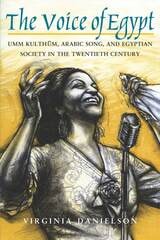
"The Voice of Egypt"
Umm Kulthum, Arabic Song, and Egyptian Society in the Twentieth CenturyVirginia Danielson
University of Chicago Press, 1997
Danielson examines the careful construction of Umm Kulthum's phenomenal popularity and success in a society that discouraged women from public performance. From childhood, her mentors honed her exceptional abilities to accord with Arab and Muslim practice, and as her stature grew, she remained attentive to her audience and the public reception of her work. Ultimately, she created from local precendents and traditions her own unique idiom and developed original song styles from both populist and neo-classical inspirations. These were enthusiastically received, heralded as crowning examples of a new, yet authentically Arab-Egyptian, culture. Danielson shows how Umm Kulthum's music and public personality helped form popular culture and contributed to the broader artistic, societal, and political forces that surrounded her.
This richly descriptive account joins biography with social theory to explore the impact of the individual virtuoso on both music and society at large while telling the compelling story of one of the most famous musicians of all time.
"She is born again every morning in the heart of 120 million beings. In the East a day without Umm Kulthum would have no color."—Omar Sharif
"This Book of Starres"
Learning to Read George HerbertJames Boyd White
University of Michigan Press, 1995
"This Book of Starres" is one of those all-too-rare books in which an author's love of someone's work--in this case, the seventeenth-century English poet George Herbert--leads to a journey of exploration.
Herbert's poetry presents a special set of challenges: It is to the modern ear archaic, difficult in thought and structure, and entirely theological in character. Yet no poet is more deeply admired by those who know him well. "This Book of Starres" is meant to engage the reader in a process of reading by which this verse can be seen to be vivid and alive. It is the record of one person's life-changing involvement with the poetry of George Herbert; in this it is about not only how, but why we read great poetry.
"It is a joy to experience Herbert's poetry in the company of James Boyd White, whose affinity for the work is always convincing and seems at times preternatural. 'This Book of Starres' is a necessary pleasure: all readers of poetry, whether expert or inexpert, will find it enriching." --Alice Fulton
". . . both a delight to read, and one of the most instructive exercises in literature and theology I have read for a long time. . . . Herbert emerges as one of the greatest, a writer to test and change the imagination, the very way in which we think about the world and that which is beyond it." --Literature and Theology
James Boyd White is Hart Wright Professor of Law, Professor of English, and Adjunct Professor of Classical Studies, University of Michigan.
"We, the Barbarians"
Three Mexican Writers in the Twenty-First CenturyMabel Moraña; Translated by Stephanie L. Kirk
Vanderbilt University Press, 2024
Characterized by the fragmentation of civil society and the decomposition of the myths that accompanied the consolidation of the modern nation, Mexican visual and literary arts have explored a myriad of representational avenues to approach the phenomena of violence, institutional decay, and political instability. The critical and theoretical approaches in “We, the Barbarians” explore a variety of alternative symbolic representations of topics such as nationalism, community, and affect in times impacted by systemic violence, precariousness, and radical inequality. Moraña perceives the negotiations between regional/local imaginaries and global scenarios characterized by the devaluation and resignification of life, both at individual and collective levels. Though it uses three authors as its focus, this book seeks to more broadly theorize the question of the relationship between literature and the social in the twenty-first century.

'Twas Only an Irishman's Dream
The Image of Ireland and the Irish in American Popular Song Lyrics, 1800-1920William H. A. Williams
University of Illinois Press, 1996
Over time, the image of the Irish in the United States changed from that of hard-drinking Paddies to genial working-class citizens.
In 'Twas Only an Irishman's Dream, William H. A. Williams traces the change in this image through more than seven hundred pieces of sheet music--popular songs from the stage and for the parlor--to show how Americans' opinions of Ireland and the Irish swung from one extreme to the other.
As Williams shows, sheet music's place as a commercial item meant it had to be acceptable to the broadest possible song-buying public. Negotiations about the image of the Irish and Irish Americans involved Irish songwriters, performers, and pressured groups on one side, and non-Irish writers, publishers, and audiences on the other. Williams ties the contents of song lyrics to the history of the Irish diaspora, revealing how societies create ethnic stereotypes and how such stereotypes evolve, and even disappear, from mainstream popular culture.
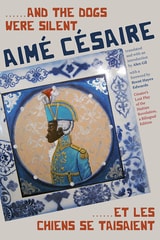
......And the Dogs Were Silent/......Et les chiens se taisaient
Aimé Césaire. Translated and with an introduction by Alex Gil. With a foreword by Brent Hayes Edwards.
Duke University Press, 2024
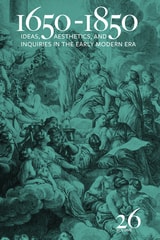
1650-1850
Ideas, Aesthetics, and Inquiries in the Early Modern Era (Volume 26)Kevin L. Cope
Bucknell University Press, 2021
Volume 26 of 1650–1850: Ideas, Aesthetics, and Inquiries in the Early Modern Era travels beyond the usual discussions of power, identity, and cultural production to visit the purlieus and provinces of Britain’s literary empire. Bulging at its bindings are essays investigating out-of-the-way but influential ensembles, whether female religious enthusiasts, annotators of Maria Edgeworth’s underappreciated works, or modern video-based Islamic super-heroines energized by Mary Wollstonecraft’s irreverance. The global impact of the local is celebrated in studies of the personal pronoun in Samuel Johnson’s political writings and of the outsize role of a difficult old codger in catalyzing the literary career of Charlotte Smith. Headlining a volume that peers into minute details in order to see the outer limits of Enlightenment culture is a special feature on metaphor in long-eighteenth-century poetry and criticism. Five interdisciplinary essays investigate the deep Enlightenment origins of a trope usually associated with the rise of Romanticism. Volume 26 culminates in a rich review section containing fourteen responses to current books on Enlightenment religion, science, literature, philosophy, political science, music, history, and art.
About the annual journal 1650-1850
1650-1850 publishes essays and reviews from and about a wide range of academic disciplines: literature (both in English and other languages), philosophy, art history, history, religion, and science. Interdisciplinary in scope and approach, 1650-1850 emphasizes aesthetic manifestations and applications of ideas, and encourages studies that move between the arts and the sciences—between the “hard” and the “humane” disciplines. The editors encourage proposals for special features that bring together five to seven essays on focused themes within its historical range, from the Interregnum to the end of the first generation of Romantic writers. While also being open to more specialized or particular studies that match up with the general themes and goals of the journal, 1650-1850 is in the first instance a journal about the artful presentation of ideas that welcomes good writing from its contributors.
ISSN 1065-3112.
Published by Bucknell University Press. Distributed worldwide by Rutgers University Press.
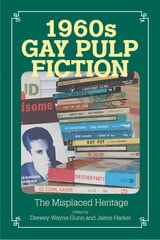
1960s Gay Pulp Fiction
The Misplaced HeritageDrewey Wayne Gunn
University of Massachusetts Press, 2013
As a result of a series of court cases, by the mid-1960s the U.S. post office could no longer interdict books that contained homosexuality. Gay writers were eager to take advantage of this new freedom, but the only houses poised to capitalize on the outpouring of manuscripts were “adult” paperback publishers who marketed their products with salacious covers. Gay critics, unlike their lesbian counterparts, have for the most part declined to take these works seriously, even though they cover an enormous range of genres: adventures, blue-collar and gray-flannel novels, coming-out stories, detective fiction, gothic novels, historical romances, military stories, political novels, prison fiction, romances, satires, sports stories, and spy thrillers—with far more short story collections than is generally realized. Twelve scholars have now banded together to begin a recovery of this largely forgotten explosion of gay writing that occurred in the 1960s.
Descriptions of these pulps have often been inadequate and misinforming, the result of misleading covers, unrepresentative sampling of texts, and a political blindness that refuses to grant worth to pre-Stonewall writing. This volume charts the broader implications of this state of affairs before examining some of the more significant pulp writers from the period. It brings together a diverse range of scholars, methodologies, and reading strategies. The evidence that these essays amass clearly demonstrates the significance of gay pulps for gay literary history, queer cultural studies, and book history.

20th-Century Italian Women Writers
The Feminine ExperienceAlba Amoia
Southern Illinois University Press, 1996
As an international scholar and resident of Italy who has observed and shared the experiences of Italian women for the past twenty years, Alba Amoia has positioned herself perfectly to report to English-speaking audiences the great range and variety of writing produced by twentieth-century Italian women. Her personal contact with many of the authors she discusses lends further immediacy to her study.
Rather than focusing exclusively on contemporary living authors, Amoia discusses writers from the early part of the twentieth century as well, linking them with later writers spanning twentieth-century Italy’s literary movements and political, social, and economic developments. Yet the connections and contradictions that bind and divide these women are only beginning to be established because Italy is still a splintered country in which perceptions of Italian women as a historical group have only begun to crystallize. While feminine voices resound on the Italian literary scene, only recently has feminine authority made itself felt in the professional and institutional worlds.
The eleven writers in this volume criticize the female role in Italian society, externalize women’s unconscious needs, and offer unusual examples of feminine creativity. Amoia provides a critical treatment of each author, incorporating the accepted opinion of Italian and other critics. She isolates recurrent and fundamental themes in each author’s literary career: linguistic repression by males, personal frustration in the realm of "householditude," and disorientation within Italy’s unbalanced institutions and hierarchies still strongly anchored in archaic structures.
Amoia begins her discussion with two illustrious predecessors of Italy’s contemporary women writers: the 1926 Nobel Prize winner Grazia Deledda and the premier literary feminist Sibilla Aleramo. Continuing in chronological order, Amoia discusses Gianna Manzini, Lalla Romano, Elsa Morante, Natalia Ginzburg, Rosetta Loy, and Dacia Maraini. Amoia concludes her exploration of Italian women writers with three journalists: Matilde Serao, Oriana Fallaci, and Camilla Cederna.
Essentially, Amoia has provided a collection of succinct and accessible monographs featuring pertinent biographical information and extensive bibliographies. She discusses each author’s most representative works, seeking to give readers both a sense of these women as writers and an understanding of their significance in the male-dominated literary scene.
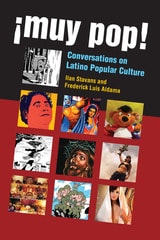
¡Muy Pop!
Conversations on Latino Popular CultureIlan Stavans and Frederick Luis Aldama
University of Michigan Press, 2013
Although investigations of Hispanic popular culture were approached for decades as part of folklore studies, in recent years scholarly explorations—of lucha libre, telenovelas, comic strips, comedy, baseball, the novela rosa and the detective novel, sci-fi, even advertising—have multiplied. What has been lacking is an overarching canvas that offers context for these studies, focusing on the crucial, framing questions: What is Hispanic pop culture? How does it change over time and from region to region? What is the relationship between highbrow and popular culture in the Hispanic world? Does it make sense to approach the whole Hispanic world as homogenized when understanding Hispanic popular culture? What are the differences between nations, classes, ethnic groups, religious communities, and so on? And what distinguishes Hispanic popular culture in the United States?
In ¡Muy Pop!, Ilan Stavans and Frederick Luis Aldama carry on a sustained, free-flowing, book-length conversation about these questions and more, concentrating on a wide range of pop manifestations and analyzing them at length. In addition to making Hispanic popular culture visible to the first-time reader, ¡Muy Pop! sheds new light on the making and consuming of Hispanic pop culture for academics, specialists, and mainstream critics.
¿Entiendes?
Queer Readings, Hispanic WritingsEmilie L. Bergmann and Paul Julian Smith, eds.
Duke University Press, 1995
Combining intimate knowledge of Spanish-speaking cultures with contemporary queer theory, these essays address texts that share both a common language and a concern with lesbian, gay, and bisexual identities. Using a variety of approaches, the contributors tease the homoerotic messages out of a wide range of works, from chronicles of colonization in the Caribbean to recent Puerto Rican writing, from the work of Cervantes to that of the most outrageous contemporary Latina performance artists. This volume offers a methodology for examining work by authors and artists whose sexuality is not so much open as "an open secret," respecting, for example, the biographical privacy of writers like Gabriela Mistral while responding to the voices that speak in their writing. Contributing to an archeology of queer discourses, ¿Entiendes? also includes important studies of terminology and encoded homosexuality in Argentine literature and Caribbean journalism of the late nineteenth century.
Whether considering homosexual panic in the stories of Borges, performances by Latino AIDS activists in Los Angeles, queer lives in turn-of-the-century Havana and Buenos Aires, or the mapping of homosexual geographies of 1930s New York in Lorca’s "Ode to Walt Whitman," ¿Entiendes? is certain to stir interest at the crossroads of sexual and national identities while proving to be an invaluable resource.
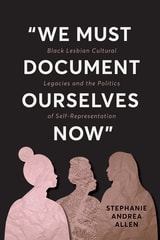
“We Must Document Ourselves Now”
Black Lesbian Cultural Legacies and the Politics of Self-RepresentationStephanie Andrea Allen
The Ohio State University Press, 2026
A long-overdue analysis of how Black lesbians have asserted their lived experience through creative practice, pushing back against heteropatriarchal systems that deny them visibility.
“We Must Document Ourselves Now” examines the essential but oft-ignored importance of Black lesbian literature and film in queer literary and film histories, arguing that Black lesbian cultural texts reflect creators’ lived experiences and resist the heteropatriarchal systems that deny Black lesbians visibility in popular culture. Stephanie Andrea Allen contends that these texts have three goals: to lay bare the experiences of Black lesbians in a raced, gendered, classed, and homophobic society; to challenge the notion that claiming Black lesbian identity is marginal or forbidden; and to take care of Black lesbians by bearing witness to their experiences through creative practice.
Insisting that Black feminist creative practice is an integral form of self and community care, Allen weaves analysis of cultural output spanning key sociocultural moments from 1974 to 2020 with interviews with Black lesbian cultural workers. “We Must Document Ourselves Now” examines the Black Arts / Black Power movement, the “boom” in lesbian and gay publishing, the so-called golden era of Black film, and twenty-first-century visual media to demonstrate how representations of Black lesbians, or lack thereof, were vital to constructing a cultural canon that focused on illuminating Black lesbian experiences in the United States.