Results by title
748 books match the query 'Influence' and 6 start with a non-letter
"Beyond This Narrow Now"
Or, Delimitations, of W. E. B. Du BoisNadhum Dimitri Chandler
Duke University Press, 2022
"K for the Way"
DJ Rhetoric and Literacy for 21st Century Writing StudiesTodd Craig
Utah State University Press, 2023
Using material from a larger qualitative research study that illustrates the Hip Hop DJ as a twenty-first-century new media reader, writer, and literary critic, Craig blends interviews from prominent and influential DJs in the Hip Hop community with narrative and interdisciplinary scholarship from writing studies, Hip Hop studies, African American studies, urban education, and ethnomusicology. The voices of DJs sit front and center, presenting a revolutionary conversation about writing and communication in the twenty-first century.
Weaving Craig’s life experiences with important discussions of racial literacies, “K for the Way” is a layered and utterly singular exploration of culture, identity, and literacy in America.
"There Is a North"
Fugitive Slaves, Political Crisis, and Cultural Transformation in the Coming of the Civil WarJohn L. Brooke
University of Massachusetts Press, 2019
How does political change take hold? In the 1850s, politicians and abolitionists despaired, complaining that the "North, the poor timid, mercenary, driveling North" offered no forceful opposition to the power of the slaveholding South. And yet, as John L. Brooke proves, the North did change. Inspired by brave fugitives who escaped slavery and the cultural craze that was Uncle Tom's Cabin, the North rose up to battle slavery, ultimately waging the bloody Civil War.
While Lincoln's alleged quip about the little woman who started the big war has been oft-repeated, scholars have not fully explained the dynamics between politics and culture in the decades leading up to 1861. Rather than simply viewing the events of the 1850s through the lens of party politics, “There Is a North” is the first book to explore how cultural action—including minstrelsy, theater, and popular literature—transformed public opinion and political structures. Taking the North's rallying cry as his title, Brooke shows how the course of history was forever changed.
1865
America Makes War and Peace in Lincoln’s Final YearEdited by Harold Holzer and Sara Vaughn Gabbard
Southern Illinois University Press, 2015
In 1865 Americans faced some of the most important issues in the nation’s history: the final battles of the Civil War, the struggle to pass the Thirteenth Amendment, the peace process, reconstruction, the role of freed slaves, the tragedy of Abraham Lincoln's assassination, and the trials of the conspirators. In this illuminating collection, prominent historians of nineteenth-century America offer insightful overviews of the individuals, events, and issues on 1865 that shaped the future of the United States.
Following an introduction by renowned Lincoln scholar Harold Holzer, nine new essays explore the end of the Civil War, Lincoln’s death, and the start of the tentative peace in 1865. Michael Vorenberg discusses how Lincoln shepherded through the House of Representatives the resolution sending the Thirteenth Amendment to the states for ratification, John F. Marszalek and Michael B. Ballard examine the partnership of Lincoln’s war management and General Ulysses S. Grant’s crucial last thrusts against Robert E. Lee, and Richard Striner recounts how Lincoln faced down Confederate emissaries who proposed immediate armistice if Lincoln were to reverse the Emancipation Proclamation. Ronald C. White Jr. offers a fresh look at Lincoln’s second inaugural address, and Richard Wightman Fox provides a vivid narrative of Lincoln’s dramatic walk through Richmond after the Confederates abandoned their capital.
Turning to Lincoln’s assassination, Edward Steers Jr. relates the story of Booth’s organizational efforts that resulted in the events of that fateful day, and Frank J. Williams explains the conspirators’ trial and whether they should have faced military or civilian tribunals. Addressing the issue of black suffrage, Edna Greene Medford focuses on the African American experience in the final year of the war. Finally, Holzer examines the use of visual arts to preserve the life and legacy of the martyred president.
Rounding out the volume are a chronology of national and international events during 1865, a close look at Lincoln’s activities and writings from January 1 through April 14, and other pertinent materials. This thoughtful collection provides an engaging evaluation of one of the most crucial years in America’s evolution.
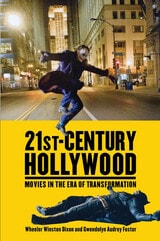
21st-Century Hollywood
Movies in the Era of TransformationDixon, Wheeler Winston
Rutgers University Press, 2011
They are shot on high-definition digital cameras—with computer-generated effects added in postproduction—and transmitted to theaters, websites, and video-on-demand networks worldwide. They are viewed on laptop, iPod, and cell phone screens. They are movies in the 21st century—the product of digital technologies that have revolutionized media production, content distribution, and the experience of moviegoing itself.
21st-Century Hollywood introduces readers to these global transformations and describes the decisive roles that Hollywood is playing in determining the digital future for world cinema. It offers clear, concise explanations of a major paradigm shift that continues to reshape our relationship to the moving image. Filled with numerous detailed examples, the book will both educate and entertain film students and movie fans alike.
9/11
The Culture of CommemorationDavid Simpson
University of Chicago Press, 2006
In 9/11, Simpson argues that elements of the conventional culture of mourning and remembrance—grieving the dead, summarizing their lives in obituaries, and erecting monuments in their memory—have been co-opted for political advantage. He also confronts those who labeled the event an “apocalypse,” condemning their exploitation of 9/11 for the defense of torture and war.
In four elegant chapters—two of which expand on essays originally published in the London Review of Books to great acclaim—Simpson analyzes the response to 9/11: the nationally syndicated “Portraits of Grief” obituaries in the New York Times; the debates over the rebuilding of the World Trade Center towers and the memorial design; the representation of American and Iraqi dead after the invasion of March 2003, along with the worldwide circulation of the Abu Ghraib torture photographs; and the urgent and largely ignored critique of homeland rhetoric from the domain of critical theory.
Calling for a sustained cultural and theoretical analysis, 9/11 is the first book of its kind to consider the events of that tragic day with a perspective so firmly grounded in the humanities and so persuasive about the contribution they can make to our understanding of its consequences.