Results by title
412 books match the query 'Japan' and 3 start with a non-letter
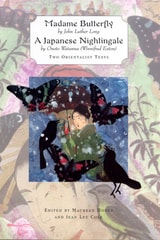
'Madame Butterfly' and 'A Japanese Nightingale'
Two Orientalist TextsCole, Jean Lee
Rutgers University Press, 2002
Madame Butterfly (1898) and A Japanese Nightingale (1901) both appeared at the height of American fascination with Japanese culture. These two novellas are paired here together for the first time to show how they defined and redefined contemporary misconceptions of the "Orient." This is the first reprinting of A Japanese Nightingale since its 1901 appearance, when it propelled Winnifred Eaton (using the pseudonym Onoto Watanna) to fame. John Luther Long's Madame Butterfly introduced American readers to the figure of the tragic geisha who falls in love with, and is then rejected by, a dashing American man; the opera Puccini based upon this work continues to enthrall audiences worldwide. Although Long emphasized the insensitivity of Westerners in their dealings with Asian people, the ever-faithful Cho-Cho-San typified Asian subservience and Western dominance. A Japanese Nightingale takes Long's revision several steps further. Eaton's heroine is powerful in her own right and is loved on her own terms. A Japanese Nightingale is also significant for its hidden personal nature. Although Eaton's pen name implied she was Japanese, she was, in fact, of Chinese descent. Living in a society that was virulently anti-Chinese, she used a Japanese screen for her own problematic identity, and A Japanese Nightingale tells us as much about the author's struggle to embrace her Asian heritage as it does about the stereotypes she contests.
[more]
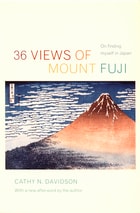
36 Views of Mount Fuji
On Finding Myself in JapanCathy N. Davidson
Duke University Press, 2006
In 1980 Cathy N. Davidson traveled to Japan to teach English at a leading all-women’s university. It was the first of many journeys and the beginning of a deep and abiding fascination. In this extraordinary book, Davidson depicts a series of intimate moments and small epiphanies that together make up a panoramic view of Japan. With wit, candor, and a lover’s keen eye, she tells captivating stories—from that of a Buddhist funeral laden with ritual to an exhilarating evening spent touring the “Floating World,” the sensual demimonde in which salaryman meets geisha and the normal rules are suspended. On a remote island inhabited by one of the last matriarchal societies in the world, a disconcertingly down-to-earth priestess leads her to the heart of a sacred grove. And she spends a few unforgettable weeks in a quasi-Victorian residence called the Practice House, where, until recently, Japanese women were taught American customs so that they would make proper wives for husbands who might be stationed abroad. In an afterword new to this edition, Davidson tells of a poignant trip back to Japan in 2005 to visit friends who had remade their lives after the Great Hanshin Earthquake of 1995, which had devastated the city of Kobe, as well as the small town where Davidson had lived and the university where she taught.
36 Views of Mount Fuji not only transforms our image of Japan, it offers a stirring look at the very nature of culture and identity. Often funny, sometimes liltingly sad, it is as intimate and irresistible as a long-awaited letter from a good friend.
[more]
“The Sting of Death” and Other Stories
Shimao Toshio; Translated with an Introduction and Interpretive Comments by Kathryn Sparling
University of Michigan Press, 1985
Until a recent “boom,” Shimao Toshio, writer of short fiction, critic, and essayist, was not widely known, even in Japan. He has never won the Akutagawa or the Naoki Prize, and none of his works had previously appeared in English translation. He is less well known than other writers (Yasuoka Shotaro, Kojima Nobuo, and Shono Junzo) with whom he has associated and whose works have been liberally translated into English. Yet, there are those who consider him to be one of the best contemporary writers in Japan.
This volume by no means exhausts the scope of Shimao's fiction. There are no stories here, for instance, about childhood or student life, and none of his many travel stories. Some of his most famous stories-- "When we Never Left Port," for example--have not been included. But the stories presented here do offer a considerable variety of style, from the pristine storybook language of "The Farthest Edge of the Islands," to the young intellectual's jargon of "Everyday Life in a Dream," to the visionary, hysterical, occasionally ritualistic prose of the "sick wife" stories, to the sober, difficult, almost ponderous narration of "This Time That Summer." Shimao's approach to his material varies as well. "Everyday Life in a Dream" is the only representative here of a large number of stories usually called surrealistic by the critics, stories whose plots progress by the logic of dreams. The individual experience of real life are lived through a combination of conscious and unconscious perception. These stories are the least approachable and the least charming to the casual reader, but they serve, among other things, to highlight patterns in the more realistic fiction. "The Farthest Edge of the Islands" is a symbolic heightening of reality in another way, a romantic fairy tale beginning at the extremity of experience, at the farthest edge of the world. The other stories are presented as precise, close chronicles of reality by a participant in that reality whose attention never waivers and who never allows himself to avert his eyes from a world that he sees as his responsibility and in a sense his fault. All but the first story, "The Farthest Edge of the Islands," which is in third-person narration, are told in the first person by the character who plays Shimao's role in the life that inspired the fiction.
[more]