Results by title
138 books match the query 'Lincoln, Abraham' and 3 start with a non-letter
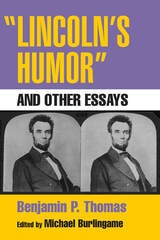
"Lincoln's Humor" and Other Essays
Benjamin P. Thomas. Edited by Michael Burlingame
University of Illinois Press, 2006
A skilled historian and a masterful storyteller himself, Thomas was widely regarded as the greatest Lincoln historian of his generation. With these essays, he combines historical depth with narrative grace in delineating Lincoln's qualities as a humorist, lawyer, and politician. From colorful tall tales to clever barbs aimed at political opponents, Lincoln clothed a shrewd wit in a homespun, backwoods vernacular. He used humor to defuse tension, illuminate a point, put others at ease--and sometimes for sheer fun. From an early reliance on broad humor and ridicule in speeches and on the stump, Lincoln's style shifted in 1854 to a more serious vein in which humor came primarily to elucidate an argument. "If I did not laugh occasionally I should die," he is said to have told his cabinet, "and you need this medicine as much as I do." Thomas brings his deep knowledge of Lincoln to essays on the great man's tumultuous career in Congress, his work as a lawyer, his experiences in the Courts, and his opinions of the South. A gracious survey of Lincoln's early biographers, particularly Ida Tarbell, stands alongside an appreciation of Harry Edward Pratt, a key figure in the early days of the Abraham Lincoln Association. Thomas also assesses Lincoln's use of language and the ongoing significance of the Gettysburg Address.
This diverse collection is enhanced by an introduction by Michael Burlingame, himself a leading biographer of Lincoln. Burlingame provides a balanced portrait of Thomas and his circuitous path toward writing history.
1863
Lincoln's Pivotal YearEdited by Harold Holzer and Sara Vaughn Gabbard
Southern Illinois University Press, 2013
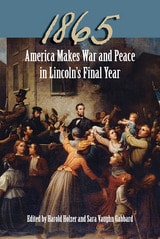
1865
America Makes War and Peace in Lincoln’s Final YearEdited by Harold Holzer and Sara Vaughn Gabbard
Southern Illinois University Press, 2015
In 1865 Americans faced some of the most important issues in the nation’s history: the final battles of the Civil War, the struggle to pass the Thirteenth Amendment, the peace process, reconstruction, the role of freed slaves, the tragedy of Abraham Lincoln's assassination, and the trials of the conspirators. In this illuminating collection, prominent historians of nineteenth-century America offer insightful overviews of the individuals, events, and issues on 1865 that shaped the future of the United States.
Following an introduction by renowned Lincoln scholar Harold Holzer, nine new essays explore the end of the Civil War, Lincoln’s death, and the start of the tentative peace in 1865. Michael Vorenberg discusses how Lincoln shepherded through the House of Representatives the resolution sending the Thirteenth Amendment to the states for ratification, John F. Marszalek and Michael B. Ballard examine the partnership of Lincoln’s war management and General Ulysses S. Grant’s crucial last thrusts against Robert E. Lee, and Richard Striner recounts how Lincoln faced down Confederate emissaries who proposed immediate armistice if Lincoln were to reverse the Emancipation Proclamation. Ronald C. White Jr. offers a fresh look at Lincoln’s second inaugural address, and Richard Wightman Fox provides a vivid narrative of Lincoln’s dramatic walk through Richmond after the Confederates abandoned their capital.
Turning to Lincoln’s assassination, Edward Steers Jr. relates the story of Booth’s organizational efforts that resulted in the events of that fateful day, and Frank J. Williams explains the conspirators’ trial and whether they should have faced military or civilian tribunals. Addressing the issue of black suffrage, Edna Greene Medford focuses on the African American experience in the final year of the war. Finally, Holzer examines the use of visual arts to preserve the life and legacy of the martyred president.
Rounding out the volume are a chronology of national and international events during 1865, a close look at Lincoln’s activities and writings from January 1 through April 14, and other pertinent materials. This thoughtful collection provides an engaging evaluation of one of the most crucial years in America’s evolution.