Results by title
1787 books match the query 'Literary Collections' and 18 start with a non-letter
"And there will be singing"
An Anthology of International WritingJim Hicks
University of Massachusetts Press, 2019
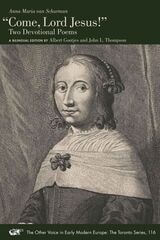
"Come, Lord Jesus!"
Two Devotional Poems. A Bilingual EditionAnna Maria van Schurman
Iter Press, 2026
The life and reputation of Anna Maria van Schurman (1607–78) swung dramatically from her early fame as a prodigy and femme savante to the infamy she bore in the wake of her late affiliation with Jean de Labadie. From her late adolescence on, van Schurman was widely known for her intellectual gifts, her mastery of languages, and her skillful portraiture and embroidery. Described by some as a femme savante and “the Star of Utrecht,” she gained an international reputation with the publication of her defense of women’s education. Her later years, however, were marked by a growing disillusionment with her own fame and intellectual achievements, and her reputation was dramatically marred in the eyes of her contemporaries when, in her final decade, she repudiated the Dutch Reformed Church to affiliate with Jean de Labadie. With him and his spiritual community, she lived out her last years in peace while also composing a two-volume defense of her actions and convictions, entitled Eukleria or The Better Choice.
The years between her withdrawal from public life and her supposedly scandalous return are not easily mapped. Drawing on two long devotional poems that she wrote during this period (and that remained unpublished during her lifetime), this bilingual edition introduces readers to van Schurman’s private piety, as well as to her theological acumen, her artistry as a vernacular poet, and her participation in the leadership of a conventicle of like-minded friends and acquaintances. The English translation closely approximates the rhyme, meter, and cadence of the Dutch original and thus facilitates an appreciation not only of the poet’s meaning but also of the auditory aesthetics of each text.
"Ich Kuss Die Hand"
The Letters of H. L. Mencken To Gretchen HoodH. L. Mencken
University of Alabama Press, 1986
“Ich Kuss Die Hand”: The Letters of H. L. Mencken to Gretchen Hood relates an episode in Mencken's life that has received only passing mention from his biographers. Gretchen Hood's acquaintance with the journalistic life of Washington formed a bond with Mencken, who thought of himself, first and foremost, as an inveterate newspaperman (they playfully entertained the idea of starting their own Washington newspaper), and she had a ready appreciation for his performances as a connoisseur of the Washington political spectacle. Mencken, the amateur musician and music buff, respected her talent and professional background.
His letters indicate that he found in her an intelligent, witty, and charming respondent to his characteristic traits of personality and style. She both flattered his ego and challenged him to exhibit his celebrated manner at its best. On her part, Hood was not simply awestruck by Mencken's attentions but met them with her independent verve. “Nothing scared me,” she later said of her attitude; “ready to take on all comers.” Mencken liked to refer to her as “a licensed outlaw,” a designation that captures his impression of her and describes as well the fashionable unconventionality, which fueled the Mencken vogue.
Mencken wrote Hood over two hundred letters, and she must have written him about the same number. For much of the time they corresponded, they exchanged several letters every month, sometimes as many as four or five a week. As their communications blossomed into a four-year friendship, personal meetings soon supplemented the flow of letters.
"Incantations" and Other Stories
An Important New Young Voice From IndiaAppachana, Anjana
Rutgers University Press, 1992
All life seems to be prescribed; these characters bravely or cautiously confront the rules and regulations or finally give in to them resignedly—any small triumphs they achieve are never clear-cut. One of the most unusual aspects of many of the stories is the way in which they are informed by but never ruled by the author's feminism. She never lectures her readers but lets us see for ourselves: a bride caught in a hopeless marriage where she has given up all rights to any life of her own, a hapless college student who is confined to campus for minor infractions just at the time when she had an appointment for an abortion, a young girl who keeps the dark secret of her sister's rape, a woman executive and a digruntled male clerk both trapped in the intricate bureaucracy of their business firm and the roles they must play to survive there. By turns warm, gullible, arrogant and bigoted, all of these characters live their lives amid contradictions and double standards, superstitions and impossible dreams. Appachana's vision is unique, her writing superb. Readers will thank her for allowing them to enter territory that is at once distant and exotic but also familiar and recognizable.
"Still They Remember Me"
Penobscot Transformer Tales, Volume 1Carol A. Dana, Margo Lukens, and Conor M. Quinn
University of Massachusetts Press, 2021
In "Still They Remember Me," stories are presented in the Penobscot language and English side-by-side, coupled with illustrations from members of the tribal community. For the first time, these stories are accessible to a young generation of Penobscot language learners and scholars of Native American literatures at all levels, from grade school to graduate school.
"Sweat"
Written by Zora Neale HurstonWall, Cheryl A
Rutgers University Press, 1997
Now frequently anthologized, Zora Neale Hurston's short story "Sweat" was first published in Firell, a legendary literary magazine of the Harlem Renaissance, whose sole issue appeared in November 1926. Among contributions by Gwendolyn Bennett, Countee Cullen, Langston Hughes, and Wallace Thurman, "Sweat" stood out both for its artistic accomplishment and its exploration of rural Southern black life. In "Sweat" Hurston claimed the voice that animates her mature fiction, notably the 1937 novel Their Eyes Were Watching God; the themes of marital conflict and the development of spiritual consciousness were introduced as well. "Sweat" exemplifies Hurston's lifelong concern with women's relation to language and the literary possibilities of black vernacular.
This casebook for the story includes an introduction by the editor, a chronology of the author's life, the authoritative text of "Sweat," and a second story, "The Gilded Six-Bits." Published in 1932, this second story was written after Hurston had spent years conducting fieldwork in the Southern United States. The volume also includes Hurston's groundbreaking 1934 essay, "Characteristics of Negro Expression," and excerpts from her autobiography, Dust Tracks on a Road. An article by folklorist Roger Abrahams provides additional cultural contexts for the story, as do selected blues and spirituals. Critical commentary comes from Alice Walker, who led the recovery of Hurston's work in the 1970s, Robert Hemenway, Henry Louis Gates, Gayl Jones, John Lowe, Kathryn Seidel, and Mary Helen Washington.
"Tell Me a Riddle"
Tillie OlsenRosenfelt, Deborah S
Rutgers University Press, 1995
This casebook includes an introduction by the editor, a chronology of Olsen’s life, an authoritative text of “Tell Me a Riddle,” relevant essays by Olsen, seven critical essays, and a bibliography.
The contributors are: Joanne Trautmann Banks, Constance Coiner, Rachel Blau Duplessis, Mara Faulkner, Elaine Orr, Linda Ray Pratt, and Deborah Silverton Rosenfelt.
"The Amber Gods" and Other Stories by Harriet Prescott Spofford
Bendixen, Alfred
Rutgers University Press, 1989
The title story presents a self-centered and captivating woman who ruthlessly steals her orphan cousin's lover. In "Circumstance," a pioneer woman returning home through the woods at night is caught by a panther; her husband, who has come to save her, can only watch from the ground as she sings for her life, pinned in a tree. A train engineer hallucinates again and again that he is running over his wife. And Mrs. Craven, who's a bit "weak" in the head, mindlessly repeats "Three men went down cellar and only two came up." These stories combine elements of the best ghost stories—timing, detail, and character —with just enough chill to make you think twice about turning out your lights at night.
"The Girl in the Window" and Other True Tales
An Anthology with Tips for Finding, Reporting, and Writing Nonfiction NarrativesLane DeGregory
University of Chicago Press, 2023
This book—part anthology, part craft guide—provides a forensic reading of twenty-four of DeGregory’s singular stories, illustrating her tips for writers alongside pieces that put those elements under the microscope. Each of the pieces gathered here—including the Pulitzer Prize–winning title story—is accompanied by notes on how she built the story, plus tips on how nonfiction writers at all levels can do the same. Featuring a foreword by Beth Macy, author of the acclaimed Dopesick, this book is sure to delight fans of DeGregory’s writing, as well as introduce her to readers and writers who have not yet discovered her inspiring body of work.
"The Skeleton in Grandpa's Barn"
And Other Stories of Growing Up in UtahStanford J. Layton
Signature Books, 2008
"Venus in Boston" and Other Tales of Nineteenth-Century City Life
George Thompson
University of Massachusetts Press, 2002
The three works in this volume offer a rich representative sample of Thompson's writing. The two novels—Venus in Boston and City Crimes—depict the American city as a place of dark mystery, bawdy humor, and near-universal corruption peopled with con artists and criminals of all kinds. In each novel, a complex narrative structure interweaves multiple stories of exploited labor, abuse of power, seduction, intrigue, and crime. Thompson's autobiography, My Life, presents the author's life in terms nearly as lively as his fiction.
Thompson's zestful, unconventional writings fly in the face of the stereotypical view of Victorian America as straitlaced and sentimental. Ideal for use as a classroom text, this new edition includes a scholarly introduction and an extensive bibliography.
'A New Home, Who Will Follow?' by Caroline Kirkland
Zagarell, Sandra A
Rutgers University Press, 1990
A New Home is a vivid contribution to a new kind of narrative developed during the antebellum period, ethnographic fiction. Kirkland highlights the importance and the drama of local practices and everyday life in Montacute. She traces the way two groups of settlers slowly adjust to each other - the old hands and the newcomers from the East;. Dramatizing differences of class and culture, she also shows how the groups finally form a genuine community and a new, diverse culture. Kirkland also gives ethnographic fiction an original twist: she satirizes the provincialism and the rigidity of both groups of settlers.
After writing A New Home, Kirkland became a professional literary woman, working as an editor as well as a writer. In her introduction, Sandra Zagarell explores the implications of Kirkland's writing and professional career for our understanding of women, writing, and the world of literature in antebellum America.
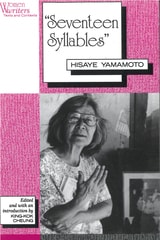
'Seventeen Syllables'
Hisaye YamamotoEdited by King-Kok Cheung
Rutgers University Press, 1994
Yamamoto's disarming style matches the verbal economy of haiku, in which all meaning is contained within seventeen syllables. Her deft characterizations and her delineations of sexuality create a haunting story of a young girl's transformation from innocence to adulthood.
This casebook includes an introduction and an essay by the editor, an interview with the author, a chronology, authoritative texts of "Seventeen Syllables" (1949) and "Yoneko's Earthquake" (1951), critical essays, and a bibliography. The contributors are Charles L. Crow, Donald C. Goellnicht, Elaine H. Kim, Dorothy Ritsuko McDonald, Zenobia Baxter Mistri, Katharine Newman, Robert M. Payne, Robert T. Rolf, and Stan Yogi.
'The Lamplighter' by Maria Susanna Cummins
Baym, Nina
Rutgers University Press, 1988
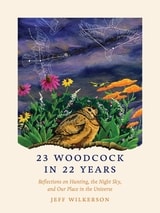
23 Woodcock in 22 Years
Reflections on Hunting, the Night Sky, and Our Place in the UniverseJeff Wilkerson
University of Iowa Press, 2024
As Wilkerson’s thoughts soar to the stars that produced the chemical elements that form us and all the land and its creatures, simple reflections on going afield to harvest a woodcock for a special holiday meal ground him. What emerges is a love story about a bird, the land, and all of creation from atomic nuclei to the farthest reaches of the universe, and a reminder to acknowledge the gentle flow of time while cherishing the everyday existence around us.
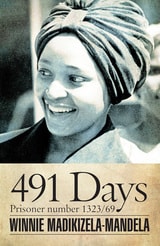
491 Days
Prisoner Number 1323/69Winnie Madikizela-Mandela
Ohio University Press, 2014
On a freezing winter’s night, a few hours before dawn on May 12, 1969, South African security police stormed the Soweto home of Winnie Madikizela-Mandela, activist and wife of the imprisoned Nelson Mandela, and arrested her in the presence of her two young daughters, then aged nine and ten.
Rounded up in a group of other antiapartheid activists under Section 6 of the Terrorism Act, designed for the security police to hold and interrogate people for as long as they wanted, she was taken away. She had no idea where they were taking her or what would happen to her children. For Winnie Mandela, this was the start of 491 days of detention and two trials.
Forty-one years after Winnie Mandela’s release on September 14, 1970, Greta Soggot, the widow of one of the defense attorneys from the 1969–70 trials, handed her a stack of papers that included a journal and notes she had written while in detention, most of the time in solitary confinement. Their reappearance brought back to Winnie vivid and horrifying memories and uncovered for the rest of us a unique and personal slice of South Africa’s history.
491 Days: Prisoner Number 1323/69 shares with the world Winnie Mandela’s moving and compelling journal along with some of the letters written between several affected parties at the time, including Winnie and Nelson Mandela, himself then a prisoner on Robben Island for nearly seven years.
Readers will gain insight into the brutality she experienced and her depths of despair, as well as her resilience and defiance under extreme pressure. This young wife and mother emerged after 491 days in detention unbowed and determined to continue the struggle for freedom.
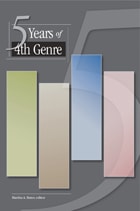
5 Years of 4th Genre
Martha Bates
Michigan State University Press, 2006
In 1999, Michigan State University Press launched Fourth Genre: Explorations in Creative Nonfiction, a journal that began with and has maintained a devotion to publishing notable, innovative work in nonfiction. The title reflects an intent to give nonfiction its due as a literary genre—to give writers of the 'fourth genre' a showcase for their work and to give readers a place to find the liveliest and most creative works in the form.
Given the genre's flexibility and expansiveness, journal editors Michael Steinberg and David Cooper have welcomed a variety of works— ranging from personal essays and memoirs to literary journalism and personal criticism. The essays are lyrical, self-interrogative, meditative, and reflective, as well as expository, analytical, exploratory, or whimsical. In short, Fourth Genre encourages a writer- to-reader conversation, one that explores the markers and boundaries of literary/creative nonfiction.
Since its inaugural issue, contributors have earned many literary awards: 5 Notable Essays of the Year (Best American Essay); the Lowell Thomas Travel Journalism Award; Notable Essay of the Year (Best American Travel Writing); and 4 Pushcart Prizes. Five Years of 4th Genre is a celebration of this significant literary journal. Culling a selection of some of the most creative of Fourth Genre’s first five years—the Pushcart winners are here, as well as those essays that are unique, those that tell us something new, those that startle us, and those that touch our hearts —this volume presents a representative sampling.
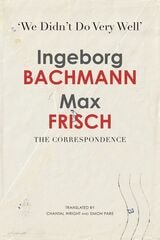
‘We Didn’t Do Very Well’
The CorrespondenceIngeborg Bachmann and Max Frisch
Seagull Books, 2026
The fraught and generative relationship between two postwar literary giants—revealed through a series of letters published for the first time in English.
Ingeborg Bachmann (1926–1973) stands among the most vital voices of postwar German literature—an acclaimed poet and prose writer who also reshaped radio drama and opera. In 1958, a letter of admiration from the Swiss novelist Max Frisch (1911–1991), written after hearing Bachmann’s radio play The Good God of Manhattan, led to a meeting in Paris and the beginning of an intense, volatile love affair that would forever leave a mark on both their lives and work. Presented here for the first time in English, 299 letters written between 1958 and 1973 trace the arc of that relationship: long separations, the strain of two writers attempting to share a life, creative rivalry, sexual jealousy, and gendered tensions sharpened by a fifteen-year age gap. The correspondence ranges from everyday logistics to raw psychological insight, from passion and longing to bitterness, silence, and regret. The later letters, written as Bachmann’s health declined, expand to include friends, relatives, and key literary figures. First published in German in 2022, this correspondence overturned long-held myths about the two writers, revealing mutual influence, negotiated freedom, and a struggle to reconcile incompatible needs. Intimate and revelatory, these letters illuminate the fragile intersection of love, power, and creativity.