Results by title
716 books match the query 'Literary Figures' and 4 start with a non-letter
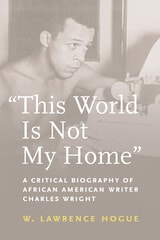
"This World Is Not My Home"
A Critical Biography of African American Writer Charles WrightW. Lawrence Hogue
University of Massachusetts Press, 2023
One of Book Authority's 8 New African-American and Black Biography Books Shaping 2025
In the 1960s, Charles Wright’s (1932–2008) star was on the rise. After dropping out of high school and serving in the Korean War, the young Black writer landed in New York, where he was mentored by Norman Mailer, signed a book deal with a leading publisher, and was celebrated by the likes of Langston Hughes and James Baldwin.
Over the decades to follow, Wright would lead a peripatetic and at times precarious life, moving between Tangier, Veracruz, Paris, and New York, penning a regular column for the Village Voice, living off the goodwill of his friends, and battling addiction and, later, mental health issues. As W. Lawrence Hogue shows, Wright’s innovative fiction stands apart, offering a different vision of outcast Black Americans in the postwar era and using satire to bring agency and humanity to working-class characters. This critical biography—the first devoted to Wright’s significant but largely forgotten story—brings new attention to the writer’s impressive body of work, in the context of a wild, but troubled, life.
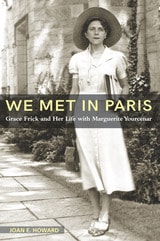
"We Met in Paris"
Grace Frick and Her Life with Marguerite YourcenarJoan E. Howard
University of Missouri Press, 2020
‘We Didn’t Do Very Well’
The CorrespondenceIngeborg Bachmann and Max Frisch
Seagull Books, 2026
The fraught and generative relationship between two postwar literary giants—revealed through a series of letters published for the first time in English.
Ingeborg Bachmann (1926–1973) stands among the most vital voices of postwar German literature—an acclaimed poet and prose writer who also reshaped radio drama and opera. In 1958, a letter of admiration from the Swiss novelist Max Frisch (1911–1991), written after hearing Bachmann’s radio play The Good God of Manhattan, led to a meeting in Paris and the beginning of an intense, volatile love affair that would forever leave a mark on both their lives and work. Presented here for the first time in English, 299 letters written between 1958 and 1973 trace the arc of that relationship: long separations, the strain of two writers attempting to share a life, creative rivalry, sexual jealousy, and gendered tensions sharpened by a fifteen-year age gap. The correspondence ranges from everyday logistics to raw psychological insight, from passion and longing to bitterness, silence, and regret. The later letters, written as Bachmann’s health declined, expand to include friends, relatives, and key literary figures. First published in German in 2022, this correspondence overturned long-held myths about the two writers, revealing mutual influence, negotiated freedom, and a struggle to reconcile incompatible needs. Intimate and revelatory, these letters illuminate the fragile intersection of love, power, and creativity.
“Here Lies” preceded by “The Indian Culture”
Antonin Artaud
Diaphanes, 2021
“Here Lies” preceded by “The Indian Culture” was translated by the award-winning translator Clayton Eshleman, widely seen as the preeminent translator into English of Artaud’s work, with its profound intensity and multiply nuanced language. For the first time since its first publication, this bilingual edition presents the two works in one volume, as Artaud originally intended. This edition also features a contextual afterword by Stephen Barber as well as new material, previously untranslated into English.