Results by title
364 books match the query 'Michigan' and 3 start with a non-letter
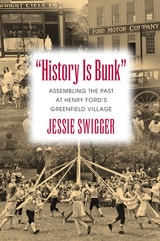
"History Is Bunk"
Assembling the Past at Henry Ford's Greenfield VillageJessie Swigger
University of Massachusetts Press, 2014
In 1916 a clearly agitated Henry Ford famously proclaimed that “history is more or less bunk.” Thirteen years later, however, he opened the outdoor history museum Greenfield Village in Dearborn, Michigan. It was written history's focus on politicians and military heroes that was bunk, he explained. Greenfield Village would correct this error by celebrating farmers and inventors.
The village eventually included a replica of Thomas Edison's Menlo Park, New Jersey, laboratory, the Wright brothers' cycle shop and home from Dayton, Ohio, and Ford's own Michigan birthplace. But not all of the structures were associated with famous men. Craft and artisan shops, a Cotswold cottage from England, and two brick slave cabins also populated the village landscape. Ford mixed replicas, preserved buildings, and whole-cloth constructions that together celebrated his personal worldview.
Greenfield Village was immediately popular. But that only ensured that the history it portrayed would be interpreted not only by Ford but also by throngs of visitors and the guides and publicity materials they encountered. After Ford's death in 1947, administrators altered the village in response to shifts in the museum profession at large, demographic changes in the Detroit metropolitan area, and the demands of their customers.
Jessie Swigger analyzes the dialogue between museum administrators and their audiences by considering the many contexts that have shaped Greenfield Village. The result is a book that simultaneously provides the most complete extant history of the site and an intimate look at how the past is assembled and constructed at history museums.
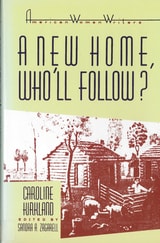
'A New Home, Who Will Follow?' by Caroline Kirkland
Zagarell, Sandra A
Rutgers University Press, 1990
A New Home is a vivid contribution to a new kind of narrative developed during the antebellum period, ethnographic fiction. Kirkland highlights the importance and the drama of local practices and everyday life in Montacute. She traces the way two groups of settlers slowly adjust to each other - the old hands and the newcomers from the East;. Dramatizing differences of class and culture, she also shows how the groups finally form a genuine community and a new, diverse culture. Kirkland also gives ethnographic fiction an original twist: she satirizes the provincialism and the rigidity of both groups of settlers.
After writing A New Home, Kirkland became a professional literary woman, working as an editor as well as a writer. In her introduction, Sandra Zagarell explores the implications of Kirkland's writing and professional career for our understanding of women, writing, and the world of literature in antebellum America.

9226 Kercheval
The Storefront that Did Not Burn, With a New PrefaceNancy Milio
University of Michigan Press, 2000