Results by title
2335 books match the query 'Modern' and 18 start with a non-letter
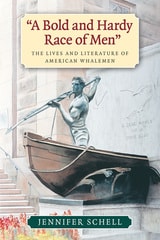
"A Bold and Hardy Race of Men"
The Lives and Literature of American WhalemenJennifer Schell
University of Massachusetts Press, 2013
In his novel Miriam Coffin, or The Whale-Fishermen (1834), Joseph C. Hart proclaimed that his characters were “a bold and hardy race of men,” who deserved the “expressive title of American Whale-Fishermen.” Hart was not the only American author to applaud these physical laborers as the embodiment of national manhood. Heroic portraits of whalers first appeared in American literature during the 1780s, and they proliferated across time. Writers as various as Lydia Howard Huntley Sigourney, Frederick Douglass, and Walt Whitman celebrated the talents of the seafarers who transformed the New England whale fishery into a globally dominant industry. But these images did not go unchallenged. Alternative visions—some of which undermined the iconic status of the trade and its workers—began to proliferate. Even so, these depictions did very little to dismantle the notion that whaling men were prime exemplars of a proud American work ethic.
To explain why this industry had such a widespread and enduring impact on American literature, Jennifer Schell juxtaposes and analyzes a wide array of eighteenth- and nineteenth-century whaling narratives. Drawing on various studies of masculinity, labor history, and transnationalism, Schell shows how this particular type of maritime work, and the traits and values associated with it, helped to shape the American literary, cultural, and historical imagination. In the process, she reveals the diverse, flexible, and often contradictory meanings of gender, class, and nation in nineteenth-century America.
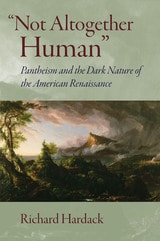
"Not Altogether Human"
Pantheism and the Dark Nature of the American RenaissanceRichard Hardack
University of Massachusetts Press, 2012
Many leading American thinkers in the nineteenth century, who accepted the premises of Emersonian transcendentalism, valued the basic concept of pantheism: that God inheres in nature and in all things, and that a person could achieve a sense of belonging she or he lacked in society by seeking a oneness with all of nature. As Richard Hardack shows, however, writers such as Ralph Waldo Emerson, Nathaniel Hawthorne, and Herman Melville conceived of nature as everything “Other”—other than the white male Protestant culture of which they were a part. This conception of nature, then, became racialized, and the divine became associated with African American and Native American identities, as well as with femininity.
In "Not Altogether Human," Hardack reevaluates transcendentalism in the context of nineteenth-century concerns about individual and national racial identity. Elucidating the influence of pantheism, Hardack draws on an array of canonical and unfamiliar materials to remap the boundaries of what has long been viewed as white male transcendental discourse.
This book significantly revises notions of what transcendentalism and pantheism mean and how they relate to each other. Hardack's close analysis of pantheism and its influence on major works and lesser known writing of the nineteenth century opens up a new perspective on American culture during this key moment in the country's history.
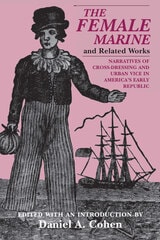
"The Female Marine" and Related Works
Narratives of Cross-Dressing and Urban Vice in America's Early RepublicDaniel A. Cohen
University of Massachusetts Press, 1997
The alternately racy and moralistic narrative recounts the adventures of a young woman from rural Massachusetts who is seduced by a false-hearted lover, flees to Boston, and is entrapped in a brothel. She eventually escapes by disguising herself as a man and serves with distinction on board the U.S. frigate Constitution during the War of 1812. After subsequent onshore adventures in and out of male dress, she is happily married to a wealthy New York gentleman.
In his introduction, Daniel A. Cohen situates the story in both its literary and historical contexts. He explains how the tale draws upon a number of popular Anglo-American literary genres, including the female warrior narrative, the sentimental novel, and the urban exposé. He then explores how The Female Marine reflects early-nineteenth-century anxieties concerning changing gender norms, the expansion of urban prostitution, the growth of Boston's African American community, and feelings of guilt aroused by New England's notoriously unpatriotic activities during the War of 1812.
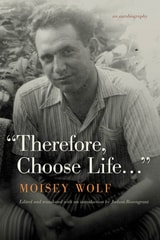
"Therefore, Choose Life..."
An AutobiographyMoisey Wolf
Oregon State University Press, 2014
Wolf describes his Jewish childhood and youth in pre-war Poland, his escape from the Holocaust and subsequent medical service in the Soviet Army during World War II and the following decade, his distinguished career in psychiatry in post-Stalinist Soviet Russia, and his final years in Portland, Oregon, after his departure from the Soviet Union in 1992.
Wolf’s narrative skill and evocative personal insights, combined with Judson Rosengrant’s judicious editing and annotation and elegant translation, provide the reader with direct access to a world that has seemingly ceased to exist, yet continues to resonate and inform our own lives in powerful ways.
“Therefore, Choose Life…” will appeal to readers interested in the history of the East-European twentieth century, pre-Holocaust Jewish family life in Poland, and in the survival of a man of deep religious faith and cultivation in the face of the catastrophes and vicissitudes of his time and place.
"We, the Barbarians"
Three Mexican Writers in the Twenty-First CenturyMabel Moraña; Translated by Stephanie L. Kirk
Vanderbilt University Press, 2024
Characterized by the fragmentation of civil society and the decomposition of the myths that accompanied the consolidation of the modern nation, Mexican visual and literary arts have explored a myriad of representational avenues to approach the phenomena of violence, institutional decay, and political instability. The critical and theoretical approaches in “We, the Barbarians” explore a variety of alternative symbolic representations of topics such as nationalism, community, and affect in times impacted by systemic violence, precariousness, and radical inequality. Moraña perceives the negotiations between regional/local imaginaries and global scenarios characterized by the devaluation and resignification of life, both at individual and collective levels. Though it uses three authors as its focus, this book seeks to more broadly theorize the question of the relationship between literature and the social in the twenty-first century.
... And Heaven Shed No Tears
Henry Armin Herzog
University of Wisconsin Press, 2005
1995 paperback, Saga Publishers / Folio Private
1650-1850
Ideas, Aesthetics, and Inquiries in the Early Modern Era (Volume 25)Kevin L. Cope
Bucknell University Press, 2020
About the annual journal 1650-1850
1650-1850 publishes essays and reviews from and about a wide range of academic disciplines—literature (both in English and other languages), philosophy, art history, history, religion, and science. Interdisciplinary in scope and approach, 1650-1850 emphasizes aesthetic manifestations and applications of ideas, and encourages studies that move between the arts and the sciences—between the “hard” and the “humane” disciplines. The editors encourage proposals for “special features” that bring together five to seven essays on focused themes within its historical range, from the Interregnum to the end of the first generation of Romantic writers. While also being open to more specialized or particular studies that match up with the general themes and goals of the journal, 1650-1850 is in the first instance a journal about the artful presentation of ideas that welcomes good writing from its contributors.
First published in 1994, 1650-1850 is currently in its 25th volume.
ISSN 1065-3112.
Published by Bucknell University Press. Distributed worldwide by Rutgers University Press.
1650-1850
Ideas, Aesthetics, and Inquiries in the Early Modern Era (Volume 26)Kevin L. Cope
Bucknell University Press, 2021
Volume 26 of 1650–1850: Ideas, Aesthetics, and Inquiries in the Early Modern Era travels beyond the usual discussions of power, identity, and cultural production to visit the purlieus and provinces of Britain’s literary empire. Bulging at its bindings are essays investigating out-of-the-way but influential ensembles, whether female religious enthusiasts, annotators of Maria Edgeworth’s underappreciated works, or modern video-based Islamic super-heroines energized by Mary Wollstonecraft’s irreverance. The global impact of the local is celebrated in studies of the personal pronoun in Samuel Johnson’s political writings and of the outsize role of a difficult old codger in catalyzing the literary career of Charlotte Smith. Headlining a volume that peers into minute details in order to see the outer limits of Enlightenment culture is a special feature on metaphor in long-eighteenth-century poetry and criticism. Five interdisciplinary essays investigate the deep Enlightenment origins of a trope usually associated with the rise of Romanticism. Volume 26 culminates in a rich review section containing fourteen responses to current books on Enlightenment religion, science, literature, philosophy, political science, music, history, and art.
About the annual journal 1650-1850
1650-1850 publishes essays and reviews from and about a wide range of academic disciplines: literature (both in English and other languages), philosophy, art history, history, religion, and science. Interdisciplinary in scope and approach, 1650-1850 emphasizes aesthetic manifestations and applications of ideas, and encourages studies that move between the arts and the sciences—between the “hard” and the “humane” disciplines. The editors encourage proposals for special features that bring together five to seven essays on focused themes within its historical range, from the Interregnum to the end of the first generation of Romantic writers. While also being open to more specialized or particular studies that match up with the general themes and goals of the journal, 1650-1850 is in the first instance a journal about the artful presentation of ideas that welcomes good writing from its contributors.
ISSN 1065-3112.
Published by Bucknell University Press. Distributed worldwide by Rutgers University Press.
1650-1850
Ideas, Aesthetics, and Inquiries in the Early Modern Era (Volume 27)Kevin L. Cope
Bucknell University Press, 2022
ISSN 1065-3112
1650-1850
Ideas, Aesthetics, and Inquiries in the Early Modern Era (Volume 28)Kevin L. Cope
Bucknell University Press, 2023
ISSN: 1065-3112
Published by Bucknell University Press, distributed worldwide by Rutgers University Press.
1650-1850
Ideas, Aesthetics, and Inquiries in the Early Modern Era (Volume 29)Kevin L. Cope
Bucknell University Press, 2024
Exploratory, investigative, and energetically analytical, 1650–1850 covers the full expanse of long-eighteenth-century thought, writing, and art while delivering abundant revelatory detail. Essays on well-known cultural figures combine with studies of emerging topics to unveil a vivid rendering of a dynamic period, simultaneously committed to singular genius and universal improvement. Welcoming research on all nations and language traditions, 1650–1850 invites readers into a truly global Enlightenment. Topics in volume 29 include Samuel Johnson’s notions about the education of women and a refreshing account of Sir Joseph Banks’s globetrotting. A guest-edited, illustration-rich, interdisciplinary special feature explores the cultural implications of water. As always, 1650–1850 culminates in a bevy of full-length book reviews critiquing the latest scholarship on long-established specialties, unusual subjects, and broad reevaluations of the period.
ISSN 1065-3112
Published by Bucknell University Press, distributed worldwide by Rutgers University Press.
1650-1850
Ideas, Aesthetics, and Inquiries in the Early Modern Era (Volume 30)Kevin L. Cope
Bucknell University Press, 2025
The contributors to volume 30 join with Enlightenment thinkers in pulling, pushing, and stretching the elastic boundaries of human experience. Essays on comical apocalypticism, the evolution of satire, and the Asian periphery of English literature open a volume that offers two special features on extreme aspects of a modernizing world. The first probes the undiscovered world of last wills and testaments, while the second explores the soaring world of eighteenth-century birds. As always, 1650–1850 culminates in a bevy of book reviews critiquing the latest scholarship on long-established specialties, unusual subjects, and broad reevaluations of the period.
Published by Bucknell University Press. Distributed worldwide by Rutgers University Press.
ISSN: 1065-3112
1650-1850
Ideas, Aesthetics, and Inquiries in the Early Modern Era (Volume 31)Kevin L. Cope
Bucknell University Press, 2026
Exploratory, investigative, and energetically analytical, 1650–1850 covers the full expanse of long-eighteenth-century thought, writing, and art while delivering abundant revelatory detail. Essays on well-known cultural figures combine with studies of emerging topics to unveil a vivid rendering of a dynamic period, simultaneously committed to singular genius and universal improvement. Welcoming research on all nations and language traditions, 1650–1850 invites readers into a truly global Enlightenment.
The contributors to volume 31 join with Enlightenment thinkers in charting the outposts of long eighteenth-century culture while discovering new features in seemingly familiar terrain. Essays explore outlandish but often observed activities such as medical quackery, Rosicrucian hermeticism, and the oral antics associated with the twisted “Malaprop” tradition. In happy contrast, the volume offers the second half of a sparkling special feature on the most familiar of all substances, water. Contributors lead us through an astounding assortment of aqueous topics, from the heritage of The Compleat Angler to the sanctified sprinklings of holy water. As always, 1650–1850 culminates in a bevy of full-length book reviews that robustly address the latest scholarship on long-established specialties, unusual subjects, and broad reevaluations of the period.
Published by Bucknell University Press. Distributed worldwide by Rutgers University Press.
ISSN: 1065-3112
1650–1850
Ideas, Aesthetics, and Inquiries in the Early Modern Era (Volume 24)Kevin L. Cope
Bucknell University Press, 2019
About the annual journal 1650-1850
1650-1850 publishes essays and reviews from and about a wide range of academic disciplines—literature (both in English and other languages), philosophy, art history, history, religion, and science. Interdisciplinary in scope and approach, 1650-1850 emphasizes aesthetic manifestations and applications of ideas, and encourages studies that move between the arts and the sciences—between the “hard” and the “humane” disciplines. The editors encourage proposals for “special features” that bring together five to seven essays on focused themes within its historical range, from the Interregnum to the end of the first generation of Romantic writers. While also being open to more specialized or particular studies that match up with the general themes and goals of the journal, 1650-1850 is in the first instance a journal about the artful presentation of ideas that welcomes good writing from its contributors.
First published in 1994, 1650-1850 is currently in its 24th volume.
ISSN 1065-3112.
1916
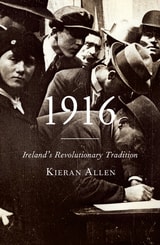
Ireland's Revolutionary TraditionKieran Allen
Pluto Press, 2016
In 1916, Kieran Allen argues that this pivotal moment in Irish history has been obscured by those who see it only as a prelude for a war of independence. Emphasizing an often ignored social and political radicalism at the heart of the rebellion, he shows that it gave birth to a revolutionary tradition that continues to haunt the Irish elite. Socialist aspirations mixed, and sometimes clashed, with the republican current, but both were crushed in a counterrevolution that accompanied the Anglo-Irish treaty of 1921. The result today is a partitioned Ireland that acts as a neoliberal tax haven for multinational corporations—a state of affairs quite alien to both Connolly’s and Pearse’s vision.
Published to coincide with the Rising’s centennial, 1916: Ireland’s Revolutionary Tradition re-establishes the political role of socialist republican figures, offers a highly accessible history of the Easter Rising, and explores the militancy and radicalism that continues to haunt the Irish elite one hundred years later.
1968 Mexico
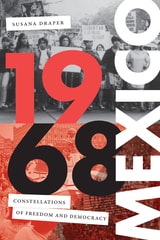
Constellations of Freedom and DemocracySusana Draper
Duke University Press, 2018
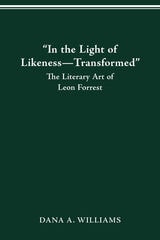
“IN THE LIGHT OF LIKENESS—TRANSFORMED”
THE LITERARY ART OF LEON FORRESTDana A. Williams
The Ohio State University Press, 2005
“In the Light of Likeness—Transformed”, by Dana A. Williams, looks critically at the work of contemporary African American author Leon Forrest. Not only does she bring to the critical table a well-known but as yet understudied modernist author—an important endeavor in and of itself—but she also explores Forrest’s novels’ cultural dialogue with black ethnic culture and other African American authors, as well as provides in-depth readings of his prose and interpretations of his narrative style. Highly touted by both his literary forebear Ralph Ellison, who wrote the foreword to Forrest’s first novel, and his literary contemporary Toni Morrison, who edited his first three novels and wrote the foreword to his third, Leon Forrest is among the most gifted African American writers of our time. Yet, he is also among our most difficult.
Forrest's highly experimental narrative style, his reinterpretation of modernism, and his transformations of black cultural traditions into literary aesthetics often pose challenges of interpretation for the reader and the scholar alike. As the first single-authored book-length study of Forrest’s novel, this book offers readers pathways into his fiction. What this culturalist approach to the novels reveals is that Forrest’s fiction was foremost concerned with investigating ways for the African American to survive in the contemporary moment. Through a variety of characters, the novels reveal the African American’s art of transformation—the ability to find ways to make the wretchedness of the past work in positive ways.
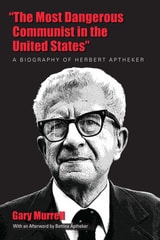
“The Most Dangerous Communist in the United States”
A Biography of Herbert ApthekerGary Murrell
University of Massachusetts Press, 2015
When J. Edgar Hoover declared Herbert Aptheker “the most dangerous Communist in the United States,” the notorious FBI director misconstrued his true significance. In this first book-length biography of Aptheker (1915–2003), Gary Murrell provides a balanced yet unflinching assessment of the controversial figure who was at once a leading historian of African America, radical political activist, literary executor of W. E. B. Du Bois, and lifelong member of the American Communist Party. Although blacklisted at U.S. universities, Aptheker published dozens of books, including the groundbreaking American Negro Slave Revolts (1943) and the monumental seven-volume Documentary History of the Negro People (1951–1994). He also edited four volumes of the correspondence and unpublished writings of Du Bois, an achievement that Eric Foner, writing in the New York Times Book Review, called “a milestone in the coming of age of Afro-American history.”
As Murrell shows, Aptheker the historian was inseparable from Aptheker the leading Communist Party intellectual, polemicist, and agitator. During the 1960s, his ability to rouse and inspire both black and white student radicals made him one of the few Old Leftists accepted by the New Left. Aptheker had joined the CPUSA during its heyday in the 1930s, convinced that only through the party's leadership could fascism be defeated and true liberation be achieved: he ended his affiliation five decades later in 1991 after the collapse of socialism in the Soviet Union and Eastern Europe.
In an afterword, Bettina Aptheker adds to Murrell's narrative by illuminating her mother Fay's vital contributions to her father's work and by affirming the particularly devastating challenges of life in a family dedicated to radical political and social change.