221 books match the query 'Personal narratives' and 4 start with a non-letter
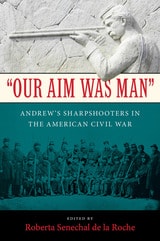
cover of "Our Aim Was Man": Andrew's Sharpshooters in the American Civil War

"Our Aim Was Man"

Andrew's Sharpshooters in the American Civil War

Roberta Senechal de la Roche

University of Massachusetts Press, 2016

One was a father who worried about his fellow soldiers' swearing. Another hoped to enter Harvard College. The third was a farmer whose letters home depict the later stages of the war. The fourth had turned to boot making when he did not inherit land. Based on the letters, diaries, and memoirs of four members of the First Company Massachusetts Sharpshooters, known as Andrew's Sharpshooters, this book provides a rare glimpse into the experiences of Union Army snipers. The company was one of the first units in American military history to be equipped with telescope-sighted rifles to enable long-distance targeting. Despite complaints that snipers violated codes of honorable combat, the members of Andrew's Sharpshooters generally expressed quiet pride in being an elite unit of highly skilled soldiers—"cool blooded sharpshooters," as one of them said.

Introduced and edited by Roberta Senechal de la Roche, these primary accounts include new details about the equipment, training, and deployment of snipers in the Army of the Potomac. They also reveal the challenges of covert warfare and include rich detail on the everyday problems of Civil War soldiers, including bad food, disease, punishing marches, and homesickness. The collected documents also convey the trials of those left on the home front.
[more]
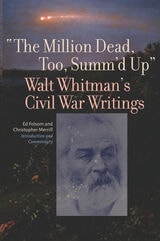
cover of "The Million Dead, Too, Summ'd Up": Walt Whitman's Civil War Writings

"The Million Dead, Too, Summ'd Up"

Walt Whitman's Civil War Writings

Walt Whitman

University of Iowa Press, 2021

This book is the first to offer a comprehensive selection of Walt Whitman’s Civil War poetry and prose with a full commentary on each work. Ed Folsom and Christopher Merrill carry on a dialogue with Whitman (and with each other) as they invite readers to trace how Whitman’s writing about the Civil War develops, shifts, and manifests itself in different genres throughout the years of the war. The book offers forty selections of Whitman’s war writings, including not only the well-known war poems but also his prose and personal letters. Each are followed by Folsom’s critical examination and then by Merrill’s afterword, suggesting broader contexts for thinking about the selection.

The real democratic reader, Whitman said, “must himself or herself construct indeed the poem, argument, history, metaphysical essay—the text furnishing the hints, the clue, the start or frame-work,” because what is needed for democracy to flourish is “a nation of supple and athletic minds.” Folsom and Merrill model this kind of active reading and encourage both seasoned and new readers of Whitman’s war writings to enter into the challenging and exhilarating mode of talking back to Whitman, arguing with him, and learning from him.
[more]
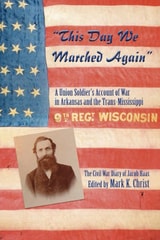
cover of "This Day We Marched Again": A Union Soldier's Account of War in Arkansas and the Trans-Mississippi

"This Day We Marched Again"

A Union Soldier's Account of War in Arkansas and the Trans-Mississippi

Mark K. Christ

Butler Center for Arkansas Studies, 2014
A testament to the valor and determination of a common soldier On September 17, 1861, twenty-two-year-old Jacob Haas enlisted in the Sheboygan Tigers, a company of German immigrants that became Company A of the Ninth Wisconsin Infantry Regiment. Over the next three years, Haas and his comrades marched thousands of miles and saw service in Arkansas, Kansas, Missouri, and the Indian Territory, including pitched battles at Newtonia, Missouri, and Jenkins’ Ferry, Arkansas. Haas describes the war from the perspective of a private soldier and an immigrant as he marches through scorching summers and brutally cold winters to fight in some of the most savage combat in the west. His diary shows us an extraordinary story of the valor and determination of a volunteer soldier. Though his health was ruined by war, Haas voiced no regrets for the price he paid to fight for his adopted country.
[more]
cover of ... And Heaven Shed No Tears

... And Heaven Shed No Tears

Henry Armin Herzog

University of Wisconsin Press, 2005

Henry Herzog survived the liquidation of the Rzeszow ghetto in Poland and endured terrible hardships in forced labor camps. He documents the increasing severity of Nazi rule in Rzeszow and the complicity of the Jewish council (the Judenrat) and Jewish police in the round-ups for deportation to the Belzec concentration camp. One of these deportations took his parents to their deaths. His brothers were caught, tortured, and killed by the Gestapo. Herzog and his sister escaped to Hungary where—although she found refuge—he was betrayed, arrested, and finally put on a train to the concentration camps. Escaping by jumping off the train and fleeing into the Tatra Mountains, he joined a group of Russian partisans to fight the Nazis.

1995 paperback, Saga Publishers / Folio Private
[more]