Results by title
3785 books match the query 'Poetry' and 28 start with a non-letter
"A Mirror for Magistrates" and the Politics of the English Reformation
Scott Lucas
University of Massachusetts Press, 2009
In a striking departure from previous scholarship, Scott Lucas shows that modern critics have misconstrued the purpose of the tragic verse narratives of the Mirror, approaching them primarily as uncontroversial meditations on abstract political and philosophical doctrines. Lucas revises this view, revealing many of the Mirror tragedies to be works topically applicable in form and politically contentious in nature.
Lucas returns the earliest poems of A Mirror for Magistrates to the troubled context of their production, the tumultuous reign of the Catholic Queen Mary (1553–1558). As Protestants suffering from the traumatic collapse of King Edward VI's "godly" rule (1547–1553) and from the current policies of Mary's government, the Mirror authors radically reshaped their poems' historical sources in order to craft emotionally moving narratives designed to provide models for interpreting the political failures of Edward VI's reign and to offer urgent warnings to Marian magistrates.
Lucas's study also reveals how, in later poems, the Mirror authors issued oblique appeals to Queen Elizabeth's officers, boldly demanding that they allow the realm of "the literary" to stand as an unfettered discursive arena of public controversy. Lucas thus provides a provocative new approach to this seminal but long-misunderstood collection, one that restores the Mirror to its rightful place as one of the greatest works of sixteenth-century English political literature.
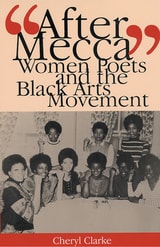
"After Mecca"
Women Poets and the Black Arts MovementClarke, Cheryl
Rutgers University Press, 2004
In "After Mecca," Cheryl Clarke explores the relationship between the Black Arts Movement and black women writers of the period. Poems by Gwendolyn Brooks, Ntozake Shange, Audre Lorde, Nikki Giovanni, Sonia Sanchez, Jayne Cortez, Alice Walker, and others chart the emergence of a new and distinct black poetry and its relationship to the black community's struggle for rights and liberation. Clarke also traces the contributions of these poets to the development of feminism and lesbian-feminism, and the legacy they left for others to build on.
She argues that whether black women poets of the time were writing from within the movement or writing against it, virtually all were responding to it. Using the trope of "Mecca," she explores the ways in which these writers were turning away from white, western society to create a new literacy of blackness.
"And there will be singing"
An Anthology of International WritingJim Hicks
University of Massachusetts Press, 2019
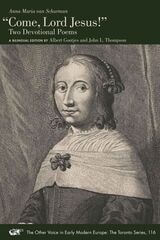
"Come, Lord Jesus!"
Two Devotional Poems. A Bilingual EditionAnna Maria van Schurman
Iter Press, 2026
The life and reputation of Anna Maria van Schurman (1607–78) swung dramatically from her early fame as a prodigy and femme savante to the infamy she bore in the wake of her late affiliation with Jean de Labadie. From her late adolescence on, van Schurman was widely known for her intellectual gifts, her mastery of languages, and her skillful portraiture and embroidery. Described by some as a femme savante and “the Star of Utrecht,” she gained an international reputation with the publication of her defense of women’s education. Her later years, however, were marked by a growing disillusionment with her own fame and intellectual achievements, and her reputation was dramatically marred in the eyes of her contemporaries when, in her final decade, she repudiated the Dutch Reformed Church to affiliate with Jean de Labadie. With him and his spiritual community, she lived out her last years in peace while also composing a two-volume defense of her actions and convictions, entitled Eukleria or The Better Choice.
The years between her withdrawal from public life and her supposedly scandalous return are not easily mapped. Drawing on two long devotional poems that she wrote during this period (and that remained unpublished during her lifetime), this bilingual edition introduces readers to van Schurman’s private piety, as well as to her theological acumen, her artistry as a vernacular poet, and her participation in the leadership of a conventicle of like-minded friends and acquaintances. The English translation closely approximates the rhyme, meter, and cadence of the Dutch original and thus facilitates an appreciation not only of the poet’s meaning but also of the auditory aesthetics of each text.
"La Clarté Notre-Dame" and "The Last Book of the Madrigals"
Philippe Jaccottet
Seagull Books, 2022
In his 96th and final year, and with the help of the poet José-Flore Tappy, celebrated Swiss poet Philippe Jaccottet finished two manuscripts-in-progress, one in prose and one in poetry, both of which are presented in this volume in John Taylor’s sensitive translation.
The first work, “La Clarté Notre-Dame,” takes off from the “pure, weightless, fragile, yet crystal-clear tinkling” of a monastery bell heard during a walk with friends. With this thought-provoking sound as a leitmotiv, Jaccottet looks back on a life of writing, reading, and scrutinizing humankind’s existential and spiritual aspirations. He sets these concerns against his equally lifelong preoccupation with “the rise of evil in today’s world,” notably in Syria. Composed in a baroque style, the verse poems collected in “The Last Book of Madrigals” explore love. Jaccottet returns in spirit to Italy, the country which for him symbolizes happiness and sensuality. As he evokes amorous attraction, he conjures up Monteverdi’s madrigals, one of Dante’s little-known rhymes, and Giuseppe Ungaretti’s last poem. Reinventing and commenting on these works, Jaccottet meditates on old age, approaching death, despair, and the persistence of love.
Together, both works grapple with devastating darkness, but as Tappy observes in her afterword, however, Jaccottet’s “greatest force” was “his perpetually renewed desire, during the most terrifying night, to head for the light.”
"Pamphilia to Amphilanthus" in Manuscript and Print
Lady Mary Wroth
Iter Press, 2017
"The God of Love’s Letter" and "The Tale of the Rose"
A Bilingual Edition. With Jean Gerson, “A Poem on Man and Woman,” Translated from the Latin by Thomas O’DonnellChristine de Pizan
Iter Press, 2020
The God of Love’s Letter (1399), Christine de Pizan’s first defense of women, is arguably her most succinct statement about gender. It also rebukes the thirteenth-century Romance of the Rose and anticipates Christine’s City of Ladies. The Tale of the Rose (1402) responds to the growth in chivalric orders for the defense of women by arguing that women, not men, should choose members of the “Order of the Rose.” Both poems are freshly edited here from their earliest manuscripts and each is newly translated into English.
"The Million Dead, Too, Summ'd Up"
Walt Whitman's Civil War WritingsWalt Whitman
University of Iowa Press, 2021
The real democratic reader, Whitman said, “must himself or herself construct indeed the poem, argument, history, metaphysical essay—the text furnishing the hints, the clue, the start or frame-work,” because what is needed for democracy to flourish is “a nation of supple and athletic minds.” Folsom and Merrill model this kind of active reading and encourage both seasoned and new readers of Whitman’s war writings to enter into the challenging and exhilarating mode of talking back to Whitman, arguing with him, and learning from him.
"This Book of Starres"
Learning to Read George HerbertJames Boyd White
University of Michigan Press, 1995
"This Book of Starres" is one of those all-too-rare books in which an author's love of someone's work--in this case, the seventeenth-century English poet George Herbert--leads to a journey of exploration.
Herbert's poetry presents a special set of challenges: It is to the modern ear archaic, difficult in thought and structure, and entirely theological in character. Yet no poet is more deeply admired by those who know him well. "This Book of Starres" is meant to engage the reader in a process of reading by which this verse can be seen to be vivid and alive. It is the record of one person's life-changing involvement with the poetry of George Herbert; in this it is about not only how, but why we read great poetry.
"It is a joy to experience Herbert's poetry in the company of James Boyd White, whose affinity for the work is always convincing and seems at times preternatural. 'This Book of Starres' is a necessary pleasure: all readers of poetry, whether expert or inexpert, will find it enriching." --Alice Fulton
". . . both a delight to read, and one of the most instructive exercises in literature and theology I have read for a long time. . . . Herbert emerges as one of the greatest, a writer to test and change the imagination, the very way in which we think about the world and that which is beyond it." --Literature and Theology
James Boyd White is Hart Wright Professor of Law, Professor of English, and Adjunct Professor of Classical Studies, University of Michigan.
"This Mighty Convulsion"
Whitman and Melville Write the Civil WarChristopher Sten and Tyler Hoffman
University of Iowa Press, 2019
This is the first book exclusively devoted to the Civil War writings of Walt Whitman and Herman Melville, arguably the most important poets of the war. The essays brought together in this volume add significantly to recent critical appreciation of the skill and sophistication of these poets; growing recognition of the complexity of their views of the war; and heightened appreciation for the anxieties they harbored about its aftermath. Both in the ways they come together and seem mutually influenced, and in the ways they disagree, Whitman and Melville grapple with the casualties, complications, and anxieties of the war while highlighting its irresolution. This collection makes clear that rather than simply and straightforwardly memorializing the events of the war, the poetry of Whitman and Melville weighs carefully all sorts of vexing questions and considerations, even as it engages a cultural politics that is never pat.
Contributors: Kyle Barton, Peter Bellis, Adam Bradford, Jonathan A. Cook, Ian Faith, Ed Folsom, Timothy Marr, Cody Marrs, Christopher Ohge, Vanessa Steinroetter, Sarah L. Thwaites, Brian Yothers
"Words for the Hour"
A New Anthology of American Civil War PoetryFaith Barrett
University of Massachusetts Press, 2005
“Words for the Hour” presents a readable and illuminating account of the Civil War, told through the words of poets North and South. From bathos to profound philosophical meditation and sorrow, the range of these poems illuminates the complexity of their era while also revealing the continuing power of this turning point in American history to speak to readers in the present day.
The volume is divided into three parts, each offering a different perspective on the poetry generated by the war. Part I samples the extraordinary range of poems written immediately preceding and during the war and published in popular periodicals, providing a kind of poetic newspaper account as one might have read it then—from the early days of optimistically heralded victory on both sides, through the mounting casualties and brutal deaths of the long middle years, to the war's conclusion and President Lincoln's assassination. Viewing the struggle from many different vantage points gives the reader access to the ways that people from various backgrounds experienced the trajectory of the war. Civilians and soldiers, free blacks and proponents of slavery, women and men from Massachusetts and Virginia and from recently admitted states and barely developed territories, writers with their eyes on the national political stage and those focused on personal domestic issues: these are the multiple voices of America responding to the war.
Part II includes substantial selections of poems by writers who published extensively in response to the conflict, providing more complex and comprehensive perceptions of the war. These poets include not just well-known figures such as Walt Whitman, Herman Melville, and John Greenleaf Whittier, but also African American poets George Moses Horton and Frances Ellen Watkins Harper and Southern poets Henry Timrod and Sarah Piatt.
Part III offers poems by two poets who did not publish during their lifetimes, but had strong imaginative responses to the conflict, thus giving a sense of the long reach of the war as a defining national experience. One of these two poets (Emily Dickinson) is now renowned while the other (Obadiah Ethelbert Baker) is first published in this volume.
“Words for the Hour” is indeed “new” among anthologies of Civil War poetry not only in its wide range of poems by popular, anonymous, and now canonical poets but also in its informational apparatus. A historical timeline listing major battles and events of the war begins the volume, and historical photographs or lithographs introduce each section of poems. The book also includes a substantial introduction, a glossary of important names and terminology relevant to understanding the poems, and biographical sketches for all the poets whose work is included.
&luckier
Christopher J Johnson
University Press of Colorado, 2016
Mountain West Poetry Series
In his first collection of poems, &luckier, Christopher J Johnson explores the depths to which we can know our most intimate friends, habits, and—even more so—selves. From a mosaic of coffee cups, dinner engagements, razors, walks around his city, and the wider realm of nature, the poet continually asks to what degree our lives can be understood, our joys engaged with, and our sorrows mitigated. In a voice that is at once contemporary and yet almost primal, these poems seek an affinity with the natural world, the passing of history, and the deepness and breadth of ancestry; they do not question the mystery of life but ask rather how we have become separated from and might return to a more aware place within the frame of it. These are poems rich with metaphor and music but also direct in their voice. Johnson exhibits a poetic tradition that—rather than employing academic allusions and direct personal statements—remains elusive in its use of the poetic “I.” The reader is never certain if they are reading about the poet, their friends, or themselves.
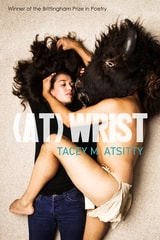
(At) Wrist
Tacey M. Atsitty
University of Wisconsin Press, 2023
All I know is it’s the season

(no subject)
Peter Burghardt
Omnidawn, 2022
The poems of (no subject) are an investigation of the personal and the everyday. This collection draws inspiration from the idea of the quickly written subjectless email, as the poet would clear small periods of time to write and record observations and thoughts, then send it to himself in untitled emails. The book takes the shape of an impressionistic twenty-first-century diary, reflecting on themes of anxiety about the future and the situation of the present. As these moments compound, the line between the present, past, and future is blurred in the conflation of self and memory. Driven by a speaker who is hermetically sealed in their private world, these ostensibly subjectless poems derive their meaning through the tension between narrative and emotional resonances. Through moment-to-moment reflections, (no subject) digs deep in search of the big little feelings transmitted by fatherhood, the fusion of time and space, loneliness, resilience, and wonder.
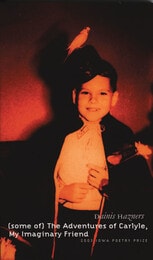
(some of) The Adventures of Carlyle, My Imaginary Friend
Dainis Hazners
University of Iowa Press, 2004
“Carlyle is spore, and mild. / He is swoon & sherbet.” Endearing and kind, if not actually cruel, he is also cold and strange. He shapeshifts, transforming into Magician and Jester, Surgeon and Scientist, Cloud; he studies fire and mirrors and bores holes in his own skull, looking for heaven. Throughout his many adventures, which range from the ludicrous to the life-threatening, he flies into the light and carries the reader with him on his perplexing and fanciful journey.

*Moon in a Mason Jar* and *What My Father Believed*
PoemsRobert Wrigley
University of Illinois Press, 1998
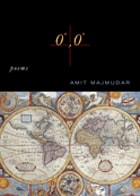
0°, 0°
PoemsAmit Majmudar
Northwestern University Press, 2009
0° , 0° is where the equator and prime meridian cross, but it is also, in Amit Majmudar’s poetic cartography, "the one True Cross, the rood’s wood warped and tacked / pole to pole." Unlikely intersections lie at the heart of Amit Majmudar's first collection of poetry. Mythical, biblical, political, and scientific allusion thrive side by side, inspiring surprise and wonder.
Majmudar’s training as a medical doctor is clearly at work as he is able to balance poetic forms requiring surgical precision—including the exceedingly difficult ghazal—with warmth and compassion for the world. Majmudar understands suffering on the large scale and the small, whether he is speaking up for the biblical character Job and "answering the whirlwind," or tallying the human cost of war at Walter Reed Army Medical Center.
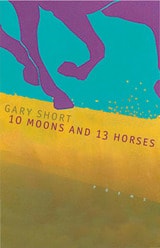
10 Moons And 13 Horses
PoemsGary Short
University of Nevada Press, 2004
Short knows Nevada’s austere landscape, its ephemeral beauty, and its stoic people as few writers in any genre do. He also understands the complexities of the human soul and the contradictions of love. So he tells of how his mother, dying of cancer, revisits a day thirty years in the past when her sons trapped a trout and kept it in their father’s horse trough and how now, in her mind’s eye, she carries the boxed-in fish to the stream to release it, “a moment/of having, not loss.” And of how the feathers of a dead owl in a long-dead oak tree have blown loose, “caught and leafed out/from each taloned twig and limb . . . each feather/a separate flight, shining to live.” This is rich and wondrous poetry, deeply moving, unforgettable.
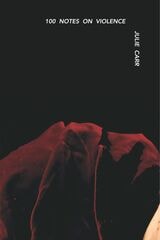
100 Notes on Violence
Julie Carr
Omnidawn, 2022
Julie Carr obsessively researches instances of intimate terrorism, looking everywhere from Walt Whitman and Emily Dickinson to lists of phobias and weapon-store catalogs. She searches for what can be learned from the statistics, the statements by and about rapists and killers, the websites of hate groups, and the capacity for cruelty that lies within all of us. 100 Notes on Violence is a diary, a document, and a dream log of the violence that grips America and devastates so many. But Carr also offers a layered and lyric tribute to violence’s counterforces: love, commonality, and care. Her unflinching “notes” provoke our minds and burrow into our emotions, leading us to confront our fears and our own complicity.
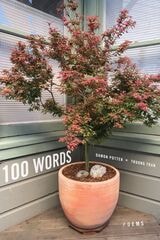
100 Words
PoemsDamon Potter and Truong Tran
Omnidawn, 2021
Tran explains this project, saying “it is occurring to me even as I am writing this now that this is not an experiment, or case study or collaboration or partnership. Damon is not the subject nor am I. This is a shared endeavor, a lived experience between two very different lives trying to understand what it means to be, to see the other.”
12 x 12
Conversations in 21st-Century Poetry and PoeticsChristina Mengert
University of Iowa Press, 2009
Christina Mengert and Joshua Marie Wilkinson have assembled an expansive and searching view of the world through the eyes of twenty-four of our most vital and engaging poets. Punctuated by poems from each contributor, 12 × 12 brings together an unparalleled range of poets and poetries, men and women from around the world, working poets for whom the form vitally matters.
Contributors
Jennifer K. Dick–Laura Mullen
Jon Woodward–Rae Armantrout
Sabrina Orah Mark–Claudia Rankine
Christina Hawkey–Tomaž Šalamun
Christine Hume–Rosemarie Waldrop
Srinkath Reddy–Mark Levine
Karen Volkman–Allen Grossman
Paul Fattaruso–Dara Wier
Mark Yakich–Mary Leader
Michelle Robinson–Paul Auster
Sawako Nakayasu–Carla Harryman
Ben Lerner–Aaron Kunin
1650-1850
Ideas, Aesthetics, and Inquiries in the Early Modern Era (Volume 26)Kevin L. Cope
Bucknell University Press, 2021
Volume 26 of 1650–1850: Ideas, Aesthetics, and Inquiries in the Early Modern Era travels beyond the usual discussions of power, identity, and cultural production to visit the purlieus and provinces of Britain’s literary empire. Bulging at its bindings are essays investigating out-of-the-way but influential ensembles, whether female religious enthusiasts, annotators of Maria Edgeworth’s underappreciated works, or modern video-based Islamic super-heroines energized by Mary Wollstonecraft’s irreverance. The global impact of the local is celebrated in studies of the personal pronoun in Samuel Johnson’s political writings and of the outsize role of a difficult old codger in catalyzing the literary career of Charlotte Smith. Headlining a volume that peers into minute details in order to see the outer limits of Enlightenment culture is a special feature on metaphor in long-eighteenth-century poetry and criticism. Five interdisciplinary essays investigate the deep Enlightenment origins of a trope usually associated with the rise of Romanticism. Volume 26 culminates in a rich review section containing fourteen responses to current books on Enlightenment religion, science, literature, philosophy, political science, music, history, and art.
About the annual journal 1650-1850
1650-1850 publishes essays and reviews from and about a wide range of academic disciplines: literature (both in English and other languages), philosophy, art history, history, religion, and science. Interdisciplinary in scope and approach, 1650-1850 emphasizes aesthetic manifestations and applications of ideas, and encourages studies that move between the arts and the sciences—between the “hard” and the “humane” disciplines. The editors encourage proposals for special features that bring together five to seven essays on focused themes within its historical range, from the Interregnum to the end of the first generation of Romantic writers. While also being open to more specialized or particular studies that match up with the general themes and goals of the journal, 1650-1850 is in the first instance a journal about the artful presentation of ideas that welcomes good writing from its contributors.
ISSN 1065-3112.
Published by Bucknell University Press. Distributed worldwide by Rutgers University Press.
2nd Chance
Daniel Becker
New Issues Poetry and Prose, 2020
500,000 Azaleas
The Selected Poems of Efraín HuertaEfraín Huerta
Northwestern University Press, 2001

99 Poets/1999
An International Poetics Symposium, Volume 26Charles Bernstein
Duke University Press, 0
Each poet was asked to ponder a series of questions: Is identity an important issue for your work, and, if so, in what sense? What do you see as the most urgent, yet insufficiently addressed or considered, issue or issues for poetry and poetics at this moment? Do you see your work in the context of a national state, or in the context of international capital, or in some other context?
After years of exchange between the artists—through translations, readings, and visits—the result is a collection of unique and significant literary works, one that is richly suggestive for the future not only of poetry but of literary and cultural studies as well.
[explicit lyrics]
PoemsAndrew Gent
University of Arkansas Press, 2016
Winner, 2016 Miller Williams Poetry Prize, edited by Billy Collins
Randall Jarrell said that when you read a poem “you are entering a foreign country whose laws and language and life are a kind of translation of your own.” In [explicit lyrics], we are visitors to a world that is familiar as if the poems are occurring in our town, on the streets where we live. But the laws have changed, and what is normally important is no longer relevant. What was meaningless is now everything.
As the title indicates, these poems are lyrics—musings on the small decisions required by existence in the modern world. They contain the grand themes of art—life, love, and mortality—but not where you expect. The smallest and most mundane objects become the catalyst for reevaluating our roles in society and the world. This is not poetry as art. This is life as art, from a country where poetry is the only language.
études
Friederike Mayröcker
Seagull Books, 2019
Exploring longing, lust for life, aging, mortality, grief, and flowers in her inimitable late style, études is a diary-like sequence of poems by one of the greatest living Austrian poets. Friederike Mayröcker’s almost daily entries give us a unique view into the interplay between desire and her motivation for writing. In Mayröcker’s case, she writes both to keep a vanished world present and to exploit the possibilities of being present for constant experimentation.
The poems in this volume are not only studies of how the mind works, moving from fragment to fragment, but also experiments with techniques of repetition, typography, collage, and quotation. Mayröcker transforms the humble page into spaces of radical openness. After all, she says, a poem is that which “opens everything up.” Each poem is date-stamped, and each date acts as a kind of permission for Mayröcker to pour in everything from notes on doctor’s visits to gorgeously structured elegies to obsessively repeating fragments of memory that act upon the whole like bits of recurring melody.
Rarely before has the intimate process of writing been so exquisitely laid bare than in études. Traversing the boundaries of literary forms with Mayröcker’s distinctive style, this important volume strikes an admirable balance between playfulness and serious inquiry.
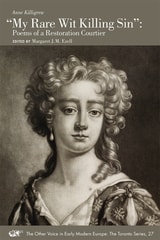
“My Rare Wit Killing Sin”
Poems of a Restoration CourtierAnne Killigrew
Iter Press, 2013