Results by title
1427 books match the query 'Politics' and 9 start with a non-letter
"A Mirror for Magistrates" and the Politics of the English Reformation
Scott Lucas
University of Massachusetts Press, 2009
In a striking departure from previous scholarship, Scott Lucas shows that modern critics have misconstrued the purpose of the tragic verse narratives of the Mirror, approaching them primarily as uncontroversial meditations on abstract political and philosophical doctrines. Lucas revises this view, revealing many of the Mirror tragedies to be works topically applicable in form and politically contentious in nature.
Lucas returns the earliest poems of A Mirror for Magistrates to the troubled context of their production, the tumultuous reign of the Catholic Queen Mary (1553–1558). As Protestants suffering from the traumatic collapse of King Edward VI's "godly" rule (1547–1553) and from the current policies of Mary's government, the Mirror authors radically reshaped their poems' historical sources in order to craft emotionally moving narratives designed to provide models for interpreting the political failures of Edward VI's reign and to offer urgent warnings to Marian magistrates.
Lucas's study also reveals how, in later poems, the Mirror authors issued oblique appeals to Queen Elizabeth's officers, boldly demanding that they allow the realm of "the literary" to stand as an unfettered discursive arena of public controversy. Lucas thus provides a provocative new approach to this seminal but long-misunderstood collection, one that restores the Mirror to its rightful place as one of the greatest works of sixteenth-century English political literature.
"Beyond the Law"
The Politics of Ending the Death Penalty for Sodomy in BritainCharles Upchurch
Temple University Press, 2021
In nineteenth-century England, sodomy was punishable by death; even an accusation could damage a man’s reputation for life. The last executions for this private, consensual act were in 1835, but the effort to change the law that allowed for those executions was intense and precarious, and not successful until 1861. In this groundbreaking book, “Beyond the Law,” noted historian Charles Upchurch pieces together fragments from history and uses a queer history methodology to recount the untold story of the political process through which the law allowing for the death penalty for sodomy was almost ended in 1841.
Upchurch recounts the legal and political efforts of reformers like Jeremy Bentham and Lord John Russell—the latter of whom argued that the death penalty for sodomy was “beyond the law and above the law.” He also reveals that a same-sex relationship linked the families of the two men responsible for co-sponsoring the key legislation. By recovering the various ethical, religious, and humanitarian arguments against punishing sodomy, “Beyond the Law” overturns longstanding assumptions of nineteenth-century British history. Upchurch demonstrates that social change came from an amalgam of reformist momentum, family affection, elitist politics, class privilege, enlightenment philosophy, and personal desires.
"My Song Is My Weapon"
People's Songs, American Communism, and the Politics of Culture, 1930-50Robbie Lieberman
University of Illinois Press, 1989

"Stay Out of Politics"
A Philosopher Views South AfricaRonald Aronson
University of Chicago Press, 1990
Along with his visa, Aronson was given the following warning by a consular officer: "Stay out of politics!" Believing that philosophy not only has a role to play but that it can, and must, involve itself in the vital social and political issues of our time, Aronson equally discovered that in South Africa politics is everywhere and inescapable. The lectures Aronson delivered focused on the meaning of progress and hope, on the threat—and experience—of disaster today, and on our responsibility to join the struggle for a humane and rational world. Two of the most provocative lectures are included here, the first a discussion of the Holocaust that has direct and intentional applications to the current situation in South Africa. The second lecture, in memory of the assassinated political philosopher Richard Turner, is a sketch of Aronson's philosophy of hope as seen from within the South African context.
Despite the limitations of teaching under possible surveillance in a revolutionary situation, Aronson witnessed the social reality of apartheid and heard the voices of its victims. Aronson's love for the South African people motivated him to write this powerful account. He presents a lecturer's tour of South Africa: the experiences that both confirmed his belief in the urgent need for majority rule but also revealed the complexities of the society that seeks to continue apartheid through all reforms; and his philosopher's reflections upon returning to the United States on the irrationality of apartheid and the ambiguities of the struggle to end it.
"Stay Out of Politics" is not only a powerful encounter with South Africa today, it is a provocative statement about philosophy—its nature, its tasks, its duty to understand and change the world in which we live.

"Work Hard, Study . . . and Keep Out of Politics!"
James A. Baker III with Steve Fiffer
Northwestern University Press, 2008
Beginning in 1975 with the Ford administration, in a job procured for him by friend and tennis partner George H. W. Bush, Baker was in the thick of American politics. He recounts the inside story of Ford’s rejection of Reagan as a running mate in 1976 with the same insight he has into Reagan’s rejection of Ford four years later. When the White House was plunged into turmoil after the Reagan assassination attempt, he was there, and his stories take readers deeper into those chaotic days. Baker was on hand for the George H. W. Bush campaign’s battle over running mate Dan Quayle and, more recently, he was again on the front row as George W. Bush fought it out in Florida. Spellbinding and frank, his stories are the ones between the lines of our history books.
In this new edition, Baker also responds for the first time in print to the George W. Bush administration’s reaction to the Iraq Study Group Report, written with his input. Baker is very qualified to comment on the political operation of the current administration, and his new writing for this paperback brings the full weight of his experience to bear.
' Ulama', Politics, and the Public Sphere
An Egyptian PerspectiveMeir Hatina
University of Utah Press, 2010
The status of the Sunni Ulama (religious scholars) in modern times has attracted renewed academic interest, in light of their assertiveness regarding moral and sociopolitical issues on the Arab-Muslim agenda. This has led to a reassessment of the narrative of historians and social scientists, who usually depicted the Ulama as marginal players in comparison with the new lay Islamists, and certainly with the Shia Ulama. The Sunni 'Ulama'’s vitality is undoubtedly related to the continuing Islamic resurgence, which since the 1970s has forced the political elites to rely increasingly on the religious establishment in order to neutralize the Islamist challenge, thus allowing the Ulama greater freedom of activity.
Hatina’s study returns to an earlier period and shows that such vitality has its roots in the second half of the nineteenth and the early twentieth centuries. Hatina traces the diverse Ulama reactions to this period of accelerated state building and national cohesion.
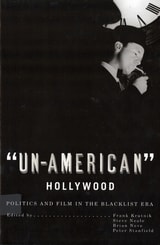
'Un-American' Hollywood
Politics and Film in the Blacklist EraStanfield, Peter
Rutgers University Press, 2007
The concept of “un-Americanism,” so vital to the HUAC crusade of the 1940s and 1950s, was resoundingly revived in the emotional rhetoric that followed the September 11th terrorist attacks. Today’s political and cultural climate makes it more crucial than ever to come to terms with the consequences of this earlier period of repression and with the contested claims of Americanism that it generated.
“Un-American” Hollywood reopens the intense critical debate on the blacklist era and on the aesthetic and political work of the Hollywood Left. In a series of fresh case studies focusing on contexts of production and reception, the contributors offer exciting and original perspectives on the role of progressive politics within a capitalist media industry.
Original essays scrutinize the work of individual practitioners, such as Robert Rossen, Joseph Losey, Jules Dassin, and Edward Dmytryk, and examine key films, including The Robe, Christ in Concrete, The House I Live In, The Lawless, The Naked City, The Prowler, Body and Soul, and FTA.
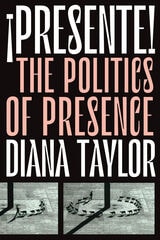
¡Presente!
The Politics of PresenceDiana Taylor
Duke University Press, 2020
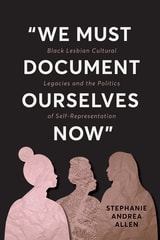
“We Must Document Ourselves Now”
Black Lesbian Cultural Legacies and the Politics of Self-RepresentationStephanie Andrea Allen
The Ohio State University Press, 2026
A long-overdue analysis of how Black lesbians have asserted their lived experience through creative practice, pushing back against heteropatriarchal systems that deny them visibility.
“We Must Document Ourselves Now” examines the essential but oft-ignored importance of Black lesbian literature and film in queer literary and film histories, arguing that Black lesbian cultural texts reflect creators’ lived experiences and resist the heteropatriarchal systems that deny Black lesbians visibility in popular culture. Stephanie Andrea Allen contends that these texts have three goals: to lay bare the experiences of Black lesbians in a raced, gendered, classed, and homophobic society; to challenge the notion that claiming Black lesbian identity is marginal or forbidden; and to take care of Black lesbians by bearing witness to their experiences through creative practice.
Insisting that Black feminist creative practice is an integral form of self and community care, Allen weaves analysis of cultural output spanning key sociocultural moments from 1974 to 2020 with interviews with Black lesbian cultural workers. “We Must Document Ourselves Now” examines the Black Arts / Black Power movement, the “boom” in lesbian and gay publishing, the so-called golden era of Black film, and twenty-first-century visual media to demonstrate how representations of Black lesbians, or lack thereof, were vital to constructing a cultural canon that focused on illuminating Black lesbian experiences in the United States.