Results by title
237 books match the query 'Race & Ethnic Relations' and 2 start with a non-letter
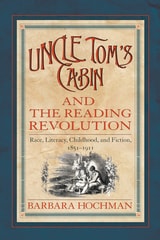
"Uncle Tom's Cabin" and the Reading Revolution
Race, Literacy, Childhood, and Fiction, 1851-1911Barbara Hochman
University of Massachusetts Press, 2011
"Uncle Tom's Cabin" and the Reading Revolution explores a transformation in the cultural meaning of Stowe's influential book by addressing changes in reading practices and a shift in widely shared cultural assumptions. These changes reshaped interpretive conventions and generated new meanings for Stowe's text in the wake of the Civil War.
During the 1850s, men, women, and children avidly devoured Stowe's novel. White adults wept and could not put the book down, neglecting work and other obligations to complete it. African Americans both celebrated and denounced the book. By the 1890s, readers understood Uncle Tom's Cabin in new ways. Prefaces and retrospectives celebrated Stowe's novel as a historical event that led directly to emancipation and national unity. Commentaries played down the evangelical and polemical messages of the book.
Illustrations and children's editions projected images of entertaining and devoted servants into an open-ended future. In the course of the 1890s, Uncle Tom's Cabin became both a more viciously racialized book than it had been and a less compelling one. White readers no longer consumed the book at one sitting; Uncle Tom's Cabin was now more widely known than read. However, in the growing silence surrounding slavery at the turn of the century, Stowe's book became an increasingly important source of ideas, facts, and images that the children of ex-slaves and other free-black readers could use to make sense of their position in U.S. culture.
1 in 100
Why So Few Latinos Find Labor Market SuccessA. Nicole Kreisberg
University of Chicago Press, 2027
A behind-the-scenes look at why Latinos—the largest immigrant group in the United States—make up a staggeringly low percentage of the elite US labor force.
Carla, Douglas, and Isabel each migrated to the United States from Latin American countries before they were teenagers. Each had big dreams—in medicine, business, and government—and each did what they were told to do to achieve their goals: work hard, stay in school, and follow the rules. Yet none of them reached the top of the labor market, and they are far from alone. Only one out of one hundred Latino immigrants who arrives in the United States as children will ever secure a job that requires a college degree and pays high wages.
In 1 in 100, sociologist A. Nicole Kreisberg explains why Latinos are more likely to have difficulty finding success in the labor market. Despite increasing access to higher education, Latino immigrant youth seldom land high-paying jobs, but not because of individual failure. Instead, these slim odds are the result of immigration laws, schools, and workplaces that interact in ways that systematically disadvantage so many Latinos. Kreisberg finds that stereotypes about Latino immigrants are activated in US schools, exacerbated in US colleges, and reinforced by employers’ hiring decisions. And because most Americans cannot tell who is and who isn’t an immigrant, the stereotypes harming immigrants often spill over to the 68 million Latinos living in the United States, including those who are US citizens.
By tracing the school-to-work trajectories of child-arriving Latino immigrants and native-born Latinos, alongside the gatekeepers who structure their opportunities, 1 in 100 shows that the 99 who struggle are not the exception—they are the unfortunate norm.