Results by title
1201 books match the query 'Race relations' and 4 start with a non-letter

"Other Sheep I Have" The Autobiography of Father Paul M. Washington
Paul Washington
Temple University Press, 1994
Father Paul M. Washington rose to local and nation prominence as an unflagging supporter of civil and women's rights. One of a handful of black priests in a traditionally white church, he fought for understanding among all people, eventually serving twenty-five years as the Rector of the Episcopal Church of the Advocate in an inner-city Philadelphia neighborhood. Though his ideas about equality often went against the views of the Episcopal church leadership, he rejected threats of withdrawn funding or retaliation to follow his heart and his theology.
Father Washington's story is a window of insight into the struggles for justice and dignity in the latter half of the twentieth century. In the tumultuous 1960s he supported the Black Power movement, the Black Panther Party, and many other groups working for peace and justice, providing meeting places and guidance. He often found himself in the midst of racial disturbances—the riots on Susquehanna Avenue in 1963 and on Columbia Avenue in 1964, in front of the Board of Education where high school students protested the Eurocentric curriculum, and outside the walls of Girard College where citizens and civic leaders demonstrated against the school's exclusion of black children. In the 1980s, he helped Philadelphia city officials negotiate with MOVE members and was a vocal supporter of Ramona Africa, fighting for her release from prison. It was in his church on the corner of 18th and Diamond Streets that women were first ordained a priests in the Episcopal church. And it was one of his congregation, Barbara Harris, who became the first female Episcopal bishop.
In his evocative voice, Father Washington describes the pivotal events of his life and how each impacted upon his evolving ideas of the relationship between religion and justice. Spanning seven decades, his account is at once an insightful and unique historical account of political action, of the reformation of the church, of the changing urban landscape, and of a life graced by leadership and spiritual enlightenment.

"Stay Out of Politics"
A Philosopher Views South AfricaRonald Aronson
University of Chicago Press, 1990
Along with his visa, Aronson was given the following warning by a consular officer: "Stay out of politics!" Believing that philosophy not only has a role to play but that it can, and must, involve itself in the vital social and political issues of our time, Aronson equally discovered that in South Africa politics is everywhere and inescapable. The lectures Aronson delivered focused on the meaning of progress and hope, on the threat—and experience—of disaster today, and on our responsibility to join the struggle for a humane and rational world. Two of the most provocative lectures are included here, the first a discussion of the Holocaust that has direct and intentional applications to the current situation in South Africa. The second lecture, in memory of the assassinated political philosopher Richard Turner, is a sketch of Aronson's philosophy of hope as seen from within the South African context.
Despite the limitations of teaching under possible surveillance in a revolutionary situation, Aronson witnessed the social reality of apartheid and heard the voices of its victims. Aronson's love for the South African people motivated him to write this powerful account. He presents a lecturer's tour of South Africa: the experiences that both confirmed his belief in the urgent need for majority rule but also revealed the complexities of the society that seeks to continue apartheid through all reforms; and his philosopher's reflections upon returning to the United States on the irrationality of apartheid and the ambiguities of the struggle to end it.
"Stay Out of Politics" is not only a powerful encounter with South Africa today, it is a provocative statement about philosophy—its nature, its tasks, its duty to understand and change the world in which we live.
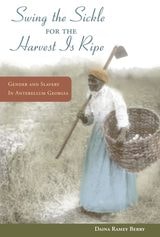
"Swing the Sickle for the Harvest is Ripe"
Gender and Slavery in Antebellum GeorgiaDaina Ramey Berry
University of Illinois Press, 2010
"Swing the Sickle for the Harvest Is Ripe" compares the work, family, and economic experiences of enslaved women and men in upcountry and lowland Georgia during the nineteenth century. Mining planters' daybooks, plantation records, and a wealth of other sources, Daina Ramey Berry shows how slaves' experiences on large plantations, which were essentially self-contained, closed communities, contrasted with those on small plantations, where planters' interests in sharing their workforce allowed slaves more open, fluid communications. By inviting readers into slaves' internal lives through her detailed examination of domestic violence, separation and sale, and forced breeding, Berry also reveals important new ways of understanding what it meant to be a female or male slave, as well as how public and private aspects of slave life influenced each other on the plantation.
A volume in the series Women in American History, edited by Anne Firor Scott, Susan Armitage, Susan K. Cahn, and Deborah Gray White
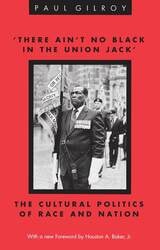
'There Ain't no Black in the Union Jack'
The Cultural Politics of Race and NationPaul Gilroy
University of Chicago Press, 1991
"Gilroy demonstrates effectively that cultural traditions are not static, but develop, grow and indeed mutate, as they influence and are influenced by the other changing traditions around them."—David Edgar, Listener Review of Books.
"A fascinating analysis of the discourses that have accompanied black settlement in Britain. . . . An important addition to the stock of critical works on race and culture."—David Okuefuna, Chicago Tribune