4743 books match the query 'Religion' and 16 start with a non-letter
cover of "A Marvelous Work": Reading Mormonism in West Africa

"A Marvelous Work"

Reading Mormonism in West Africa

Laurie F. Maffly-Kipp

Utah State University Press, 2022

Two decades before the Church of Jesus Christ of Latter-day Saints began official missionary work in West Africa, pamphlets, books, and other church materials had been circulating among Christians in Nigeria and Ghana. Brought by seekers who had studied abroad or encountered church members from other countries, those texts formed the basis for a Mormon community outside the bounds of U.S. institutional authority or oversight. What did this international Mormonism look like, and how did believers craft churches out of the bare materials of tracts and inspirational volumes? Laurie F. Maffly-Kipp explores the circulation and interpretation of this homegrown Mormon faith in the 1960s and 1970s and concludes with the dilemmas raised by the religious self-fashioning of the Church of Jesus Christ of Latter-day Saints establishment after 1978.
 
The Arrington Lecture series, established by one of the twentieth-century West's most distinguished historians, Leonard Arrington, has become a leading forum for prominent historians to address topics related to Mormon history. Utah State University hosts the Leonard J. Arrington Mormon History Lecture Series through the Merrill-Cazier Library Special Collections and Archives department.
 
[more]
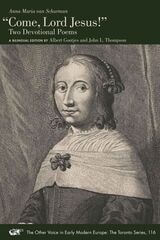
cover of "Come, Lord Jesus!": Two Devotional Poems. A Bilingual Edition

"Come, Lord Jesus!"

Two Devotional Poems. A Bilingual Edition

Anna Maria van Schurman

Iter Press, 2026

A bilingual edition of the devotional poems of Dutch scholar and poet Anna Maria van Schurman, illuminating the period of her withdrawal from public life.

The life and reputation of Anna Maria van Schurman (1607–78) swung dramatically from her early fame as a prodigy and femme savante to the infamy she bore in the wake of her late affiliation with Jean de Labadie. From her late adolescence on, van Schurman was widely known for her intellectual gifts, her mastery of languages, and her skillful portraiture and embroidery. Described by some as a femme savante and “the Star of Utrecht,” she gained an international reputation with the publication of her defense of women’s education. Her later years, however, were marked by a growing disillusionment with her own fame and intellectual achievements, and her reputation was dramatically marred in the eyes of her contemporaries when, in her final decade, she repudiated the Dutch Reformed Church to affiliate with Jean de Labadie. With him and his spiritual community, she lived out her last years in peace while also composing a two-volume defense of her actions and convictions, entitled Eukleria or The Better Choice.

The years between her withdrawal from public life and her supposedly scandalous return are not easily mapped. Drawing on two long devotional poems that she wrote during this period (and that remained unpublished during her lifetime), this bilingual edition introduces readers to van Schurman’s private piety, as well as to her theological acumen, her artistry as a vernacular poet, and her participation in the leadership of a conventicle of like-minded friends and acquaintances. The English translation closely approximates the rhyme, meter, and cadence of the Dutch original and thus facilitates an appreciation not only of the poet’s meaning but also of the auditory aesthetics of each text.
 
[more]
cover of "For the Good of Their Souls": Performing Christianity in Eighteenth-Century Mohawk Country

"For the Good of Their Souls"

Performing Christianity in Eighteenth-Century Mohawk Country

William B. Hart

University of Massachusetts Press, 2020

In 1712, the Society for the Propagation of the Gospel in Foreign Parts opened its mission near present-day Albany, New York, and began baptizing residents of the nearby Mohawk village Tiononderoge, the easternmost nation of the Haudenosaunee (Iroquois) Confederacy. Within three years, about one-fifth of the Mohawks in the area began attending services. They even adapted versions of the service for use in private spaces, which potentially opened a door to an imagined faith community with the Protestants.

Using the lens of performance theory to explain the ways in which the Mohawks considered converting and participating in Christian rituals, historian William B. Hart contends that Mohawks who prayed, sang hymns, submitted to baptism, took communion, and acquired literacy did so to protect their nation's sovereignty, fulfill their responsibility of reciprocity, serve their communities, and reinvent themselves. Performing Christianity was a means of "survivance," a strategy for sustaining Mohawk life and culture on their terms in a changing world.
[more]
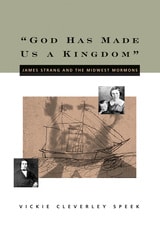
cover of "God Has Made Us a Kingdom": James Strang and the Midwest Mormons

"God Has Made Us a Kingdom"

James Strang and the Midwest Mormons

Vickie Cleverley Speek

Signature Books, 2006

Was polygamy the downfall of the Strangite kingdom or was it something far more ominous and wide-reaching? Vickie Cleverley Speek examines the charismatic figure of James J. Strang and provides a detailed first look at his wives, children, and the Strangite families left behind at his martyrdom. She makes an especially close examination of the practice of “consecration of gentile property” in the Strangite colonies on Beaver Island in Lake Michigan. Were the Strangites guilty of piracy and other crimes, and if so, to what extent?

Strang was considered the prophetic successor to Joseph Smith for the Mormons of the Midwest who later formed the nucleus for the membership of what is now the Community of Christ. Today, 150 years after Strang’s death, about 100 faithful followers in the United States still await the emergence of another prophet to succeed Strang. In the prophetic tradition of Joseph Smith, Strang similarly excavated ancient metallic plates and translated them into the Book of the Law of the Lord and the Rajah Manchou of Vorito. Like Joseph Smith, Strang instigated polygamy, secret ceremonies, baptism for the dead, and communal living. He also introduced a bloomer-like fashion for women, as well as other innovations. Like Joseph Smith, he had himself crowned king of the world.

Where previous treatments of Strang have relied either on inside or outside sources to show either a prophet or charlatan, Speek utilizes all sources, updates the record, corrects previous errors, and shows diverse perspectives. She recounts the turbulent and dramatic events of the 1840s-50s, including the plot to murder Strang and the heartbreaking exile of the Saints from Beaver Island. She traces the dispersion of this once formidable colony of Mormons to the forests of northwest Wisconsin, the far-flung outposts of southwest New Mexico, the hills of Lamoni, Iowa, and to Salt Lake City, Utah.
[more]
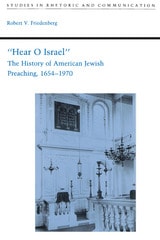
cover of "Hear O Israel": The History of American Jewish Preaching, 1654-1970

"Hear O Israel"

The History of American Jewish Preaching, 1654-1970

Robert V. Friedenberg

University of Alabama Press, 1989

The only examination of the history of American Jewish preaching, from the settlement of the first Jews in the United States until 1970

Biblical passages indicate that as early as the return to Palestine from Babylon, Hebrew was no longer understood by the masses, which necessitated the use of vernacular translations to explain the Torah. Thus, the preaching tradition was well established in Judaism during the biblical period, predating Christianity, and long before the New World was explored and colonized. However, for reasons that have never been fully explained, sermons largely disappeared from European Jewish services in the late 17th and early 18th centuries.
 
“Hear O Israel” is the only examination of the history of American Jewish preaching, from the settlement of the first Jews in the United States until 1970. Drawing on three centuries of American Jewish sermons, this study addresses two principal questions. First, how did the American Jewish preaching tradition evolve? Second, how have national and international events been treated in Jewish sermons, and in turn, how have these events affected Jewish preaching?
[more]
cover of "I Bring My Whole Self:" The Life and Legacy of Sister Thea Bowman

"I Bring My Whole Self

" The Life and Legacy of Sister Thea Bowman

Angela McRae

Catholic University of America Press, 2027
This volume grows out of a gathering dedicated to remembering and celebrating the life and legacy of Sister Thea Bowman. What began as a conference becomes, in these pages, an invitation to reflect on how one person’s faith, voice, and witness can continue to shape lives and communities long after her time. Rather than offering a single, definitive portrait, the book brings together a range of perspectives that help readers encounter Sister Thea in a more personal and meaningful way. The collection unfolds in two parts. The first explores Sister Thea’s life through historical, theological, and biographical reflections. These essays consider her early formation, her work as a scholar and teacher, and the communities that nurtured her vocation. They also introduce readers to her intellectual contributions and the broader significance of her journey within the life of the Church, including the ongoing process of recognizing her path toward sainthood. The second part shifts to personal reflections from those who knew Sister Thea or were influenced by her life and work. These contributors share stories of her presence as an educator, mentor, and advocate—someone who encouraged others to embrace their full identities with courage and joy. Through these accounts, readers see how her impact continues to unfold in both quiet and profound ways. Together, these essays offer more than a look back at Sister Thea’s life; they open a space for readers to consider her lasting influence today. Her example—marked by a deep commitment to faith, culture, justice, and joy—continues to inspire. This volume invites readers not only to learn about Sister Thea Bowman, but to reflect on how her spirit might shape their own lives and communities.
[more]
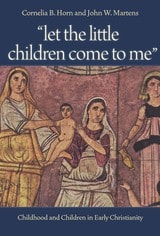
cover of "Let the Little Children Come to Me": Childhood and Children in Early Christianity"

"Let the Little Children Come to Me"

Childhood and Children in Early Christianity"

Cornelia B. Horn

Catholic University of America Press, 2009
Although Jesus called on his first followers to welcome children in his name and to become like children, the lives of the first Christian children have remained in the shadows. This book explores the hidden lives of children at the origins of Christianity. It draws on insights gained from comparisons of children's experiences in ancient Judaism and the Graeco-Roman world. The authors also engage a vast body of early Christian literature, extending from the New Testament to sermons, letters, theological treatises, poetry, pedagogical manuals, and historiography in Greek, Latin, Syriac, and other languages current in the early Christian world. The guiding question of the book focuses on how Christianity changed the lives of children in the ancient world. Some of the other questions examined by the authors include: Did boys and girls both receive a formal education? Were Christian children slaves? How did they participate in manual labor? What kinds of games did children play? How did children become a part of the Christian church? This book breaks new ground in the study of early Christianity by examining the challenges to Christian childhood in the first centuries of the Church. The authors look at violence perpetrated against children, and they consider the effects and opportunities arising from Christians' experiences of martyrdom, and from the increased Christian interest in various forms of asceticism, including celibacy. The book brings into the open the lives of early Christian children and throws much needed light on what has been a largely neglected area of study in early Christianity.
[more]
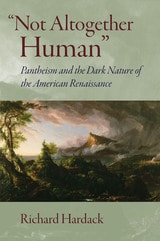
cover of "Not Altogether Human": Pantheism and the Dark Nature of the American Renaissance

"Not Altogether Human"

Pantheism and the Dark Nature of the American Renaissance

Richard Hardack

University of Massachusetts Press, 2012

Many leading American thinkers in the nineteenth century, who accepted the premises of Emersonian transcendentalism, valued the basic concept of pantheism: that God inheres in nature and in all things, and that a person could achieve a sense of belonging she or he lacked in society by seeking a oneness with all of nature. As Richard Hardack shows, however, writers such as Ralph Waldo Emerson, Nathaniel Hawthorne, and Herman Melville conceived of nature as everything “Other”—other than the white male Protestant culture of which they were a part. This conception of nature, then, became racialized, and the divine became associated with African American and Native American identities, as well as with femininity.

In "Not Altogether Human," Hardack reevaluates transcendentalism in the context of nineteenth-century concerns about individual and national racial identity. Elucidating the influence of pantheism, Hardack draws on an array of canonical and unfamiliar materials to remap the boundaries of what has long been viewed as white male transcendental discourse.

This book significantly revises notions of what transcendentalism and pantheism mean and how they relate to each other. Hardack's close analysis of pantheism and its influence on major works and lesser known writing of the nineteenth century opens up a new perspective on American culture during this key moment in the country's history.

[more]
cover of "Other Sheep I Have"  The Autobiography of Father Paul M. Washington

"Other Sheep I Have" The Autobiography of Father Paul M. Washington

Paul Washington

Temple University Press, 1994

Father Paul M. Washington rose to local and nation prominence as an unflagging supporter of civil and women's rights. One of a handful of black priests in a traditionally white church, he fought for understanding among all people, eventually serving twenty-five years as the Rector of the Episcopal Church of the Advocate in an inner-city Philadelphia neighborhood. Though his ideas about equality often went against the views of the Episcopal church leadership, he rejected threats of withdrawn funding or retaliation to follow his heart and his theology.

Father Washington's story is a window of insight into the struggles for justice and dignity in the latter half of the twentieth century. In the tumultuous 1960s he supported the Black Power movement, the Black Panther Party, and many other groups working for peace and justice, providing meeting places and guidance. He often found himself in the midst of racial disturbances—the riots on Susquehanna Avenue in 1963 and on Columbia Avenue in 1964, in front of the Board of Education where high school students protested the Eurocentric curriculum, and outside the walls of Girard College where citizens and civic leaders demonstrated against the school's exclusion of black children. In the 1980s, he helped Philadelphia city officials negotiate with MOVE members and was a vocal supporter of Ramona Africa, fighting for her release from prison. It was in his church on the corner of 18th and Diamond Streets that women were first ordained a priests in the Episcopal church. And it was one of his congregation, Barbara Harris, who became the first female Episcopal bishop.

In his evocative voice, Father Washington describes the pivotal events of his life and how each impacted upon his evolving ideas of the relationship between religion and justice. Spanning seven decades, his account is at once an insightful and unique historical account of political action, of the reformation of the church, of the changing urban landscape, and of a life graced by leadership and spiritual enlightenment.
[more]
cover of "The One Who Sows Bountifully": Essays in Honor of Stanley K. Stowers

"The One Who Sows Bountifully"

Essays in Honor of Stanley K. Stowers

Caroline Johnson Hodge

SBL Press, 2014

This festschrift honors the work of Stanley K. Stowers, a renowned specialist in the field of Pauline studies and early Christianity, on the occasion of his sixty-fifth birthday and retirement from Brown University. The collection includes twenty-eight essays on theory and history of interpretation, Israelite religion and ancient Judaism, the Greco-Roman world, and early Christinity, a preface honoring Stowers, and a select bibliography of his publications.

Contributors include: Adriana Destro, John T. Fitzgerald, John G. Gager, Caroline Johnson Hodge, Ross S. Kraemer, Saul M. Olyan, Mauro Pesce, Daniel Ullucci, Debra Scoggins Ballentine, William K. Gilders, David Konstan, Nathaniel B. Levtow, Jordan D. Rosenblum, Michael L. Satlow, Karen B. Stern, Emma Wasserman, Nathaniel DesRosiers, John S. Kloppenborg, Luther H. Martin, Arthur P. Urbano, L. Michael White, William Arnal, Pamela Eisenbaum, Troels Engberg-Pedersen, Karen L. King, Christopher R. Matthews, Erin Roberts, and Richard Wright.
[more]
cover of 1 Enoch: An Ethiopic Reader’s Edition

1 Enoch

An Ethiopic Reader’s Edition

Vladimir Olivero

SBL Press, 2025

The book of 1 Enoch is one of the most remarkable literary products of Second Temple Judaism. Attributed to Enoch, the great-grandfather of Noah, the text provides details about how some early Jews understood the cosmos, angels, the corruption of humanity, and coming judgment. Despite 1 Enoch’s importance for understanding early Jewish and Christian eschatology, its complicated textual history has left the work largely inaccessible in its original languages. With the tools provided in this volume, Vladimir Olivero takes intermediate students of Ethiopic through 1 Enoch in one of its primary languages, Ge‘ez. Students not only gain greater facility in language but prepare themselves for more advanced textual study of this important text across its various witnesses. This unique, user-friendly guide introduces readers to 1 Enoch’s linguistic features. Olivero parses all the verbs and provides English glosses for the verbs and nouns that appear in 1 Enoch. A convenient lexicon and concordance at the end of the volume provide the range of translations available for each word occurring in 1 Enoch and a list of passages in which the term occurs. This volume is perfect for independent learning, classroom settings, or as a refresher to Classical Ethiopic.
[more]
cover of 4QInstruction

4QInstruction

Matthew J. Goff

SBL Press, 2013
The wisdom tradition of ancient Israel, represented in the Hebrew Bible by Proverbs, Job, and Ecclesiastes and in the Apocrypha by Ben Sira and the Wisdom of Solomon, is also well-attested in the texts from Qumran. 4QInstruction (1Q26, 4Q415–418, 4Q423), the largest wisdom text of the Dead Sea Scrolls, is considered a sapiential text primarily because of its explicit and insistent pedagogical nature. To make this significant wisdom text more widely available, this volume offers a critical edition, translation, and commentary on the main fragments of 4QInstruction. It examines particular texts of 4QInstruction as well as broader issues, including its date, genre, main themes, and place in Second Temple Judaism. Finally, in order to contextualize this pivotal work, 4QInstruction’s relationship to the sapiential and apocalyptic traditions is also explored.
[more]
cover of <i>Verbum Domini</i> and the Complementarity of Exegesis and Theology

<i>Verbum Domini</i> and the Complementarity of Exegesis and Theology

Scott Carl

Saint Paul Seminary Press, 2021
In Verbum Domini, his 2010 apostolic exhortation, Pope Benedict XVI challenged the church to keep theology firmly rooted in the study of Scripture. The essays collected here respond thoughtfully and concretely to that charge, together demonstrating that exegesis is essential to the theological task and to faith for scholars, students, and the broader Church.
[more]
cover of Águila: The Vision, Life, Death, and Rebirth of a Two-Spirit Shaman in the Ozark Mountains

Águila

The Vision, Life, Death, and Rebirth of a Two-Spirit Shaman in the Ozark Mountains

María Cristina Moroles

University of Arkansas Press, 2024
In Águila: The Vision, Life, Death, and Rebirth of a Two-Spirit Shaman in the Ozark Mountains, María Cristina Moroles traces the path of her extraordinary life from the streets of Dallas to the wilderness of the Arkansas Ozarks, where she has resided for fifty years. Hailing from a large Indigenous and Mexican American family in Texas, Moroles apprentices herself to healers and shamans across the Americas as she follows the spiritual vision that leads her to establish a mountaintop sanctuary for women and children of color in a notoriously insular location in the Ozark Mountains. This is a survivor’s tale, and a back-to-the-lander’s tale, unlike any other. From early traumas to countercultural rebellion and profound spiritual awakening, Moroles recounts milestones that earn her the ceremonial names SunHawk and Águila, as she builds a sustainable community off the grid, atop a mountain otherwise uninhabited by human life. Águila tells the truth of one woman’s search for freedom and all women’s quest for dignity as it celebrates the healing powers of nature.
[more]
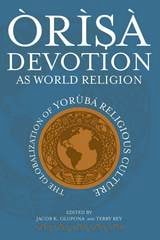
cover of Òrìsà Devotion as World Religion: The Globalization of Yorùbá Religious Culture

Òrìsà Devotion as World Religion

The Globalization of Yorùbá Religious Culture

Edited by Jacob K. Olupona and Terry Rey

University of Wisconsin Press, 2008

As the twenty-first century begins, tens of millions of people participate in devotions to the spirits called Òrìsà. This book explores the emergence of Òrìsà devotion as a world religion, one of the most remarkable and compelling developments in the history of the human religious quest. Originating among the Yorùbá people of West Africa, the varied traditions that comprise Òrìsà devotion are today found in Africa, the Americas, Asia, Europe, and Australia.
    The African spirit proved remarkably resilient in the face of the transatlantic slave trade, inspiring the perseverance of African religion wherever its adherents settled in the New World. Among the most significant manifestations of this spirit, Yorùbá religious culture persisted, adapted, and even flourished in the Americas, especially in Brazil and Cuba, where it thrives as Candomblé and Lukumi/Santería, respectively. After the end of slavery in the Americas, the free migrations of Latin American and African practitioners has further spread the religion to places like New York City and Miami. Thousands of African Americans have turned to the religion of their ancestors, as have many other spiritual seekers who are not themselves of African descent. 
    Ifá divination in Nigeria, Candomblé funerary chants in Brazil, the role of music in Yorùbá revivalism in the United States, gender and representational authority in Yorùbá religious culture—these are among the many subjects discussed here by experts from around the world. Approaching Òrìsà devotion from diverse vantage points, their collective effort makes this one of the most authoritative texts on Yorùbá religion and a groundbreaking book that heralds this rich, complex, and variegated tradition as one of the world’s great religions.   
[more]
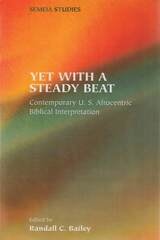
cover of “Yet with a Steady Beat”: U. S. Afrocentric Biblical  Interpretation

“Yet with a Steady Beat”

U. S. Afrocentric Biblical Interpretation

Randall C. Bailey

SBL Press, 2003

This collection of essays exemplifies new directions being taken by biblical scholars using new literary, historical, and sociological critical tools to explore issues of concern to their communities and thus poses a challenge to others in the discipline to broaden the canons of interpretation and sources. The essays, from the generation of scholars following the writers of the historic Stony the Road We Trod: African American Biblical Interpretation (Fortress, 1991), address issues of cultural criticism, utilization of Black religious sources such as the Negro spirituals and sermons, histories of struggles of Afro-diasporan peoples, and ideological criticism in interpreting the biblical text. This collection of essays exemplifies new directions being taken by biblical scholars using new literary, historical, and sociological critical tools to explore issues of concern to their communities and thus poses a challenge to others in the discipline to broaden the canons of interpretation and sources. The essays, from the generation of scholars following the writers of the historic Stony the Road We Trod: African American Biblical Interpretation (Fortress, 1991), address issues of cultural criticism, utilization of Black religious sources such as the Negro spirituals and sermons, histories of struggles of Afro-diasporan peoples, and ideological criticism in interpreting the biblical text.
[more]