Results by title
13 books match the query 'Masses'
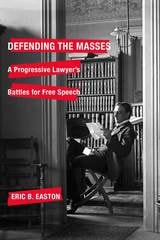
Defending the Masses
A Progressive Lawyer's Battles for Free SpeechEric B. Easton
University of Wisconsin Press, 2018
Roe was the principal trial lawyer of the Free Speech League—a precursor of the American Civil Liberties Union. His cases involved such activists as Emma Goldman, Lincoln Steffens, Margaret Sanger, Max Eastman, Upton Sinclair, John Reed, and Eugene Debs, as well as the socialist magazine The Masses and the New York City Teachers Union. A friend of Wisconsin's progressive senator Robert La Follette since their law partnership as young men, Roe defended "Fighting Bob" when the Senate tried to expel him for opposing America's entry into World War I.
In articulating and upholding Americans' fundamental right to free expression against charges of obscenity, libel, espionage, sedition, or conspiracy during turbulent times, Roe was rarely successful in the courts. But his battles illuminate the evolution of free speech doctrine and practice in an era when it was under heavy assault. His greatest victory, including the 1917 decision by Judge Learned Hand in The Masses Publishing Co. v. Patten, is still influential today.
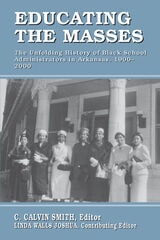
Educating the Masses
The Unfolding History of Black School Administrators in Arkansas, 1900-2000C. Calvin Smith
University of Arkansas Press, 2003

Elites, Masses, and Modernization in Latin America, 1850–1930
By E. Bradford Burns and Thomas E. Skidmore
University of Texas Press, 1979
The interactions between the elites and the lower classes of Latin America are explored from the divergent perspectives of three eminent historians in this volume. The result is a counterbalance of viewpoints on the urban and the rural, the rich and the poor, and the Europeanized and the traditional of Latin America during the late nineteenth and early twentieth centuries.
E. Bradford Burns advances the view that two cultures were in conflict in nineteenth-century Latin America: that of the modernizing, European-oriented elite, and that of the “common folk” of mixed racial background who lived close to the earth. Thomas E. Skidmore discusses the emerging field of labor history in twentieth-century Latin America, suggesting that the historical roots of today’s exacerbated tensions lie in the secular struggle of army against workers that he describes. In the introduction, Richard Graham takes issue with both authors on certain basic premises and points out implications of their essays for the understanding of North American as well as Latin American history.
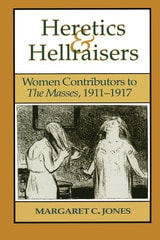
Heretics and Hellraisers
Women Contributors to The Masses, 1911-1917By Margaret C. Jones
University of Texas Press, 1993
The Masses was the most dynamic and influential left-wing magazine of the early twentieth century, a touchstone for understanding radical thought and social movements in the United States during that era. As a magazine that supported feminist issues, it played a crucial role in shaping public discourse about women's concerns. Women editors, fiction writers, poets, and activists like Mary Heaton Vorse, Louise Bryant, Adriana Spadoni, Elsie Clews Parsons, Inez Haynes Gillmore, and Helen Hull contributed as significantly to the magazine as better-known male figures.
In this major revisionist work, Margaret C. Jones calls for reexamination of the relevance of Masses feminism to that of the 1990s. She explores women contributors' perspectives on crucial issues: patriarchy, birth control, the labor movement, woman suffrage, pacifism, and ethnicity. The book includes numerous examples of the writings and visual art of Masses women and a series of biographical/bibliographical sketches designed to aid other researchers.
Masses and Man
Nationalist and Fascist Perceptions of RealityGeorge L. Mosse
University of Wisconsin Press, 2024
Masses and Man comprises three parts. The first lays out a cultural history of nationalism, essentially the first of its kind, emphasizing the importance of sacred expressions like myths, symbols, and rituals as appropriated in a political context. The second zeroes in on fascism’s most dramatic irruptions in European history in the rise of Italian Fascism and the Nazi Party in Germany, elucidating these as not just political movements but also cultural and even aesthetic ones. The third part considers nationalism and fascism from the particular standpoint of German Jews.
Taken in full, the volume offers an eloquent summation of Mosse’s groundbreaking insights into European nationalism, fascism, and Jewish history in the twentieth century. A new critical introduction by Enzo Traverso helpfully situates Mosse’s work in context and exposes the many ways in which Masses and Man, first published in 1980, remains relevant today.
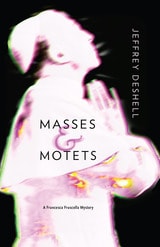
Masses and Motets
A Francesca Fruscella MysteryJeffrey DeShell
University of Alabama Press, 2019
Masses and Motets is a tale composed of four basic interwoven threads, corresponding to the four-part choral writing of Pierre de la Rue’s service music. The first thread comes from the diaries of a recently murdered priest, Father Andrea Vidal, former secretary to the notorious Father Marcial Maciel. The second thread is the mystery story, a police procedural focusing on the efforts of Denver detective Francesca Fruscella to solve the murder and retrieve Vidal’s diary. The third strand is the story of Father Signelli, a priest sent from the Vatican to “fix” the murder. And the fourth strand explores the best and worst of Catholic culture: art and music created by Catholic artists and sexual abuse by Catholic priests.
Vidal’s narrative is the story of a priest who systematically, sincerely, and hopefully tries to destroy his very self through sex, drinking, and drugs in order to get closer to God. Fruscella’s story is that of a middle-aged, female detective trying to solve a ghastly murder while constantly battling the sexism of the Catholic Church. Signelli’s tale is that of an older career priest who, in doing the bidding of his superiors to fix problems that threaten the order of the Church, has perhaps compromised his own soul. By no means a simple narrative of wicked priests, this is a story of men who desperately want to believe, as well as a story of what this belief might shelter and cost.
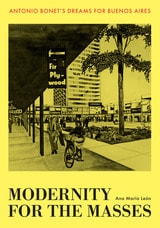
Modernity for the Masses
Antonio Bonet's Dreams for Buenos AiresBy Ana María León
University of Texas Press, 2021
2022 PROSE Award Finalist in Architecture and Urban Planning
2022 Association for Latin American Art Arvey Foundation Book Award, Honorable Mention
Throughout the early twentieth century, waves of migration brought working-class people to the outskirts of Buenos Aires. This prompted a dilemma: Where should these restive populations be situated relative to the city’s spatial politics? Might housing serve as a tool to discipline their behavior?
Enter Antonio Bonet, a Catalan architect inspired by the transatlantic modernist and surrealist movements. Ana María León follows Bonet's decades-long, state-backed quest to house Buenos Aires's diverse and fractious population. Working with totalitarian and populist regimes, Bonet developed three large-scale housing plans, each scuttled as a new government took over. Yet these incomplete plans—Bonet's dreams—teach us much about the relationship between modernism and state power.
Modernity for the Masses finds in Bonet's projects the disconnect between modern architecture’s discourse of emancipation and the reality of its rationalizing control. Although he and his patrons constantly glorified the people and depicted them in housing plans, Bonet never consulted them. Instead he succumbed to official and elite fears of the people's latent political power. In careful readings of Bonet's work, León discovers the progressive erasure of surrealism's psychological sensitivity, replaced with an impulse, realized in modernist design, to contain the increasingly empowered population.

No Sanctuary
Teachers and the School Reform That Brought Gay Rights to the MassesStephen Lane
University Press of New England, 2018
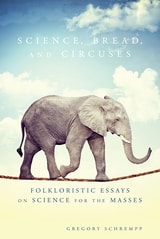
Science, Bread, and Circuses
Folkloristic Essays on Science for the MassesGregory Schrempp
Utah State University Press, 2014
In Science, Bread, and Circuses, Gregory Schrempp brings a folkloristic viewpoint to the topic of popular science, calling attention to the persistence of folkloric form, idiom, and worldview within the increasingly important dimension of popular consciousness defined by the impact of science.
Schrempp considers specific examples of texts in which science interpreters employ folkloric tropes—myths, legends, epics, proverbs, spectacles, and a variety of gestures from religious tradition—to lend credibility and appeal to their messages. In each essay he explores an instance of science popularization rooted in the quotidian round: variations of proverb formulas in monumental measurements, invocations of science heroes like saints or other inspirational figures, the battle of mythos and logos in parenting and academe, how the meme has become embroiled in quasi-religious treatments of the problem of evil, and a range of other tropes of folklore drafted to serve the exposition of science.
Science, Bread, and Circuses places the relationship of science and folklore at the very center of folkloristic inquiry by exploring a range of attempts to rephrase and thus domesticate scientific findings and claims in folklorically imbued popular forms.
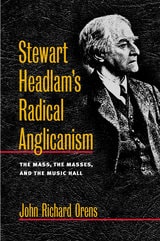
Stewart Headlam's Radical Anglicanism
The Mass, the Masses, and the Music HallJohn Richard Orens
University of Illinois Press, 2003
This book, the first significant study of Headlam since 1928, paints a rich and complex picture of this larger-than-life man of the cloth, charting the trail he blazed across the social, political, and religious landscape of late nineteenth- and early twentieth-century Britain.
Dissatisfied from an early age with his family’s Evangelical faith, Headlam became an Anglican curate, but his political views were increasingly radicalized as he befriended working-class atheists and trade union leaders. John Richard Orens details Headlam’s repeated conflicts with the establishment figures of his faith over his defense of music hall ballet performers’ right to reveal their legs, his role in the early years of the Fabian Society, his anti-puritanism, and his passionate socialism. Headlam was even instrumental in having Oscar Wilde bailed out of prison following the writer’s arrest for “homosexual offenses.”
With this intellectual biography, Orens places Headlam’s life, beliefs, and actions in the context of the period, contributing to the ongoing debate about the proper relationship between Christianity, on the one hand, and society, sexuality, and the arts, on the other.

The Lucca Choirbook
Lucca, Archivio di Stato, MS 238; Lucca, Archivio Arcivescovile, MS 97; Pisa, Archivo Arcivescovile, Biblioteca Maffi, Cartella 11/IIIEdited and with an Introduction and Inventory by Reinhard Strohm
University of Chicago Press, 2009
More than forty years ago in the state archives of Lucca, Italy, musicologist Reinhard Strohm noticed that bindings on some of the books were unusual: they consisted of the pages of a centuries-old music manuscript. In the following years, Strohm worked with the archivists to remove these leaves and reassemble as much as possible of the original manuscript, a major cultural recovery now known as The Lucca Choirbook.
The recovered volume comprises what remains of a gigantic cathedral codex commissioned in Bruges around 1463 and containing English, Franco-Flemish, and Italian sacred music of the fifteenth century—including works by the celebrated composers Guillaume Du Fay and Henricus Isaac.
This facsimile of the choirbook includes all the known leaves, ordered according to their proper placement in the original codex. In the introduction, Strohm tells the fascinating story of this choirbook, identifying its early users and reconstructing its travel from Bruges to Lucca.
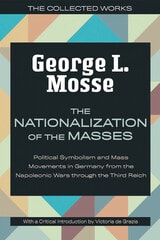
The Nationalization of the Masses
Political Symbolism and Mass Movements in Germany from the Napoleonic Wars Through the Third ReichGeorge L. Mosse
University of Wisconsin Press, 2023
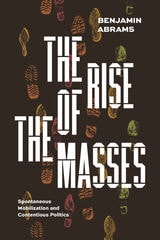
The Rise of the Masses
Spontaneous Mobilization and Contentious PoliticsBenjamin Abrams
University of Chicago Press, 2023
Between 15 and 26 million Americans participated in protests surrounding the murders of George Floyd, Ahmaud Arbery, Breonna Taylor, and others as part of the Black Lives Matter protests in 2020, which is only one of the most recent examples of an immense mobilization of citizens around a cause. In The Rise of the Masses, sociologist Benjamin Abrams addresses why and how people spontaneously protest, riot, and revolt en masse. While most uprisings of such a scale require tremendous resources and organizing, this book focuses on cases where people with no connection to organized movements take to the streets, largely of their own accord. Looking to the Arab Spring, Occupy Wall Street, and the Black Lives Uprising, as well as the historical case of the French Revolution, Abrams lays out a theory of how and why massive mobilizations arise without the large-scale planning that usually goes into staging protests.
Analyzing a breadth of historical and regional cases that provide insight into mass collective behavior, Abrams draws on first-person interviews and archival sources to argue that people organically mobilize when a movement speaks to their pre-existing dispositions and when structural and social conditions make it easier to get involved—what Abrams terms affinity-convergence theory. Shedding a light on the drivers behind large spontaneous protests, The Rise of the Masses offers a significant theory that could help predict movements to come.