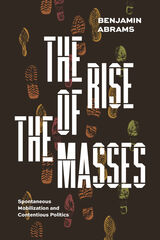
The Rise of the Masses: Spontaneous Mobilization and Contentious Politics
University of Chicago Press, 2023
Cloth: 978-0-226-82681-3 | Paper: 978-0-226-82683-7 | eISBN: 978-0-226-82682-0 (all)
Library of Congress Classification HM883.A267 2023
Dewey Decimal Classification 303.484
Cloth: 978-0-226-82681-3 | Paper: 978-0-226-82683-7 | eISBN: 978-0-226-82682-0 (all)
Library of Congress Classification HM883.A267 2023
Dewey Decimal Classification 303.484
ABOUT THIS BOOK | AUTHOR BIOGRAPHY | REVIEWS | TOC | REQUEST ACCESSIBLE FILE
ABOUT THIS BOOK
An insightful examination of how intersecting individual motivations and social structures mobilize spontaneous mass protests.
Between 15 and 26 million Americans participated in protests surrounding the murders of George Floyd, Ahmaud Arbery, Breonna Taylor, and others as part of the Black Lives Matter protests in 2020, which is only one of the most recent examples of an immense mobilization of citizens around a cause. In The Rise of the Masses, sociologist Benjamin Abrams addresses why and how people spontaneously protest, riot, and revolt en masse. While most uprisings of such a scale require tremendous resources and organizing, this book focuses on cases where people with no connection to organized movements take to the streets, largely of their own accord. Looking to the Arab Spring, Occupy Wall Street, and the Black Lives Uprising, as well as the historical case of the French Revolution, Abrams lays out a theory of how and why massive mobilizations arise without the large-scale planning that usually goes into staging protests.
Analyzing a breadth of historical and regional cases that provide insight into mass collective behavior, Abrams draws on first-person interviews and archival sources to argue that people organically mobilize when a movement speaks to their pre-existing dispositions and when structural and social conditions make it easier to get involved—what Abrams terms affinity-convergence theory. Shedding a light on the drivers behind large spontaneous protests, The Rise of the Masses offers a significant theory that could help predict movements to come.
See other books on: Activism & Social Justice | Comparative Politics | Egypt | Protest movements | Social Theory
See other titles from University of Chicago Press