Results by title
231 books match the query 'Revolutionary Period (1775-1800)' and 2 start with a non-letter
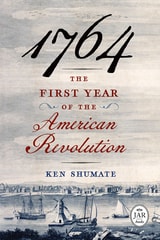
1764—The First Year of the American Revolution
Ken Shumate
Westholme Publishing, 2021
How the American Response to British Plans for Parliamentary Taxation Set in Motion the Movement for Independence
The year 1764 is of extraordinary importance to the history of the American Revolution. It was a watershed year in the relationship between Great Britain and its North American colonies.
In 1763, the British began to strictly enforce the laws of trade in order to advance a newly formulated colonial policy that included use of customs duties as a means of drawing revenue from the colonies. Americans early in 1764 protested that the laws being enforced were economically unsound and would be destructive to the trade of the colonies. Despite knowing of the American discontent, British officials moved forward with their new colonial policy. Resolutions made by the House of Commons in March 1764 not only codified a more restrictive trade policy, but revealed a plan to impose direct parliamentary taxation. A resolution to levy stamp duties brought forth a storm of American petitions and essays in late 1764 that constitute the beginning of what has become known as the Stamp Act Crisis.
In 1764: The First Year of the American Revolution, Ken Shumate presents the American arguments against the new British policy. The most prominent protests against direct parliamentary taxation were made by New York, Massachusetts, Virginia, Connecticut, and Rhode Island. Supporting the petitions were thoughtful essays by James Otis, Oxenbridge Thacher, Richard Bland, Thomas Fitch, and Stephen Hopkins. Shumate demonstrates the importance of these petitions and essays, written before the passage of the Stamp Act in 1765, as establishing the constitutional basis for the heated protests of that year and the following decade. The British interpretation of these writings as rejecting the supremacy of Parliament—even the sovereignty of Great Britain—further motivated the need for the Stamp Act as a demonstration of the fundamental right of Parliament to levy such taxes.
[more]
1777
The Year of the HangmanJohn S. Pancake
University of Alabama Press, 1977
A detailed study of the British invasion from Canada during the War of Independence
No one who has read the history of the War of Independence can fail to be fascinated by the campaign of Gentleman Johnny Burgoyne. The story evokes pictures in the mind's eye: scarlet-coated Englishmen; the green and blue uniforms of the German mercenaries; the flash of brass and silver and steel accoutrements; the swarms of Indians in their war paint; the whole moving through the green forests or sailing the blue waters of lakes and rivers. Even the names have a lyrical tone: Richelieu, Champlain, Oriskany, Ticonderoga, and La Chine.
Part of this fascination is the fact that the fate of the expedition marked a turning point in the history of the war. It is not surprising that there has been a host of chroniclers, scholars, and novelists, and those who fall in a category somewhere between because their artistry bridges the gaps that footnoted facts cannot, and so allows some scope for imagination (and may teach more history than the rest).
This fascination was partly responsible for Pancake’s exploration of this particular part of the history of the war. There was also the fact that no scholar since Hoffman Nickerson in his Turning Point of the Revolution (1926) has attempted a detailed study of the British invasion from Canada, although there has been a vast amount of literature on specific aspects of the campaign. No study to date has attempted to link the Canadian expedition to the concurrent operation of General Sir William Howe in Pennsylvania in such a way as to present a complete story of the campaign of 1777. From the point of its inception and launching by the American Secretary, Lord George Germain, to the point where it was reduced to a shambles at the end of the year.
[more]